My life’s calculations were always expressed in grams, pennies, and minutes. “Enough” wasn’t a stable condition in our home; rather, it was a precarious agreement that I had to negotiate on a daily basis with the local supermarket and power companies. That truce felt especially flimsy on a Tuesday night in late March. To serve a family of three, I carefully sliced three chicken thighs while standing at the kitchen counter. I could make sure Dan and Samantha were satisfied if I chopped the portions tiny enough and added extra rice and the remaining carrots to bulk the meal. If I was lucky, there might be a small container left for my lunch the next afternoon.
The scent of sawdust and fatigue clung to Dan’s flannel shirt as he entered from the garage. I could see the weight on his shoulders without his having to say anything. He worked twice as hard for half as much, as shown by his callused hands and constant oil stains. The construction sector was slow. With a tired clatter, he dropped his keys into the ceramic bowl near the door.
“Dinner soon, hon?” he said in a hushed voice.
“Ten minutes,” I said, keeping my eyes fixed on the burner. I was already rearranging the plates in my head. Sam would receive enough to support her adolescent development, Dan would receive the largest share due to the physical nature of his employment, and I would take whatever was left.
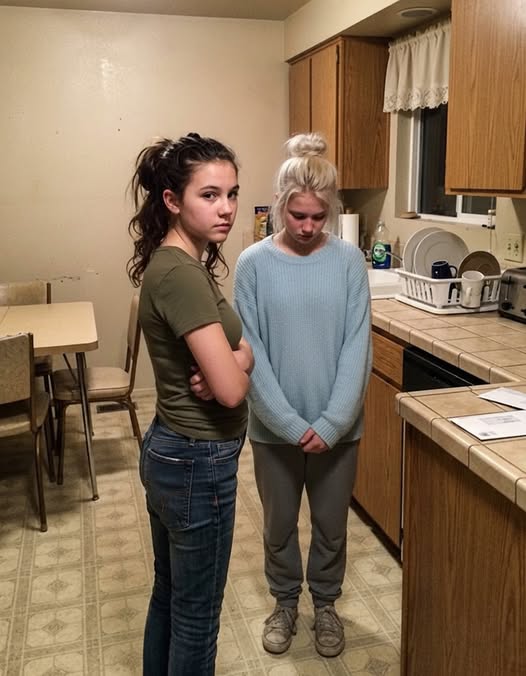
Sam rushed in as the front door opened. She was usually a teenage angst and headphones whirlwind, but now she was unnervingly concentrated. A girl I had never seen before stood behind her. She had a worn purple rucksack pressed up to her chest like a shield, and she seemed small, almost delicate. Her scuffed sneakers appeared two sizes too big, and her oversized hoodie failed to conceal the sharpness of her figure.
Sam said, “Mom, Lizie is eating with us.” It wasn’t a query. It was a manifesto.
The wooden spoon was mid-stir when I froze. I glanced at the properly measured pot of rice for three before turning to face the girl whose gaze was fixed on our linoleum floor. My initial reaction was a chill of panic. A fourth plate seemed physically unattainable as I was already extending a supper for three. However, when Lizie looked up, my inner accountant was quiet by the vacant expression in her eyes.
“Hello,” I said, trying to seem as kind as our budget. “Sweetheart, grab a chair. Plenty is available for everyone.
Although it was a falsehood, it was essential. There was a tightness in the air as we sat down that I couldn’t quite put my finger on. Lizie didn’t eat like a typical thirteen-year-old. She didn’t pick at the chicken or gripe about the carrots. She ate with a silent, terrible precision. Every grain of rice was counted, and she took each bite deliberately as though attempting to commit the feeling of fullness to memory. Her body twisted like a spring when she winced at the sound of Dan’s fork striking the ceramic.
Dan, always the one to establish bridges, attempted to break the stillness. “Sam says you’re a bit of a track star, Lizie.”
For a brief moment, Lizie’s eyes briefly lifted. She said, “I just like to run.”
“She’s being modest,” Sam said in an unusually aggressive tone. In the gym, she is the fastest. She never gives up.
I observed my daughter. I had never noticed her protective edge before. She was observing me, daring me to gripe about the serving sizes or the additional dish that needed to be cleaned. It dawned on me then that my daughter had been counting the ribs visible through her friend’s t-shirt while I had been counting pennies.
Lizie insisted on clearing the table after supper. As she worked with the plates, her hands trembled a little. She started to walk away, but Sam stopped her and put a granola bar and a banana in her hands.
“House rule,” Sam firmly stated. “No one goes home empty-handed.”
My annoyance erupted as soon as the door shut and Lizie disappeared into the dusk. You can’t just invite people around without asking, Sam. As it is, we are just scraping by.
“Mom, she passed out in the gym today,” Sam retorted, her voice breaking. The teachers advised her to “eat better,” as if it were an option. She doesn’t have power. Even with her dad’s three jobs, they are still unable to maintain the lights. We have a hot dinner and a roof. How could I fail to bring her home?
My lungs were empty of air. My daughter’s lucidity made my small worries about chicken thighs seem hideous. As I sat down at the table, waves of shame swept over me. I had forgotten that “enough” is a relative phrase since I was so preoccupied with my personal struggle.
Lizie turned into a shadow in our house during the course of the following few days. She was there for dinner, for schoolwork, and for the quiet times in between. She was a courteous, ethereal figure who made an effort to appear as little as possible. However, the façade fell apart on Friday.
Lizie’s backpack fell off the stool as she was reaching for a textbook at the kitchen island. With a loud thud, it fell to the ground, the zipper exploding. I knelt down to assist her, but my breath caught in my throat.
Not only did notebooks fall out of the bag, but a frenzied assortment of reality did as well. Utility bills with the words “FINAL DISCONNECT” stamped in a fierce red pen were crumpled. A tiny envelope containing nickels and cents was present. The notepad came next. It had fallen open to reveal a page with the title, “What we take first if we get evicted,” written in a clean, heartbroken script.
“Mom’s picture,” “clean socks,” and “the canned beans” were among the items on the list.
I picked up the shutdown notification and exhaled, “Lizie.” “Why didn’t you mention how awful it was?”
Lizie’s face turned a ghostly white as she froze. Her motions were frantic as she rushed to collect the documents. “My father advised me not to tell. He claimed that when people are aware of your failure, they perceive you differently. We’re not beggars, he said.
Dan entered at that moment, seeing the scene. His jaw tightened as he read the eviction notice over my shoulder. He didn’t use clichés. “Pride is a luxury you can’t afford right now, Lizie,” he remarked, just sitting on the floor beside this scared child. However, you never have to pay for family. And until this is resolved, you will remain with us.
The next few hours were a flurry of phone calls and challenging discussions. That night, we met Lizie’s father, Paul. He was a widower attempting to contain the ocean with a plastic bucket, a guy hollowed down by grief and excessive work. He didn’t want our assistance, but the argument eventually subsided when he noticed his daughter soundly dozing off on our couch.
We had a community even though we didn’t have much. In order to preserve Lizie’s dignity, Sam planned a clothes drive at the school under the pretense of a general charity event; Dan spoke with a contractor acquaintance who needed a dependable hand; and I called the food pantry where I occasionally helped.
The “enough” we had been battling for started to grow gradually. As it happened, “enough” was not a limited resource like a box of rice or a gallon of milk. The more you shared it, the more it flourished as a living entity. Through Dan’s contacts, Lizie’s father was able to secure a reliable job, and their landlord agreed to a payment schedule in exchange for Paul fixing the building.
The mood of our kitchen had changed after a few weeks. The beef slices were no longer being counted. A peculiar, resilient peace had taken the place of the tension that had simmered over every bill. Lizie was no longer a ghost; instead, she was a girl who assisted with the dishes without being asked and smiled at Sam’s jokes.
Sam and Lizie were bent over a math textbook one evening while I prepared four dishes for a straightforward pasta lunch. My daughter hadn’t simply brought a hungry girl home for dinner, I realized. She had brought a mirror into our house, making me realize that we are frequently richer than we think, even when we feel like we have nothing left to give.
I yelled, “Dinner is ready.”
A sincere, radiant smile spread across Lizie’s face as she looked up. “Aunt Helena, coming.”
That’s when I understood the math had finally altered. Sometimes one plus one meant saving a life rather than merely making two. And I realized that we had more than enough for the first time in years.