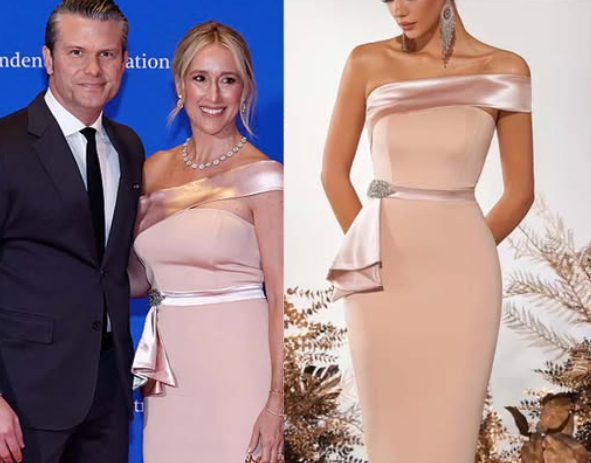
The room was filled with influence, status, and carefully orchestrated presence—but somehow, attention narrowed to a single detail. Outside, there had been a security scare. Inside, a president was present, along with figures whose decisions shape conversations far beyond that space. Yet despite all of that, the focus shifted quickly and decisively. What people talked about, what circulated online, what drew the strongest reactions, was not policy or security—it was a dress.
In a matter of moments, the night took on a different tone. What began as a formal, high-profile gathering turned into something far more fragmented, where public perception moved faster than the event itself. A claim surfaced: that Jennifer Rauchet was wearing a gown linked to Temu. Whether confirmed or not, the idea alone was enough to spark a wave of commentary. A TikToker amplified the claim, framing it as a contradiction, and from there, the conversation expanded rapidly.
What followed was less about verifying details and more about interpreting meaning. The dress became a symbol—something onto which broader ideas were projected. Politics intersected with consumer choices, and personal style became a point of debate about identity and values. The phrase “America First” was placed alongside “Made in China,” creating a contrast that people interpreted in different ways depending on their perspective.
For some, the situation raised questions about consistency. If someone is publicly associated with certain economic or political positions, should their personal choices reflect those positions in visible ways? The dress, in that sense, became part of a larger narrative about alignment between message and action.
For others, the reaction itself was the issue. They saw the criticism as disproportionate, arguing that focusing on the origin or price of a dress overlooked the broader context. In their view, personal style choices should not be turned into tests of political loyalty or ideological purity. They also pointed out the contradiction in criticizing someone for not spending more—suggesting that the expectation of expensive clothing could itself reflect a different kind of bias.
As the discussion spread, it expanded beyond the individual at the center of it. It became a conversation about fast fashion more generally—about how clothing is produced, where it comes from, and what those processes involve. Some participants in the debate highlighted concerns about labor practices and design ethics, suggesting that these factors make fashion a more complex choice than it might appear. Others pushed back, emphasizing accessibility and the reality that not everyone approaches clothing from the same economic position.
The result was a layered exchange, where different viewpoints overlapped and sometimes conflicted. What began as a comment about a single outfit evolved into a broader reflection of how quickly everyday details can take on larger meaning in a highly connected environment. Social media accelerated that process, turning a moment into a conversation that moved far beyond the original setting.
At the center of it all was a simple reality: clothing, while often seen as a personal choice, can also function as a form of expression. It can signal identity, preference, or affiliation, whether intentionally or not. When those signals are interpreted within a political or cultural framework, they can take on significance that extends beyond the individual wearing them.
What this moment revealed is not just how people view fashion, but how they interpret consistency, authenticity, and representation. It showed how quickly attention can shift from major events to smaller details, and how those details can become focal points for broader debates.
In the end, the dress itself remained unchanged.
But the meaning attached to it varied widely.
For some, it was a symbol of contradiction.
For others, it was an example of overreaction.
And for many, it became a reminder of how easily ordinary choices can be pulled into larger conversations about identity, values, and perception.
What started as a detail became a discussion.
And that discussion revealed more about the moment than the outfit ever could.