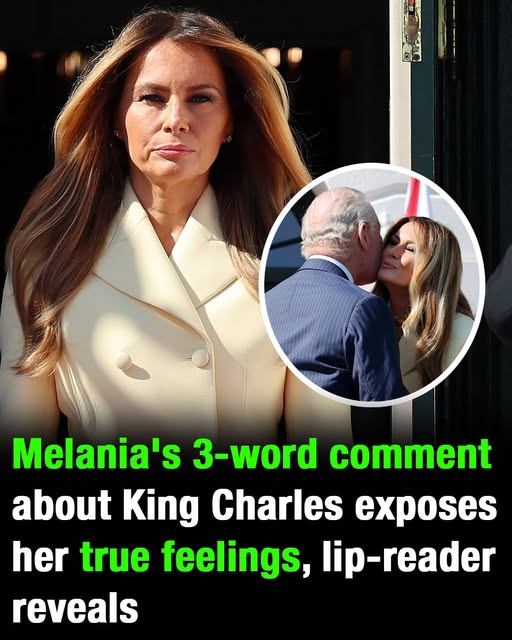
Melania Trump didn’t try to conceal what she felt in that moment. While the arrival of King Charles and Queen Camilla at the White House was marked by ceremony, protocol, and carefully planned symbolism, it was a brief, almost unnoticed exchange that drew the most attention. As the four-day State Visit began and the cameras captured every movement, a small interaction between the First Lady and the monarch seemed to carry more meaning than any prepared speech or official statement. It was subtle, easy to miss if you weren’t looking closely—but once noticed, it became the focal point of discussion.
Observers quickly turned their attention to that moment, analyzing every detail, from the tone of voice to the expressions exchanged. A forensic lip-reader reportedly interpreted the words spoken, suggesting that Melania’s comment was direct, genuine, and unfiltered in a way that stood out against the formal backdrop of the event. What might have been expected to be a purely ceremonial greeting instead felt more personal, more spontaneous, and more revealing than the setting might have allowed.
Away from the strict choreography of official appearances—the precise timing, the measured gestures, the carefully controlled interactions—their greeting unfolded with a different kind of energy. It didn’t feel rehearsed. It didn’t feel distant. Instead, it carried the tone of familiarity, as though the two were reconnecting rather than simply meeting as representatives of their respective roles.
King Charles, who in the past had shared light, almost playful remarks with her—including a comment about a hat that might be carried away by the wind—approached with a sense of ease that suggested continuity rather than formality. His words, “Oh, it’s so nice to see you,” were simple, but delivered in a way that felt warm and genuine. It wasn’t the language of diplomacy alone—it was something closer to personal recognition.
Melania, known for maintaining a composed and often reserved public presence, responded in a way that stood out precisely because it broke slightly from that pattern. She did not withdraw into a strictly formal demeanor. Instead, she met the moment directly, engaging with the same level of openness. The exchange of cheek kisses, a gesture that can carry both cultural and personal meaning, added to that sense of familiarity.
Her reply—“So pleased to see you. I’m really delighted.”—was equally straightforward, but what made it notable was not the wording itself, but the tone it conveyed. It didn’t feel obligatory or rehearsed. It felt like something said without overthinking, without the layers of caution that often define public interactions at that level.
In that brief exchange, something became clear without needing to be explained. The interaction suggested that this was not simply a formal meeting between public figures fulfilling their roles. It was the continuation of a connection that had been established earlier, during previous encounters, including their time at Windsor. That shared history, however limited, seemed to shape the way they greeted each other in this moment.
Their body language reinforced that impression. There was a noticeable ease—relaxed posture, natural smiles, movements that didn’t appear forced or overly calculated. In an environment where every gesture is often scrutinized and interpreted, that kind of natural interaction can stand out. It creates a contrast with the surrounding formality, drawing attention precisely because it feels less structured.
For a brief moment, the larger context—the political significance of the visit, the responsibilities tied to their positions, the expectations of the audience—seemed to fade into the background. What remained was something simpler: two individuals acknowledging each other with genuine warmth.
That moment, though small, carried a kind of clarity. It showed how personal dynamics can exist even within highly formal settings, and how those dynamics can subtly shape the tone of an interaction. It also highlighted how much can be communicated without extended dialogue—through tone, gesture, and presence alone.
In the end, it wasn’t a long conversation or a dramatic exchange that captured attention. It was something quieter, more understated. A brief interaction that, for a moment, cut through the layers of ceremony and revealed something more human beneath them.
Not a performance.
Not a statement.
Just a moment of recognition between two people meeting again.