I used to believe that the worst moment of my life had already happened—the night my husband walked out the door without looking back. It came after years in which I had stood beside him through difficulties, especially financial ones that had weighed heavily on both of us. I had supported him in ways that went beyond what I ever imagined I would have to do, believing that commitment meant staying, even when things were uncertain. At the time, I thought that moment—watching him leave—was the deepest point of loss I would experience.
But I was wrong.
What followed was something I could not have prepared for: a courtroom where the story of my life, the choices I had made, and the sacrifices I had given were reshaped into something unrecognizable. It wasn’t just a legal process—it felt like a place where reality itself was being rewritten. And just when it seemed like everything I had built was about to slip away—not only my home, but also the time and bond I shared with my son—something unexpected happened. Something that shifted everything in a way no one in that room could ignore.
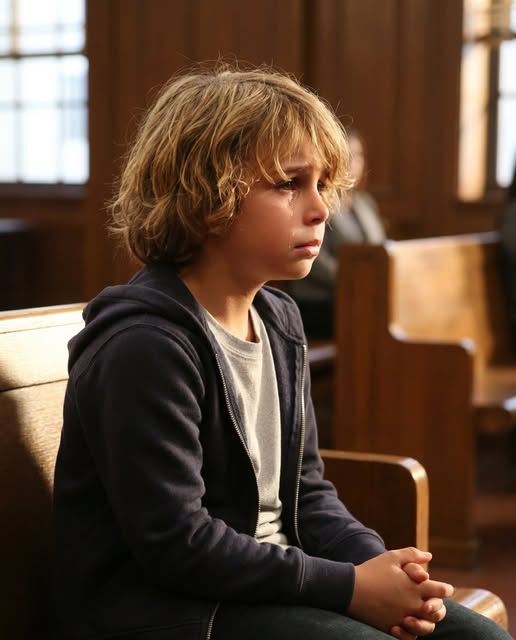
My 10-year-old son stood up.
For years, I had lived with the belief that effort could fix what was broken. That if I worked harder, gave more, and remained patient, things would eventually stabilize. I took on responsibilities that stretched me thin. I covered debts, let go of personal savings, and continued to hold onto the idea that what we had built together was worth saving. Even when things felt uneven, I stayed.
And then, just when the situation finally began to improve—when the financial strain had eased and things seemed to be moving toward stability—everything changed. My husband left. Not gradually, not after long discussions, but suddenly. And within days, that departure turned into something else entirely: legal action.
The process moved quickly. Papers were filed. Claims were made. And those claims went far beyond what I expected. He sought not only a share of what we owned, but also custody of our son. The accusations that followed were difficult to hear, not just because of their seriousness, but because they presented a version of me that did not align with the reality I had lived. It felt like watching someone describe a stranger, except that stranger had my name.
I remember sitting there, trying to process it all, feeling a mix of disbelief and exhaustion. It wasn’t just about defending myself—it was about trying to understand how things had reached that point. How years of shared life could be reduced to statements that felt so disconnected from the truth. And as the case moved forward, I began to feel overwhelmed by the structure of it all—the formal language, the arguments, the sense that everything had already been carefully arranged.
When the court hearing began, that feeling only deepened. The arguments presented were structured, deliberate, and difficult to respond to in the moment. They raised questions that made me second-guess not just the situation, but my own ability to explain it. It felt as though the narrative had been prepared in advance, leaving little room for anything outside of it.
Then something happened that no one had anticipated.
My son asked if he could speak.
At first, it seemed like a small interruption in a process that was otherwise moving in a very controlled way. But when he stood up, there was a quiet shift in the room. He wasn’t holding notes from a lawyer or repeating something he had been told to say. Instead, he brought forward something he had created himself—a simple timeline.
It wasn’t complicated. It didn’t rely on technical language or detailed arguments. It was just a sequence of events, arranged in the order he had experienced them. But that simplicity was exactly what made it powerful.
He spoke calmly, pointing out what he had seen, what had changed, and when those changes had happened. He described the progression in a way that cut through the layers of interpretation that had been building throughout the case. There was no attempt to persuade, no effort to argue—just a clear presentation of what he had observed.
And in that moment, something shifted.
The room, which had been filled with structured arguments and competing narratives, became still. His words redirected attention to something that had been overlooked—not because it was hidden, but because it had been surrounded by too much complexity. He brought the focus back to the sequence of events, to the timing, to the contrast between what had been and what was now being claimed.
It wasn’t dramatic, but it was undeniable.
His honesty carried a kind of clarity that no formal argument had managed to achieve. It didn’t replace the legal process, but it reframed it. It created space for the facts to be seen differently, without the layers that had made them harder to recognize.
By the end of it, the outcome reflected that shift.
But more than the result itself, what stayed with me was the realization that came from that moment. Children observe far more than we often assume. They notice patterns, changes, and inconsistencies in ways that can be both simple and deeply perceptive. They may not express those observations in complex terms, but that doesn’t make them any less accurate.
That day showed me something I hadn’t fully understood before. That clarity doesn’t always come from complexity. Sometimes, it comes from stripping things back to what actually happened, and allowing that to be seen without distortion.
The process as a whole was not easy. It carried emotional weight, uncertainty, and moments where it felt like everything could shift in the wrong direction. But that moment—when my son stood up and spoke—became a turning point. Not just in the case, but in how I understood the situation itself.
It reminded me that truth doesn’t always need to be defended through elaborate arguments. Sometimes, it simply needs the space to be expressed clearly.
And even in the most difficult circumstances, when it feels like everything is working against you, it can still find a way to be heard.