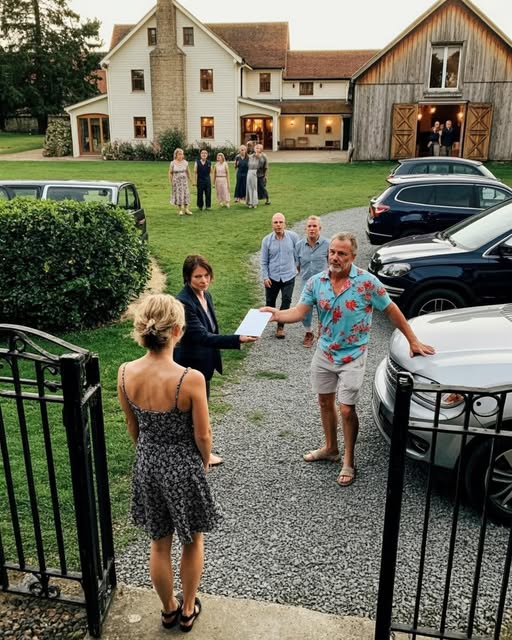
By the time my brother’s third car pulled up at the gate that Memorial Day weekend, the string quartet had already begun tuning beside the pond.
I stood behind the barn doors with a clipboard in hand, watching the white drapes ripple in the breeze while servers carried trays of iced tea across the lawn. The air carried the scent of freshly cut grass, roses, and warm butter from the caterer’s rolls. Then I heard gravel crunch beneath tires, and instantly I knew who had decided that my silence meant approval.
Derek stepped out first, just as he had done the last time—too relaxed, too sure of himself, wearing a loud Hawaiian shirt like he was arriving at a resort he owned. He slapped the roof of his SUV and grinned at the people behind him. “Told you,” I heard him say. “Plenty of room.”
There were fifteen of them this time. Children, coolers, overnight bags, inflatable toys, a stroller, a woman I vaguely remembered from one Christmas years ago, and a man I didn’t know carrying a case of beer. The kids spotted the pool through the hedges and began shouting before they were even unbuckled.
But this time, instead of open access, they were met by a locked black iron gate—and Leah Whitmore standing firmly in front of it, posture straight, expression neutral. Leah had spent twenty years running a boutique inn before joining me to manage the farm as an event venue. She had a way of handling chaos with calm precision—directing vendors, reassuring anxious brides, and shutting down problems with just a few words.
When Derek approached her with a smile, she didn’t return it.
“Private event today,” she said. “Invited guests only.”
Derek laughed, as if she had misunderstood.
“I’m family. Tell my sister we’re here. She knows.”
From where I stood, I recognized the tension in his jaw—that familiar flicker of impatience when people didn’t fall in line quickly enough. I had spent most of my life responding to that look. But that day, for the first time, I stayed where I was and let someone else handle it.
Three years earlier, no one in my family wanted anything to do with my grandmother’s farm. They called it too far, too rundown, too much effort. My sister used to wrinkle her nose at it. Derek called it “the garbage dump” so often it became normalized.
When Grandma June’s health declined and she could no longer manage alone, I moved in, thinking it would be temporary. A few weeks became nineteen months. During that time, I learned the sounds of the house in winter, how to fix small things, how to care for her needs, and how deeply meaningful it is to show up for someone you love.
Grandma was sharp, direct, and full of opinions. She didn’t soften her words. She told me my coffee was weak, my posture was poor, and that I apologized too much for things that weren’t my fault. Over time, those words began to shape me.
We spent evenings on the porch, her telling stories about the land—how the pond was her husband’s idea, how the rose beds marked moments in her life, how the barn carried history in every beam.
When she passed, quietly one winter morning, she left the farm to me.
My siblings were not pleased. The same property they once dismissed suddenly became something valuable once it wasn’t theirs. Derek implied I had positioned myself to inherit it simply by being present. I didn’t argue. I had learned better than to engage him that way.
Instead, I returned to the farm and began building something.
The idea of turning it into an event venue came gradually. One afternoon, standing in the barn with light pouring through the windows, I realized its potential. It wasn’t something that could be recreated—it had history, presence, something irreplaceable.
I didn’t have money, but I had the property and the determination to make it work.
Leah became an essential partner in that process. She understood logistics, people, and how to make a space function seamlessly. Together, we transformed the farm into something new while preserving what made it special.
The first year was challenging—financially, physically, emotionally. But some of the hardest moments came from family.
Derek had already shown up unannounced before, bringing people as if the place belonged to him. Each time, I had to draw boundaries—something that never came easily with him.
Eventually, I installed a gate.
He called it hostile.
I called it necessary.
So on that Memorial Day, when he arrived again with fifteen people expecting access, the gate did its job.
Leah handled him calmly and professionally, explaining that it was a private event. Derek insisted, used my name like a key, tried to negotiate his way in. But I didn’t come out.
From behind the barn doors, I watched him take in the scene—the transformed farm, the event, the life I had built. And I watched the realization settle in that he no longer had automatic access to it.
Eventually, he left.
The wedding continued—beautiful, intentional, exactly as it was meant to be.
Later, standing by the pond, I reflected on everything. Not with triumph, but with a sense of completion. The gate wasn’t punishment. It was simply a boundary doing its job.
When Derek later called to propose a “family agreement,” I understood his angle immediately. He had always treated family as a way to access what others built. But this time, I didn’t bend.
I offered him something different: structured, respectful access—not entitlement.
Months later, he came in the fall as agreed. And for the first time, he experienced the farm differently—not as something to take, but as something to be in.
We shared a meal. The family gathered. The space felt alive again in a new way.
Sitting at my grandmother’s table, I understood something clearly:
This place wasn’t just land.
It was care, time, and intention.
I hadn’t built it for recognition. I had built it by showing up.
And now, as I sat there in the quiet after everything, I knew—
It was mine.