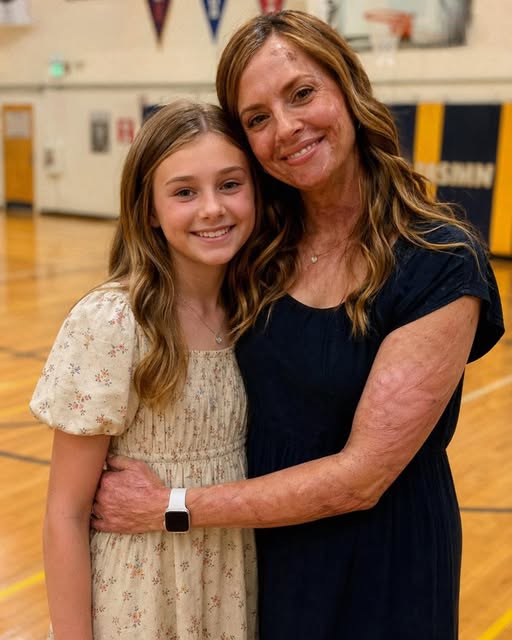
I face a reflection every morning that most people would avoid. A tragedy that occurred twenty years ago is mapped out on the left side of my face. My temple, cheek, and neck hollow are all covered with thick, ridged scars. The past etched on my skin cannot be erased by makeup, but it can smooth its edges. I have been navigating a world of looks for twenty years, some of which are pitying, some of which are interested, and some of which are viciously insulting. Although I had become used to the weight of those eyes, I never imagined that my own daughter would be the one to give in to them.
Since my husband died when Clara was only three years old, I have raised her by myself. With my mother Rose, who lived next door, as our pillar, our existence was modest but full. Clara was always the kind of sensitive youngster who would trace the creases on my jaw with her tiny, sticky fingers and ask if it hurt. For a long while, it was sufficient that I constantly told her no. However, the innocence of childhood turned into the self-consciousness of puberty as she started the fifth grade.
The shift took place on a Tuesday. I had made the decision to pick Clara up early from school. She was standing with some classmates when I was waiting by the curb. A group of boys started laughing as one of them gestured to my car and muttered something behind his hand. Clara’s response was immediate; she dropped her head, stooped her shoulders, and got into the car without looking at me. My chest ached from the oppressive quiet in the car, which vibrated with an unsaid humiliation.
At last, she urged me to cease attending her school in a whisper that seemed like a physical blow. She sobbed as she said that her class was getting ready for Mother’s Day and that each student would bring their mother onstage for a presentation. Jokes about “monster moms” had already begun. Cruel drawings had been disseminated behind the teacher’s back, and she had been referred to as a “monster’s baby.” Clara was just a young child drowning in a sea of hatred from her peers; she wasn’t being nasty. Since no one made fun of Grandma, she wanted Grandma to take my place.
I traced the uneven ridges of my skin with my fingers as I sat in the silence of my kitchen that evening. Twenty years ago on that night, I recalled the screaming, the smoke, and the heat. I didn’t want my trauma to ruin Clara’s early years, so I never told her the whole tale. I didn’t want to be a victim, a survivor, or a hero; I just wanted to be “Mom.” However, as I stared at her vacant chair, I came to the realization that by remaining silent, I was giving the world the worst opportunity to define me.
I put on a navy robe that felt like a coat of armor the following morning. Instead of hiding the scars, I curled my hair to highlight them. With intense pride in her eyes, my mother stood in the doorway. For the first time in days, I felt a glimmer of resolve when she told me to go make them uncomfortable.
Clara was a shadow of her former self when we got to the school. She held onto the door handle as though she may run away at any moment. I took her hand and guided her inside the packed auditorium, where the aroma of perfume and floor wax filled the air. I felt the familiar pinch of glances as we sat down. Mothers and kids came onstage one by one to offer nighttime prayers and lasagna stories as the event got underway. Every round of applause seemed like a countdown to our own execution in public.
Clara froze when her name was called. I got up and extended my hand as we made our way over to the stage. A wad of crumpled paper hit my shoulder halfway down the aisle. It was a hideous drawing of a horned creature with scarred cheeks when I took it up and smoothed it out. “There’s the monster’s daughter!” a lad growled from the rear. This time, instead of bursting into laughter, the room descended into an uneasy, jagged stillness.
With my pulse pounding against my chest, I accepted the microphone. I started talking to my daughter instead of the audience. I explained to the group that having my child feel embarrassed of her mother was the worst thing that had happened to me, not these scars. I started talking about the night of the fire, describing how, as a teenager, I had fled back into a blazing apartment complex to save three kids. The massive doors at the rear of the auditorium banged open before I could finish my sentence.
Breathing as though he had just finished a marathon, a guy entered the light. It was Scott, the music instructor at the school. With his gaze fixed on the stage, he strode down the aisle. Using the microphone, he informed the crowd that they were not fully aware of the truth. He turned to face Clara and disclosed that Emily had saved more than simply three children twenty years prior. After the first journey, she had noticed that one was still missing. She had returned to the fire one last time, even though the building was crumbling and firefighters were yelling at her to stay back.
“She discovered me,” Scott replied in a passionate tone. She carried me out through the flames while I was ten years old and crouched behind a table. She lost her face protecting me, not a bunch of strangers. He clarified that at the time, all I asked of his parents was that they never share the tale. I didn’t want a child to bear the shame of my wounds as they grew up.
The room’s vibe abruptly changed. The ridicule disappeared, to be replaced by an almost tangible weight of realization. A distinct kind of shame burned in the boy’s face as he bent his head after tossing the paper. For the first time, Clara turned to face me with wide eyes and saw me as the woman who had given up her beauty to give a stranger a lifetime rather than as someone to be ashamed of.
As I knelt in front of her on stage, she muttered, “I was ashamed.” “And I allowed them to chuckle.” I embraced her and told her that there was nothing to forgive and that she was just a child who had been harmed. The auditorium exploded in thundering, standing ovations that appeared to shake the walls, rather than the courteous applauding that had previously occurred.
It was a strange ride home. The air seemed fresh, and the windows were closed. I told Clara the truth when she asked why I had kept the secret for so long: I didn’t want the fire to define who I was. Instead of becoming a tragedy, I wanted to be her mother. However, I now understand that the truth completes me rather than making me tragic. My scars now serve as a tribute to what I was willing to give rather than a reminder of what I lost. Clara didn’t glance at the floor when we entered our home together. For the first time in twenty years, I didn’t feel the urge to turn away from the mirror as she stared at me.