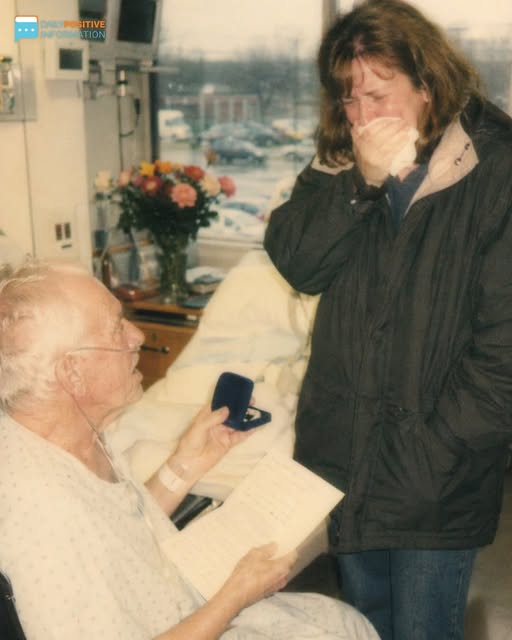
I ended up at Maple Grove Care Center almost by coincidence.
At least, that’s the story I kept telling myself for quite a while — because it felt easier than admitting that sometimes life opens certain doors exactly when a hidden truth can no longer remain buried.
It was a gray Friday afternoon toward the end of September, the sky over Columbus thick with clouds, and all I had planned was to drop off some paperwork at the dental clinic where I worked. My GPS misled me, guiding me through the wrong lot, making me take unnecessary turns, until I found myself parked in front of a modest brick building with a covered entrance and a sign I had somehow never noticed before. I was ready to back out and leave without giving it another thought.
Then I saw him through the glass.
A tall man, bent forward in a way that didn’t match the version of him I remembered, sat in a wheelchair next to a television he didn’t seem to be watching. He shifted slightly, and the light caught his face — and recognition hit me instantly, before I even had time to process it.
Walter Hayes. Daniel’s father.
The only person from my ex-husband’s family who had ever treated me like a real human being, not just an accessory attached to the “right” last name.
It had been almost four years since I last saw him. Not since the divorce. Not since that winter day when I walked out of the courthouse feeling like I had escaped something others still insisted on calling a marriage. Back then, he had still been on his feet — slower, yes, but steady — dressed in his familiar flannel shirts, carrying himself with a quiet dignity that came from years of observing more than speaking.
He had been the only one at that table who never made me feel like I was there on borrowed permission. When Daniel cut me off mid-sentence, Walter would calmly ask me to continue. When Margaret turned dinners into performances of status and superiority, Walter gently redirected conversations to things that couldn’t be measured by money. And when Daniel started coming home late — lying poorly, wearing unfamiliar cologne, smiling like someone already halfway out the door — Walter never defended him. He didn’t confront him openly either. But he also refused to humiliate me by pretending I was imagining everything.
I still remember that last Thanksgiving.
Daniel glued to his phone. Margaret criticizing my pumpkin pie for being “too plain.” Her sister talking about divorce like it was contagious. Daniel laughing at jokes about “overly sensitive women.”
And under the table — Walter’s hand briefly squeezing mine. Just for a second. But it said more than words ever could.
Two months later, I filed for divorce.
Daniel called me selfish, childish, vindictive — all the usual words men reach for when they’re shocked that a woman refuses to keep shrinking herself. Margaret accused me of ruining her son, of being ungrateful, of not understanding when to stay quiet.
Walter said nothing.
That silence hurt more than all the yelling combined.
Because he was the only one I believed could tell the difference between loyalty and complicity — and yet, in the end, even he chose silence.
So when I saw him that day, my first reaction wasn’t warmth.
It was exhaustion. And curiosity.
My life had become quiet since then. A small, clean apartment. Plants in the kitchen. A blue chair by the window. Peace that didn’t depend on anyone else’s mood. A stable job. Sunday grocery trips. Coffee that no one touched without asking. A bed free of secrets.
Technically, the Hayes family was no longer my concern.
But I couldn’t stop looking at him.
Because some forms of abandonment are instantly recognizable — the kind you see in someone’s posture, in the way they’ve stopped expecting anyone to come.
So I went inside.
The receptionist mentioned that he rarely had visitors — and the way she said it carried a blunt honesty that felt almost uncomfortable.
The woman at the desk, with her white hair and purple-framed glasses, looked up and asked who I had come to see.
When I told her his name, she checked the logbook, and something in her expression softened before she spoke.
“He doesn’t get many visitors,” she said. Then, after a brief pause, she corrected herself with sharper precision. “Actually… hardly ever.”
His room was at the far end of the west corridor, where the air carried a mix of reheated meals, antiseptic creams, and that stillness that clings to places where time seems to stall. A faded blanket rested over his legs. Two framed photographs lay face-down on the dresser. A plastic cup of water sat untouched. Even his slippers were aligned too perfectly — like a quiet attempt to hold onto control over the few things still within reach.
When I said his name, he slowly lifted his gaze, as if my voice had to travel through a heavy fog to reach him. It took a couple of seconds — but then recognition came.
And what I saw in his eyes was worse than confusion.
It was shame.
“Claire?” he whispered.
I nodded and pulled a chair closer.
We talked for about twenty minutes that first visit. He told me Daniel was very busy. That Margaret had trouble driving now. That winter made his memory worse. That the food wasn’t as bad as it looked.
Everything sounded rehearsed.
Not like a performance — but like fragments of truth repeated so many times they had hardened into something that could pass as dignity. A way to avoid naming abandonment for what it really was.
I left that day with a tight feeling in my chest — and a quiet promise to myself not to return.
I came back the following Tuesday.
I brought clean socks, sugar-free biscuits, and a used Louis L’Amour novel because I remembered he liked those. After that, my visits became routine. Once a week. Then twice. Then three times.
Walter slowly became part of my life again — not dramatically, but with the same quiet persistence with which cold settles into old bones.
I told myself it was simple kindness. A decent person sees an abandoned old man and does something. Nothing more complicated than that.
But that wasn’t entirely true.
Caring for Walter forced me to reopen questions I had carefully buried along with my divorce papers — questions that had hurt too much to keep asking.
For four years, I had built my peace carefully. Brick by brick. And it was real — stable, solid, mine.
But underneath it all were questions I had never fully faced.
Why had Daniel insisted I sign certain documents without reading them properly?
Why had the financial settlement felt so unfair, even back then?
Why had Margaret’s hostility always felt… defensive, as if she were protecting something bigger?
These thoughts had lived quietly in the background of my life — easy to ignore most days, but impossible to silence completely.
On Walter’s clearer days, he asked about my job, about whether I was still overworking, about my wrist that used to ache in the rain — an old injury Daniel had never even noticed.
Other days, he didn’t recognize me at all.
Sometimes he called me “daughter.” Other times, “the woman in the blue coat,” even when I wasn’t wearing blue.
And then there were moments — sudden, sharp — when his mind cleared completely.
“You should never have married a man who wanted to resemble his father without having even half his loyalty,” he murmured one afternoon.
I pretended I hadn’t heard him.
But I spent two days thinking about that sentence.
I never once saw Daniel there.
Not once.
Nor Margaret. Nor any relative. No one.
The receptionist eventually started greeting me like family.
And that detail hurt more than I expected — because it revealed something deeply wrong: in just a couple of months, I had filled a space his own son had completely abandoned.
On a stormy Thursday night, instead of going home, I drove back to the care center — and what he placed in my hand changed everything.
About eight weeks after that accidental visit, a violent storm rolled over Columbus. Rain hammered against windows, turning them into drums.
I had finished work late, soaked and exhausted, planning to go home, eat something simple, and sleep.
Instead, I drove to Maple Grove.
Not because it made sense.
But because something inside me felt like time with Walter was running out.
The building was quiet that night. Almost empty.
When I entered his room, he was awake — unusually alert. Too alert.
The kind of clarity that sometimes appears just before the end.
He saw me immediately.
“Claire,” he said, urgently. “Come closer. Before it’s too late.”
I dropped my bag and stepped forward.
He grabbed my wrist with surprising strength, then slowly opened his hand.
A small golden key fell into my palm.
It was heavier than it looked. Attached to it was a worn leather tag with two faded words written on it:
BOX 214.
“Daniel lied to you,” Walter whispered, each word costing him effort. “About everything. The money. The house. Why he let you go. What he did after.”
My heart started pounding.
“The safe deposit box downtown,” he continued. “Your name is on it. There’s a letter inside. Read it alone. Don’t give it to anyone. Especially not Daniel.”
And just like that — the clarity vanished.
His eyes clouded over again. His grip loosened.
“It’s cold in the barn, Ruth…” he murmured, drifting into another time, another memory.
Within seconds, he was asleep.
I left the building with the key clenched so tightly in my hand it left marks in my skin.
Standing in the parking lot, under the rain, I realized something:
This wasn’t just a key.
It was proof that Walter had been waiting for me.