The shimmer of champagne flutes and the polished smiles of the most influential people in the country are typically reflected in the chandeliers of the Washington Hilton ballroom. However, those same crystals served as silent witnesses to the disintegration of the American mind on the evening of April 26, 2026. Instead of a toast, it started with a mechanical, rhythmic thump that cut through the three thousand attendees’ laughing. The White House Correspondents’ Dinner quickly changed from a gala to a bloodbath after being long denounced as a self-congratulatory “nerd prom” for the media and political elite.
There had been an abnormally tense mood before the first shot. Protesters had packed the streets outside, their voices muted by the hotel’s heavy walls. Unaware that the security cordon had already been broken, the President sat inside with the titans of cable news and Hollywood aristocracy at his sides. The ballroom reacted with astonishment rather than horror when the first round of gunfire broke out. Afterwards, a lot of attendees said they thought it was a pyrotechnic show or a poorly executed sound effect for a comedian’s introductory speech. When a well-known news anchor’s wine glass burst, dousing a nearby senator in red liquid that wasn’t Merlot, that delusion vanished.
The ensuing mayhem was a visceral plunge into primordial survival. The cameras that had been broadcasting the incident live to millions of homes across the globe froze on hysterical shots. A throng of Secret Service agents not only escorted the President but also physically tackled him, dragging him from the dais with such force that notes and water pitchers spilled all over the platform. From a corner of the room, a deep, creepy chant of “God Bless America” started to swell, providing an unsettling juxtaposition to the high-pitched cries of staffers and socialites diving under white linen-draped tables.
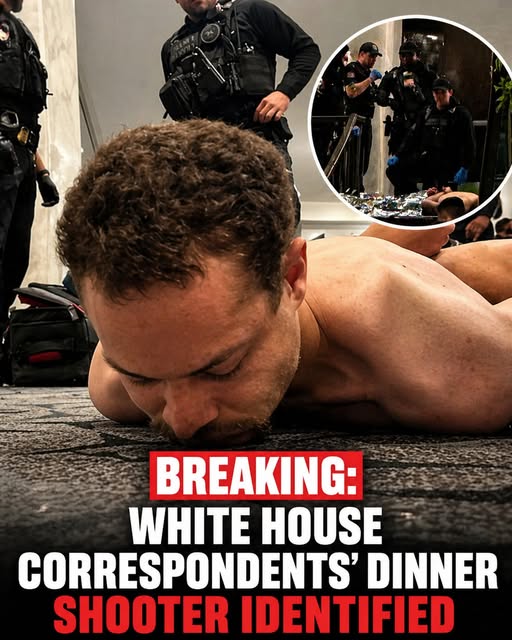
Near the back of the ballroom, security personnel gathered at a single location. The metallic tang of blood and the sharp smell of gunpowder filled the air. The threat was eliminated in a matter of minutes. The suspected gunman was pinned to the luxurious, patterned carpet after being tackled. The attacker was discovered to be shirtless, his torso covered with a jumbled map of symbols and scars in a bizarre scene that would soon take over every screen on the planet. He was surrounded by an armory that looked more appropriate for a battlefield than a banquet hall: several high-capacity magazines, tactical knives with serrated edges, and numerous semi-automatic firearms.
The shooter’s identify started to spread among the terrified throng as the smoke cleared. The most notorious person in the world was John Revokee, a name that had previously only been found in the shadowy, dusty corners of radicalized online forums. While federal authorities removed him of his remaining equipment, he laid face down, mute and indignant. Revokee’s background study showed a troubling trend of a man who believed he had been left behind by the modern world. His digital footprint was a breadcrumb path of complaints directed at the same individuals present in that meeting, including the information gatekeepers, policy planners, and celebrities who drove the cultural apparatus.
The Hilton’s aftermath was a spectacle of crushed prestige. Broken glass crunched beneath tactical teams’ boots. There were half-eaten plates of pricey sea bass sitting next to dropped cell phones that were constantly buzzing with texts from the outer world asking, “Are you okay?” Originally intended to honor the First Amendment and the peaceful exchange of ideas, the occasion has turned into a somber illustration of the unpredictability of the present day. It was a symbolic murder of the American social compact rather than merely a bodily assault.
Journalists who had dedicated their life to covering catastrophes were now the main focus of one. Winners of the Pulitzer Prize were spotted crying in the corridors, the dust from the ballroom floor staining their elegant dresses. Nobody missed the irony: those who devoted their professional lives to studying the “pulse of the nation” had been caught off guard by the very fury they frequently professed to comprehend. Not only had the gunman brought guns, but he also brought a mirror, making the elite confront the violent fringe that their words may have unintentionally fostered.
The city of Washington, D.C. went into complete lockdown in the hours that followed the arrest. Armored vehicles guarded the streets of the Capitol, which was dark. The story of the “lone wolf” started to spread, but the intricacy of Revokee’s evasion of several levels of private and Secret Service security pointed to something far more structured. There were rumors that the hotel’s security procedures had failed or that there had been an internal compromise. How could the President and the whole executive branch of the American media be in the same room as a man without a shirt and armed to the teeth?
The scene’s medical reports were terrifying. The President was safely removed by the Secret Service, but a number of prominent visitors did not have the same luck. Once a representation of the “inner circle,” the ballroom was now marked off with yellow tape as a murder scene. Slowly moving between the tables, evidence specialists bagged shot shells and took pictures of the devastation. Many found it difficult to comprehend the visual mismatch presented by the FBI agents’ tactical gear and tuxedoed bodies.
The public’s response was swift and divisive. Dark parts of the internet started to glorify Revokee while the rest of the country watched in terror. They saw his rebellious, shirtless posture as a representation of the “forgotten man” retaliating against an aloof and heartless elite. A terrifying reminder that the dance floor was only one front in a much bigger, ideological conflict was provided by this radicalization. The shooting was more than just a violent act; it was a message conveyed from the periphery to the heart of power, one that was terrible and bloody.
The world was left to consider the ramifications of the White House Correspondents’ Dinner massacre as the sun rose over the Potomac. After the “nerd prom,” there was a mound of questions and a lack of security. Although the gunman had been discovered, the underlying rot that gave rise to him had not been addressed. Overnight, John Revokee became a household name, a martyr to some and a bogeyman to others. However, the sound of the gunfire would never really end for those in that room. A constant reminder that the elite’s walls are more thinner than they appear, it would reverberate in the quiet moments of every upcoming broadcast and linger in the shadows of every gala. The drama was just getting started, etched in the blood of a nation’s collapsing composure and the ink of trauma, even though the cameras had frozen that night.