The first sound wasn’t a scream—it was a sharp, unnatural crack that cut straight through the laughter, breaking the illusion of safety in an instant. One moment, the room was filled with conversation, clinking glasses, and easy humor; the next, everything shifted violently. In seconds, the elegance of the evening collapsed. Gowns brushed the floor as people dropped low, chairs overturned in the rush to get out of harm’s way, and the President of the United States disappeared almost instantly behind a moving shield of agents with weapons drawn. Panic spread quickly and without direction. Guests crawled, some cried, others whispered prayers under their breath, trying to make sense of what had just happened. Outside, the scene was just as chaotic—one man in body armor bleeding, another lying motionless on the ground—while what had begun as a polished Washington event shattered into something unrecognizable.
What unfolded inside the Washington Hilton was more than just a moment of danger—it was a sudden collision between control and vulnerability. Just seconds earlier, the room had been alive with jokes, handshakes, and the constant flash of cameras capturing a carefully managed public moment. That sense of order vanished almost immediately. Tables were left overturned, drinks abandoned mid-toast, conversations cut off in mid-sentence. The transformation was so abrupt that many people didn’t fully grasp the seriousness of the situation right away. It was only when they saw agents moving decisively toward the source of danger—running into it rather than away—that the reality began to settle in. This was not confusion. This was a real threat unfolding in real time.
The response was swift and highly coordinated, but the speed of it added to the shock. The President was moved out of sight so quickly that for many in the room, his absence became one of the first clear signals that something serious had happened. Around him, trained professionals acted with precision, forming barriers, scanning for threats, and securing the environment as efficiently as possible. Yet even with that level of preparation, the event exposed something deeper—the fact that even the most protected spaces can be disrupted in an instant.
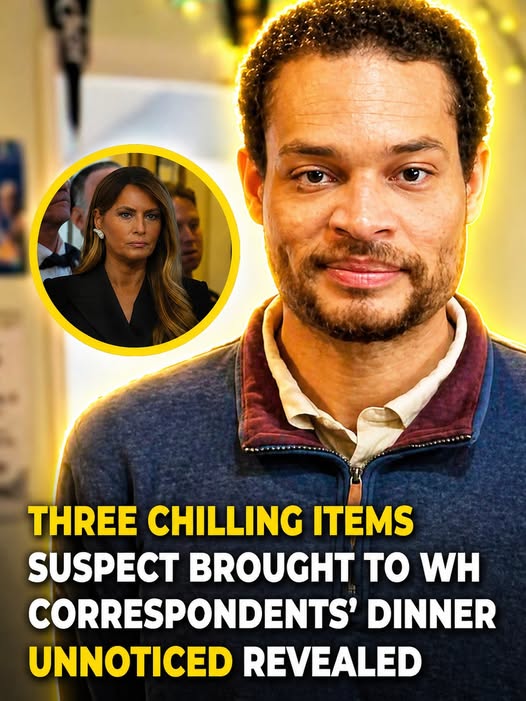
In the hours that followed, as information began to emerge, the story became even more unsettling. The alleged gunman, Cole Tomas Allen, did not match the image many expected. He wasn’t someone already known for extremism or flagged in advance. Instead, he had a background that appeared stable and conventional—a high-performing tutor, a graduate of Caltech, and a video game developer with no obvious warning signs. His public record showed little that would raise immediate concern, aside from a small political donation that, on its own, meant very little. This contrast—between expectation and reality—introduced a new layer of uncertainty.
Investigators were left facing a difficult and uncomfortable question: how does someone who appears outwardly successful and unremarkable come to be connected to such a serious event? The answer is not simple, and it is not immediate. It requires careful examination, patience, and a willingness to look beyond assumptions. Until those answers are found, the impact of that night will linger.
What happened didn’t just disrupt a single event—it changed the way people look at similar moments moving forward. Spaces that once felt controlled and secure now carry a sense of fragility. The confidence that such environments are untouchable has been shaken, even if only slightly. And while life and public events will continue, there will remain a subtle awareness beneath them—a recognition that even the most carefully planned occasions exist alongside uncertainty.
In the end, what began as an evening of routine political theater became something far more significant. It served as a reminder of how quickly normalcy can be interrupted, how thin the line can be between order and chaos, and how important it is to understand not just what happened—but why.