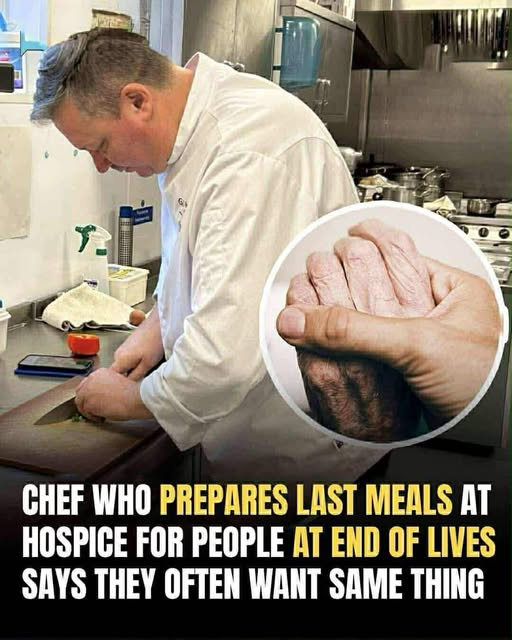
At an Oxfordshire hospice, chef Spencer Richards dedicates his time and skill to ensuring that people nearing the end of their lives are served meals prepared with genuine care, attention, and compassion. In a place where comfort matters more than anything else, food becomes more than just nourishment—it becomes a source of warmth, dignity, and connection. Every plate he prepares carries meaning, not just ingredients, because he understands that for many of these patients, each meal could be one of their last. That awareness shapes everything he does, from the way he listens to their wishes to the effort he puts into making each dish as special as possible.
For Spencer Richards, cooking for terminally ill patients is far more than a profession or a daily responsibility—it is something he sees as a calling, a purpose that gives deeper meaning to his work. He approaches every request with respect and empathy, recognizing that he is not just feeding people, but offering them moments of comfort during one of the most difficult times in their lives. Speaking to the Mirror, he explained that there is no greater privilege than being able to improve someone’s final days through food that brings them even a small sense of joy. For him, this role carries emotional weight, but also a profound sense of fulfillment.
“My own philosophy is that there can be no greater privilege as a chef than serving someone their final meal,” he shared. Recently, he worked with a 21-year-old patient who struggled to connect with anything on the standard hospice menu. The patient was young, with different tastes and preferences than what was typically offered, and none of the usual options appealed to him. Instead of insisting on the available dishes, Spencer took the time to talk with him, to understand what he actually enjoyed eating. Through that conversation, he learned that the patient liked street food—simple, flavorful, familiar meals that felt closer to his own world. So Spencer adapted, creating something tailored specifically for him, turning a standard experience into something personal and meaningful.
He also recalled a deeply emotional moment involving a 93-year-old patient who had lived her entire life in a very traditional environment, where birthdays were not celebrated and occasions passed without recognition. Wanting to give her something she had never experienced before, Spencer decided to prepare a birthday cake in her honor. When the staff surprised her with it, the reaction was overwhelming. She became emotional, moved to tears by a gesture that, for many people, might seem small, but for her meant everything. In that moment, the cake represented more than a dessert—it symbolized recognition, care, and a celebration of her life that she had never had before.
In fact, Spencer noted that birthday cakes are among the most frequently requested items by patients at Sobell House Hospice as they approach the end of their lives. Even when time is limited, people still wish to celebrate, to mark a moment, to feel seen and remembered. These requests may seem simple, but they carry deep emotional significance. For individuals who may have spent long periods feeling isolated, forgotten, or alone, even a small celebration can provide comfort and restore a sense of connection. As Spencer explained, these gestures, though modest, can mean a great deal to those who receive them.
“They’re small things, but especially for people who’ve been isolated or are feeling lonely, they mean a lot,” he said. His words reflect a broader understanding of how important human connection is, especially in environments where patients may feel separated from their usual lives. Food, in this context, becomes a bridge—something that brings back memories, emotions, and a sense of normalcy.
He also emphasized that adapting meals is a crucial part of his work, as many patients in palliative care experience physical changes that affect how they eat. As illnesses progress, patients often lose the ability to swallow easily, making traditional textures difficult or even impossible to handle. In addition, their taste preferences can shift due to medications and treatments, meaning foods they once loved may no longer appeal to them. Spencer must constantly adjust his cooking—changing textures, flavors, and presentation—to suit each individual’s needs, ensuring that meals remain both safe and enjoyable.
One observation he has made over time is that many patients with cancer develop a stronger preference for sweet foods. Even those who may not have previously favored desserts often begin to crave sweeter flavors as their condition progresses. At the same time, many patients become more sensitive to salt, requiring careful balance in seasoning to avoid discomfort. These details, though subtle, are essential in creating meals that patients can still enjoy despite the challenges they face.
“Food is a powerfully emotive medium—it can bring back childhood memories and also create new ones that last,” Spencer explained. For him, this is at the heart of what he does. Each meal is not just about taste, but about emotion, memory, and experience. It is about giving patients something meaningful in a time when so much else is uncertain. Through his work, he helps create moments that patients and their families can hold onto—moments of comfort, care, and humanity.
Please share this article with your family and friends on Facebook so that more people can understand the importance of compassion in even the smallest acts.