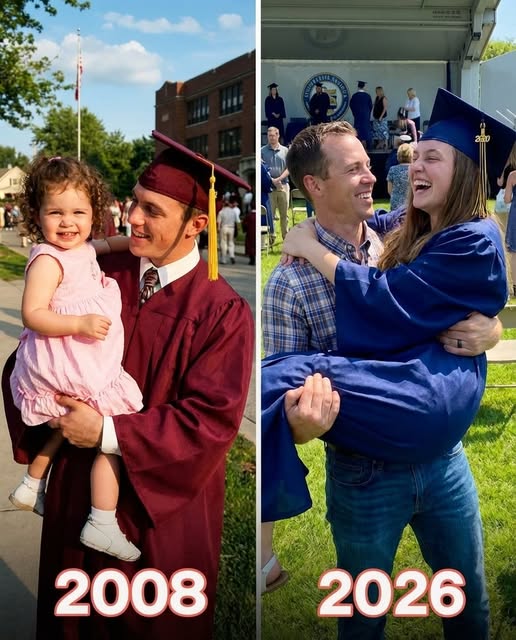
The framed pictures that lined our hallway were covered in long, victorious shadows as the golden afternoon light streamed through the living room curtains. The weight of the day was finally starting to seep into my bones as I sat on the edge of the sofa in my stiff dress shirt. Getting Maya to that point has been my life’s primary goal for almost twenty years. I felt a deep sense of accomplishment when I saw her cross it earlier that afternoon, her graduation cap neatly perched atop her head and her eyes scouring the crowd for mine. In my opinion, it was a calm, precious moment between a father and a daughter who had weathered the world together, despite the thunderous acclaim.
At the age of seventeen, when most lads are preoccupied with prom dates and college applications, I became a father. I carried diaper bags in place of textbooks, and I wore the diverse uniforms of the three jobs I balanced to keep us afloat in place of a varsity jacket. The world seemed to shrink to the size of a cot when Maya’s mother left six months after the baby was born. I recall understanding that my life was no longer mine while sitting in a poorly lit kitchen with a wailing baby in one arm and a calculator in the other. It was hers. My dreams of becoming an architect, the university admission letter, and the hope of a carefree adolescence were all packed away and placed in a dusty box in the attic of my memory.
We were a two-person team for eighteen years. Late at night, I watched films on a flickering monitor to learn how to braid my hair. Driving her to soccer practice taught me how to explain the intricacies of the world. We created a life based on a very particular type of resilience. I carried my sacrifices in silence because I never wanted her to feel the burden of them. I always made sure there was plenty on the table, even if it meant skipping a meal on the pretense of not being hungry, and I made sure she never saw the financial statements that made my hands tremble. Though I hoped her life would be softer than mine had been, she developed into a thoughtful, fiercely independent young woman with a quiet strength that frequently reflected my own.
After the celebration supper was over and the family had left, the house was quiet that evening. I was experiencing a rare sense of complete tranquility as I replayed the image of her grinning while holding her certificate. A strong, rhythmic knock at the front door broke that tranquility. It was authoritative, not the hesitant knock of a neighbor or the enthusiastic thud of a buddy.
My heart fell into my stomach as soon as I opened the door. Standing beneath the porch light were two police policemen. The sharp blue and red lights of their cruiser parked at the curb framed their expressions, making them unreadable. My thoughts raced through every nightmare a parent might have for a split second. Was she involved in an accident? Was she injured?
The first cop to speak was a man with graying hair and a soft voice. He inquired as to whether I was Maya’s father and whether I was aware of her exact activities throughout the previous six months. My throat became parched. I stumbled and defended her right away, mentioning her character and grades. The officer lifted a hand to reassure me, but my dread started to give way to confusion. He clarified that she was in difficulty, which is why they weren’t present. A downtown outreach campaign and a number of reports from the neighborhood community center brought them there.
Maya materialized at the top of the stairs as they were talking. She seems determined rather than shocked. The cops clarified that they had observed her organizing as well as volunteering almost every weekend and numerous weeknights. In order to help parents who had been compelled to leave the system, she had been collaborating with the university’s outreach office and a nearby legal aid clinic. She had established herself as a mainstay in their offices, persistently studying old records and bugging administrators, earning the admiration of everyone she came into contact with. The cops had been by merely to return a folder she had left in the common area of the precinct and to tell me, one-on-one, that they had never seen a young child so committed to making amends for a silent wrong.
The silence in the home felt different after the officers departed; it was filled with a mystery that I still hadn’t figured out. Maya carried a little, worn wooden box as she slowly descended the stairs. She put it on the coffee table and sat across from me. I was physically startled when she opened it. My old university acceptance letter from about 20 years ago was inside. The ink was a little faded and the borders were yellowed, but the admissions office seal was still visible.
When she discovered it a year ago while searching through old pictures, she looked into why it had never been used rather than simply putting it back. She was aware of the chronology. She knew exactly what I had given up for her when she compared the dates on the letter and her birth certificate.
She started taking out more papers, contemporary ones. Brochures, a breakdown of financial help, and a letter from the dean of adult admissions were all present. She clarified that she had been working with these organizations to find a means to reinstate my credits and acquire a grant particularly intended for parents returning to complete their degrees, rather than just volunteering for the purpose of a résumé. She had battled to reopen a door that I had closed and bolted years ago while negotiating the bureaucracy of my past during her final year of high school.
She informed me that she had shared my tale with my previous instructors who were still employed by the department. In the fall, when she would be embarking on her own adventure, she had discovered a way for me to return. Her confident, steady speech made me understand that I was no longer just staring at my daughter but rather at a peer, a woman of great character who had been listening to every unsaid lesson I had ever attempted to impart.
She explained to me that since love doesn’t maintain a ledger, it wasn’t a debt she was repaying. It was an homage. She wanted me to see the world the way I did before things became complex. Even while I was most pleased of my role as a father, she wanted me to remember that my identity didn’t end there.
The satisfaction I had felt at the graduation ceremony earlier that day seemed insignificant when I glanced at the well-organized notes and the possibility of a future I had long since lamented. I came to the realization that neither the house we resided in nor her graduation was my greatest accomplishment. It was that I had brought up a person who saw a chance for healing in a sacrifice. She had chosen to make sure that I was not constrained by our circumstances in exchange for my spending eighteen years trying to make sure she never felt that way. At last, the circle had come to an end with an invitation for both of us to begin anew rather than a farewell as she left for her own life.