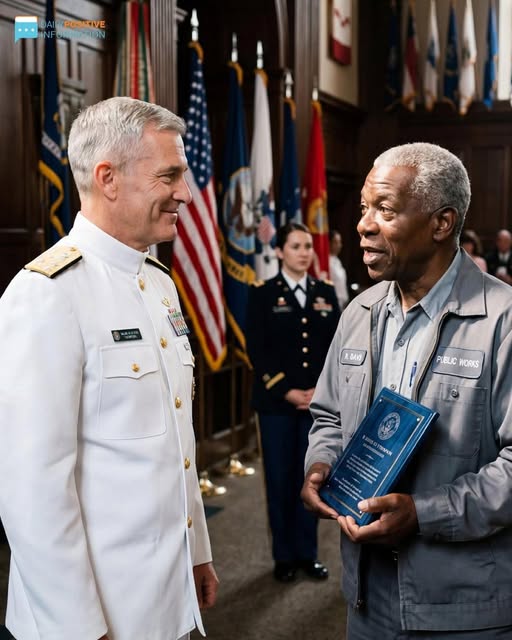
The tension inside the Naval Special Warfare Command facility in Virginia Beach that morning was almost tangible—thick, electric, like a charge you could feel against your skin. It was the kind of atmosphere that forms when a room is filled with ambitious people doing everything they can not to make a mistake.
Admiral Riker Blackwood was coming.
His portrait hung in the main hall. His legend filled the training manuals. His name was spoken in hushed tones among officers—some with admiration, others with a quiet sense of dread. This wasn’t a routine visit. It was the kind of inspection that could build careers or destroy them, and every officer in the building had been “performing” their role since 0500, trying to appear competent enough to survive scrutiny.
No one paid much attention to Thorn Calloway.
They almost never did.
And in many ways, that was exactly how he wanted it.
He moved through the pre-inspection chaos with steady, measured rhythm—a mop in his hand, a cart in front of him, gray coveralls worn at the elbows, his presence as unnoticed as the hum of the ventilation system overhead. He was the facility’s janitor. A ghost in plain sight. A man whose name was hard to recall even if you had passed him a hundred times.
But he was also a single father.
The kind who packed school lunches at 5:30 in the morning, checked homework at night, and made sure the lights were out on time. His son, Emery, was seventeen and preparing for MIT applications—completely unaware that the man who corrected his physics assignments had once commanded elite special operations units in circumstances no textbook could explain.
And Thorn wanted it that way.
He had wanted it that way for fifteen years.
That morning, he spent hours cleaning surfaces that would later be inspected by a man who had built his career on Thorn’s work.
By 0600, the building buzzed with tension. Officers moved with clipped urgency, fully aware they were being evaluated. Commander Ellis had already snapped at Thorn twice about the quality of cleaning in one section, never making eye contact, speaking to him like an object that had failed to arrange itself properly.
Thorn cleaned the smudge and moved on.
In the officers’ restroom, he overheard three junior officers rehearsing talking points about tactical readiness like actors before an audition. None of them acknowledged him. One even made a joke about the janitor—while leaving without washing his hands.
Thorn noted both facts with the same neutrality.
He had spent eight years in that facility. Before that, five years building a civilian identity strong enough to withstand scrutiny. And before that—an entirely different life.
A life that had cost him everything except his son.
Lieutenant Adira Nassar was the only one who saw him differently. She had started asking questions—not direct ones, but careful ones. The kind that suggested she was piecing something together.
“You stand like someone who served,” she had told him.
“Some habits never leave,” he replied.
She was getting close.
At 0800, when Admiral Blackwood entered, the room changed instantly. He moved with the confidence of a man who never questioned his place. He began inspecting with surgical precision, identifying weaknesses effortlessly.
Then he saw Thorn.
For a brief moment, something shifted in his expression.
He recognized him.
And decided to use it.
He approached and, in front of everyone, mockingly asked for his “rank.”
The room erupted in laughter.
But when Thorn lifted his head and met his eyes, the laughter died.
“Major General,” he said calmly.
Two words.
And everything changed.
The silence that followed was absolute. Officers froze. Blackwood tried to recover, but control was slipping.
Nassar understood first.
She had spent days connecting fragments of information, and now it all made sense. Operation Hermes’ Fall—one of the most celebrated missions—had been falsely credited. The real name had been erased.
And that name stood before her.
Thorn Calloway.
Meanwhile, far from that room, his son Emery had begun uncovering the truth about his family’s past—a story involving his mother’s suspicious death and a deliberate gap in official records.
Fifteen years earlier, everything had changed.
The operation had been manipulated. The truth buried. And Thorn’s wife had been killed after discovering it.
He had faced two choices: justice or his son’s safety.
He chose his son.
And spent years building a new identity, becoming invisible, gathering evidence.
Until that day.
When the truth finally surfaced, everything began to collapse for Blackwood. Investigations started immediately. Serious accusations followed. His network began to unravel.
At one critical moment, even Thorn’s son was used as leverage—but that only accelerated the downfall.
Within hours, the Department of Defense intervened. Blackwood left the facility not as an admiral, but as a suspect.
In the weeks that followed, the truth came to light.
Thorn was officially reinstated to his rank. His name was restored. Justice for his wife finally began to take shape.
And his son—now knowing everything—stood beside him, no longer as a boy in the dark, but as someone beginning to understand what it means to choose what matters most.
In the end, what remained wasn’t just the story of a general who hid as a janitor.
It was a story about choices.
About sacrifice.
About the patience to wait for the right moment.
And about a simple truth: what people see is not always what you truly are.
If this story stayed with you, share your thoughts—because some stories find exactly the people who need them most.