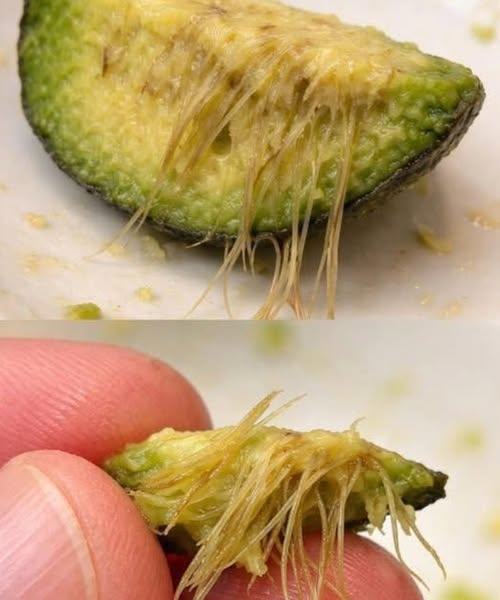
The avocado is now more than simply a fruit; it is a culinary mainstay, a cultural phenomenon, and the undisputed monarch of the contemporary morning table. Despite its widespread appeal, avocados continue to be among the most erratic and enigmatic fruit commodities. Everyone has gone through the “avocado vigil” ritual, which involves gently squeezing the fruit for a few days as we wait for the precise moment when it is perfectly ripe. Our goal is to create an interior that is smooth, neon green, and has the texture of room-temperature butter. However, far too frequently, the knife cuts through the skin to disclose an unsatisfactory inside landscape. Rather than perfection, the flesh is made up of a network of fine, dark, hair-like filaments. Usually, this revelation results in an instant feeling of betrayal and a hasty rush to the trash can. But before you throw away your next fibrous fruit, it’s important to comprehend the biological reality of those strings and what they tell us about the avocado’s life.
We must first examine the basic biology of the plant in order to demystify the stringy avocado. The avocado, botanically known as Persea americana, is a big berry with a single, enormous seed rather than a vegetable. The fruit needs a sophisticated internal infrastructure to thrive, just like any other living thing. These annoying brown strings are the remains of the fruit’s vascular system, not an indication of rot or infection. These are referred to as xylem and phloem in the world of plants. These microscopic canals act as a conduit for water and vital nutrients when the avocado is still hanging on the tree in the groves of Mexico, California, or Peru. They are the lifelines that move the fruit’s constituent parts from the leaves and roots into the growing berry. These vascular bundles maintain their softness, suppleness, and near indistinguishability from the surrounding fatty flesh under ideal growing and harvesting conditions. However, these “highways” get lignified—that is, they toughen up and form the woody, fibrous threads that afflict our toast—when the delicate balance of the avocado’s environment is upset.
This vascular system suddenly becomes noticeable and unappealing for a number of reasons. The age of the tree itself is one of the most frequent offenders. Fruit from younger avocado trees, especially those in their initial few years of production, is infamous for having more noticeable fibers. The fruit usually gets creamier and less “stringy” as the tree ages and its internal processes become more effective. This textural obstacle is considerably more likely to occur if you buy a batch of avocados from a recently planted grove. Additionally, the particular avocado cultivar has a significant impact. There are hundreds of other avocado kinds, such the Fuerte or the Gwen, that may have a stronger tendency to form fibers based on the soil and environment in which they were raised, but the Hass avocado is the world standard because of its high oil content and creamy smoothness.
Another significant factor that transforms a buttery avocado into a stringy mess is environmental stress. Avocados are susceptible to the whims of nature, just like every other crop. Fruit may produce its vascular tissue more aggressively as a defense strategy in response to irregular watering schedules or abrupt, drastic temperature changes. A tree’s vascular bundles may “harden” as they strain to disperse the sudden surge of nutrients if it goes through a period of drought followed by a torrent of rain. In a similar vein, the internal fibers may become rough and brown when the fruit attempts to ripen off the vine if it is harvested too soon or exposed to cold conditions before it has fully developed on the branch.
For the typical consumer, overripening is the most common cause of stringiness. Long after it has been harvested, an avocado undergoes chemical changes since it is a living organism. The flesh’s cellular walls start to deteriorate when the fruit reaches its maximum window of freshness. The harder vascular bundles last longer than the surrounding soft tissue, but the lipids and oils that give them their distinctive creaminess begin to oxidize. This produces a striking contrast: the brown fibers stand out like a skeleton framework, while the skin turns mushy and gray. When the oils start to go rancid, the fruit’s flavor often changes significantly, giving it a metallic or fermented aftertaste.
This raises the crucial question: Is it safe to consume a stringy avocado? The quick answer is nearly always in the affirmative. These fibers are completely natural and non-toxic, despite their poor texture and lack of aesthetic appeal. They are just cellulose and lignin, the same substances that give wood its hardness or celery its crunch. Consuming the fruit has no health risks if it still has a fresh scent and most of its flesh is green. Mouthfeel is the only factor that contributes to the “ick factor.” But there are unmistakable indicators that an avocado has actually gone bad and need to be avoided. The fruit has passed the “fibrous” stage and into the “decayed” stage if you see big, sunken black pits in the flesh, a strong, sour smell like old gym socks, or a watery, weeping consistency.
You don’t have to discard an avocado if you have one that is okay to eat but too stringy for a lovely salad or a crisp piece of toast. These flawed fruits are ideal for recipes that change or conceal texture. Particularly when combined with the crunch of onions, the acidity of lime, and the sting of cilantro, mashing a stringy avocado into a chunky guacamole frequently conceals the fibers. You can use a food processor or a fine-mesh sieve on the avocado if the fibers are very difficult to remove. You can enjoy the potassium and healthful monounsaturated fats without the chewy distraction by blending the fruit into a smoothie or a creamy spaghetti sauce, which effectively pulverizes the vascular bundles.
Astute consumers should seek out avocados that are substantial for their size and have a uniform, dark skin without soft “divots” to reduce the likelihood of taking home a stringy letdown. The easiest technique to guarantee a uniform disintegration of the internal tissue is to ripen them at home at room temperature, out of direct sunshine. Transferring them to the refrigerator can slow down the process and stop the vascular bundles from browning once they reach that magical stage of yielding to light pressure. Ultimately, the brown strings serve as a modest reminder that our food is produced on Earth rather than in a factory. Even while they may not be attractive, they serve as a reminder of the intricate, living systems that sustain us on a daily basis. They are the scars of a fruit that put a lot of effort into growing.