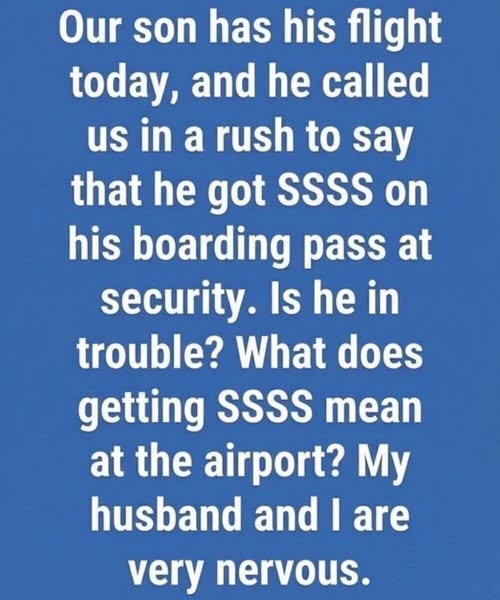
The modern airport experience is frequently a well-planned dance involving patience, timing, and logistics. With the sole intention of arriving at their gate prior to the last boarding call, travelers make their way through the maze-like terminals, checking clocks and navigating security lines. But for a small and frequently confused group of travelers, that trip is cut short by a set of characters that are subtly printed on their boarding pass and alter everything. A tourist has been flagged for a thorough and frequently intrusive security examination when the digital brand SSSS, which stands for Secondary Security Screening Selection, appears. Passengers tagged with this abbreviation are drawn into a secondary realm of examination, which is run mostly behind closed doors and is controlled by sophisticated algorithms and high-level intelligence data, while the majority of passengers easily pass through the standard metal detectors or body scanners. Anyone hoping to fly at a time of increased monitoring must comprehend why this occurs, how the Secure Flight Program finds targets, and what actually takes place behind the scenes of a secondary check.
A startling noise at the boarding gate or the self-service kiosk’s inability to provide a digital pass typically signal the time of detection. The regular airport regulations vanish when a tourist sees those four bold letters. This is the result of the Transportation Security Administration’s Secure Flight Program, a back-end system that verifies passenger data against multiple federal watchlists prior to the creation of a boarding card. Although the program’s goal was to identify high-risk persons before they even entered a sterile part of the airport, its vast net frequently caught regular people. The selection criterion can be anything from the obvious to the seemingly arbitrary. Many travelers are alerted for more commonplace irregularities in their travel habits, but high-profile reasons include being on a No Fly List or a Selectee List. Traveling to or from high-risk international locations, arranging a flight at the last minute, or paying cash for a one-way ticket can all result in the SSSS designation. In order to keep security procedures surprising, the TSA also maintains a completely random selection method, which means that even the most regular and law-abiding travelers may suddenly find themselves under scrutiny.
The exhilaration of your trip day changes to one of clinical observation when you are selected for secondary screening. The traveler will be escorted to a designated area for a more comprehensive check by TSA officials who are trained to look for subtle behavioral indicators. This isn’t just the walk-through scanner again. A thorough examination of the traveler’s person and belongings is the secondary check. Usually, it starts with a thorough pat-down, which is far more thorough than a routine check to make sure that nothing illegal is hidden under clothing. After that, each item of carry-on luggage is opened and carefully examined. To look for minute traces of hazardous materials, TSA officials frequently utilize explosive trace detection swabs on gadgets, clothes waistbands, and the inside of baggage. Travelers are frequently asked to turn on their electronic devices, such as computers and smartphones, to demonstrate that they are operational and have not been altered or turned into homemade explosives.
This technique can have a substantial psychological cost. A passenger’s fear may be increased by the icy, detached demeanor of security guards, and being picked out in a crowded terminal feels like a public accusation. However, radical calm and preparedness are the keys to surviving an SSSS encounter without ruining your trip. Security may misunderstand evident displeasure or panic as suspicious conduct, which could result in additional delays or more in-depth interrogation. If tourists believe they may be subject to further screening, experts advise them to be at the airport at least three hours in advance. This is because the secondary process can prolong the boarding process by thirty to sixty minutes. The best method to speed up the procedure is to be aware of your rights and to act in a kind and helpful manner. Keeping your electronics close at hand and your carry-on luggage neat is also beneficial because a disorganized suitcase will just make the manual search take longer.
The experience can become a chronic burden that makes flying nearly intolerable for people who are frequently chosen for SSSS. This frequent flagging frequently points to an instance of misidentification or a name that closely resembles someone on a government watchlist. Through the Traveler Redress Inquiry Program, the Department of Homeland Security provides a Redress Number in certain situations. A traveler can request that the government check their records and fix any data inaccuracies that result in repeated secondary screenings by applying for this number. The risk of seeing those dreaded four letters on subsequent flights is greatly decreased if a Redress Number is issued and attached to a ticket reservation. It serves as a digital signal that the passenger has been screened and cleared.
The SSSS protocol serves as a clear reminder of the conflict that exists in the twenty-first century between individual freedom and public safety. The TSA argues that these security layers are the only thing separating the traveling public from potential threats, despite the fact that they are unquestionably uncomfortable and can feel like an invasion of privacy. To stay ahead of new threats, the Secure Flight Program is always improving its algorithms and incorporating fresh data. As technology develops, screening techniques may evolve to include additional biometric and face recognition information, but the fundamental idea is always the same: the government has the power to examine anyone entering the country’s airspace more closely.
Knowledge is ultimately the best defense against the strain of an SSSS label. A traveler can distance themselves from the frustration of the moment by realizing that the choice is frequently the product of an automatic algorithm rather than a subjective assessment. The chilly stare of an agent and the error tone at the kiosk are merely components of a bigger, unseen system that keeps the skies intact. The experience doesn’t have to be disastrous, regardless of whether you are selected for a particular travel oddity or just by rolling a digital die. You can pass through the secondary check and return to your gate with your dignity intact if you have the correct attitude, a little additional time, and a dedication to cooperation. Your entire journey need not be defined by the four letters on your boarding card, even though they can determine the next hour of your life. The key to a successful flight in the complicated world of contemporary aviation is being ready for the times when the trip becomes less predictable.