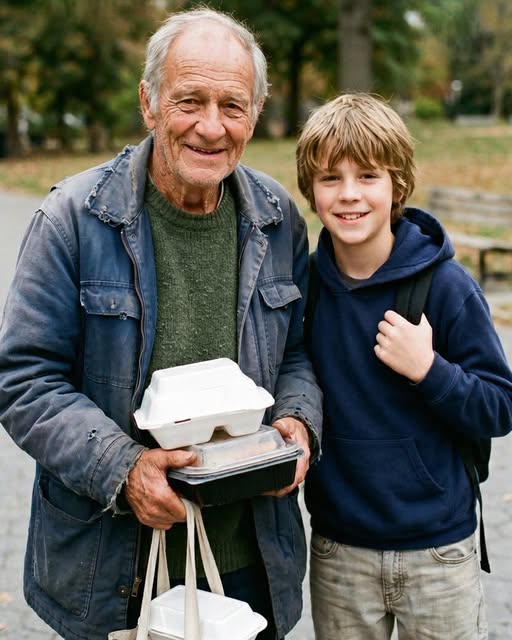
The smell of simmering chicken soup filled the kitchen with a delectable, steamy aroma, but everything changed when there was a firm, sharp knock on the door. Noah, my thirteen-year-old son, was standing at the stove, stirring the pot with a wrinkled brow. We assumed we were cooking for Mr. Bennett, the old man who had been living on a worn bench close to our church for the past few months. However, I recognized that the peaceful life we had been leading was about to be upended by a reality we never anticipated when I opened the door and saw two grim-faced officers waiting on my porch.
With his eyes searching my face for a response, one of the officers brought up a picture. How did I know the man in the photo, he asked? I turned to face Noah, who was no longer moving, his eyes wide with a mixture of dread and fascination. “My son feeds him,” was the only thing that made sense when I turned to face the officer again. The officers exchanged a gaze that made me shiver. The older one, a tired-looking sergeant, opened a folder and spoke softly and precisely. “The man you know as Mr. Bennett is not who he claims to be,” he continued, “Ma’am.”
You have to go back three months in order to comprehend the gravity of that statement. It began at Saint Luke’s on an extremely cold Sunday. Noah tugged at my sleeve while I fumbled in my purse for my gloves since the air was sharp enough to pain. He gestured to an elderly man sitting crouched on a bench at the edge of the church parking lot. There was something about the way he sat—shoulders squared, spine straight as a rod—that didn’t fit the stereotype of a guy who had lost everything, even if his coat was paper-thin and his beard was a shock of tangled white.
Noah didn’t wait for permission because he is an impetuous and passionate boy. To find out if the man was okay, he jogged across the lot. The man claimed to be eighty years old and to have just fallen on hard times. He identified himself as Mr. Bennett. Noah insisted that we bring him dinner that evening because of the quiet dignity with which he spoke. On the way home, Noah had told me, “Nice people still say thank you like it costs them something.” That observation served as the basis for a three-month ritual.
Noah became a chef with a mission every single day. He would rummage in the refrigerator, questioning whether the tea was good enough or if the carrots were fresh enough. He started to view Mr. Bennett as a person rather than as a charity case. He saw how the elderly guy folded his scant blankets with military precision, cleaned his battered boots until they sparkled, and always stood up when I walked up, despite the obvious anguish in his knees. With a cold, arrogant finality, Mr. Bennett declined the comfort of a shelter or our guest couch. He was a guy of “ma’ams” and “thank yous.”
Noah once questioned him about why he was always sitting with a camera on him. Mr. Bennett gazed out over the deserted lot after taking a long sip from his thermos. “Son, it’s a habit,” he muttered. “The kind that, despite your desire to lose, you do not.” That was the first break in the façade, an indication that the man sitting on the bench was actually a ghost of someone much more important.
When Mr. Bennett abruptly disappeared, the mystery grew more complex. The bench was vacant for four days. After school, Noah was distressed and worried that something horrible had happened to his friend. He checked the church lot. The police showed up at that point. They clarified that “Mr. Bennett” had fallen behind a nearby pharmacy. His fingerprints had set off a system-wide alarm during his hospital admission. His true identity was Walter, and he was a highly decorated Army veteran who had vanished years prior. He was not an anonymous drifter.
Walter had just stopped when his wife died. He withdrew into the anonymity of the streets, stopped using his housing assistance, and stopped cashing his veteran benefits. He didn’t want the accolades, the tales, or the appreciation of an uninformed public. He desired to vanish. However, he did not name a lawyer or a long-lost cousin when the hospital staff asked him who they should call in his last moments of consciousness. He provided our address to them. He told them about Noah, a boy who brought him dinner and spoke to him as if he were still important.
Noah was greeted like a celebrity by the nurses when we got to the hospital. One muttered, “He’s asked for you twice.” Walter appeared smaller and more frail than he had ever been on that bench when we discovered him in a clean room. Noah went straight to the bedside and placed a thermos there. “You vanished,” Noah murmured, his voice breaking. At last, Walter’s pride started to melt as he examined his hands. He acknowledged that he had concealed his name because he no longer wanted to be the story’s hero. All he wanted was to be a man.
With tears in his eyes, Walter said to Noah, “You never asked me to be impressive.” “You brought dinner just now.”
The town was altered when Walter’s identity was discovered. People who had passed that bench for months without giving it a second look now wanted to shake his hand and buy him lunch. Walter, meanwhile, had little interest in the publicity. The youngster who had seen him while he was invisible was all that mattered to him. Walter eventually consented to move into veteran housing and begin the challenging process of treatment to deal with his grief thanks to Noah’s insistence.
Wearing a clean coat and the green scarf Noah had given him, Walter stood on the church steps the next Sunday with an arrow-straight posture. He received a container of macaroni from Noah, and their laughter reverberated throughout the parking lot. Noah continued to regard Walter with the same straightforward compassion that he had displayed on that chilly December morning, even though half the village now regarded him with wonder due to his service.
As I observed them from the car, I realized that my kid had nourished a starving soul as well as a hungry man. It took a thirteen-year-old boy with a pot of soup to remind Walter that he was worth rescuing after he had spent years trying to forget that he meant to the world. The light in Walter’s eyes as he joked with my son was the real miracle, even though the medals on his chest were spectacular. Noah reminded us that our greatest value is found in the small, unobtrusive ways we support one another in a society that frequently gauges our worth by our accomplishments.