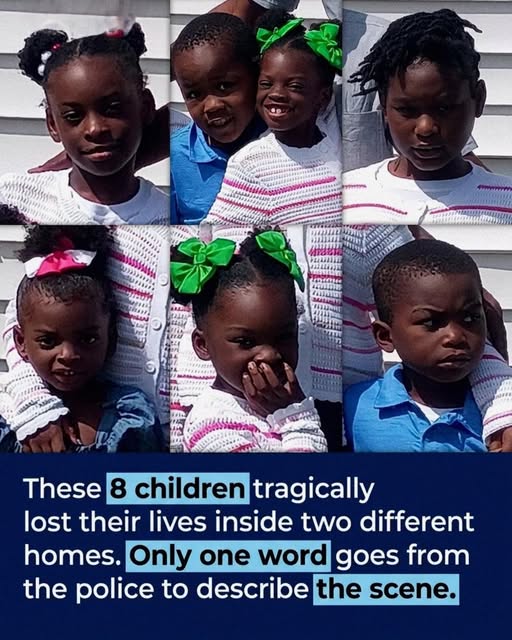
Community relationships have traditionally been strong in Shreveport, Louisiana, but on the morning of April 19, 2026, a wave of violence so intense that it left the whole region in a state of collective paralysis broke those ties. Shamar Elkins, a guy whose digital trace has turned into a somber map for investigators and a source of eerie conjecture for a bereaved public, is at the center of this storm. Even when the police cruisers’ flashing lights have dimmed and the crime scene tape has been removed, the story of what transpired at many locations in Caddo Parish is still not fully understood. It is hard to imagine the scope of the tragedy: two women are still fighting for their lives in a nearby intensive care unit, and eight children—seven of whom were Elkins’ own relatives—were killed.
The series of events started in the wee hours of the morning and developed at a horrifying rate that surpassed the city’s emergency response. The violence was a mobile disaster that extended from the residential streets of the Cedar Grove neighborhood to the nearby jurisdiction of Bossier City; it was not limited to a single room or even a single house. The devastation was finished by the time the sun had fully risen. Elkins met his demise after a high-stakes altercation with law officers after escaping the initial scenes and carjacking a car in a last-ditch effort to avoid capture. Ballistics experts are still trying to determine if he died by his own hand in a final act of cowardice or from the accuracy of police gunfire.
The “why” has taken precedence over the “how” in the days following the murders, drawing both the public and detectives back to Elkins’ social media accounts. Elkins’ posts from March and April 2026 are now being examined in the harsh, retroactive light of mass murder because, in the present era, a man’s digital life frequently serves as a forerunner to his physical actions. His words may have appeared to a casual observer at the time to be the typical outbursts of a man grappling with life’s universal weight. He talked a lot about his struggles with anxiety and despair, his faith, and the therapeutic value of prayer. But when these feelings are combined with family members’ stories, a much harsher picture becomes apparent.
Since then, family members have come forward to describe a man who was drowning in “dark thoughts.” A family member recalled a discussion in which Elkins discussed the nature of internal conflict and eerily implied that some people “don’t come back from their demons.” This statement now reads like a manifesto of intent, whereas previously it might have been written off as a philosophical reflection or an appeal for pity. Elkins and his wife were going through a turbulent divorce at the time of the murders. A court date to resolve their marital situation was apparently set for the very next day, indicating that the timing of the atrocity was especially well-planned. Elkins obviously concluded that no one would ever meet the deadline.
The tragedy also reveals a serious flaw in the preventative and legal frameworks intended to protect communities. Elkins was a convicted felon, with a firearms conviction from 2019, according to investigators. He was forbidden from owning a firearm for a minimum of ten years by both federal and state law. He was nevertheless able to obtain and execute youngsters between the ages of three and eleven with an assault-style weapon in spite of this legal obstacle. This discovery has sparked a flurry of inquiries about the availability of firearms and the application of current legislation. How can a man with a history of firearms charges in Caddo Parish enter a house carrying a rifle with a large capacity?
Social media users discover a man who was skillfully concealing his deadly nature beneath a façade of spiritual pursuits as they go through his last posts. While he was probably organizing the logistics of a multi-site attack, he posted about “finding peace” and “trusting the process.” One of the case’s most unsettling features is this duality. It serves as a reminder that the commonplace or relatable can frequently mask the warning indicators of domestic terror. Anger and melancholy are common, but when they are combined with a violent past and an impending court case, they turn into an explosive concoction that, in this instance, killed a whole family.
The fatalities were innocent spectators in a battle they did not initiate; their names are now included on prayer cards and vigils around Shreveport. In an attempt to find a way to memorialize lives that were just ten years old, classmates and neighbors have met in neighborhood parks and released balloons into the Louisiana sky. The two survivors—Elkins’ wife included—represent a difficult road to healing. In addition to recovering from the physical pain of “serious injuries,” they must contend with the unachievable challenge of outliving their offspring. Experienced police officers who responded to the Cedar Grove residences characterized the scenes as some of the most awful in the city’s long history, raising serious concerns about the mental health of first responders.
Local authorities and community leaders have taken care to guide the public away from answers that are solely digital. Social media offers a glimpse into Elkins’ declining mental health, but it doesn’t provide a whole explanation or motivation. The case is being treated purely as a high-level domestic violence incident, when a man decided to use the most extreme form of control over people he professed to love. The awareness that “separation” is frequently the most hazardous period for victims of domestic abuse is currently plaguing the city. A man who wouldn’t let his family survive without him was triggered by the court date.
Shreveport is still in grief, but it’s also looking for answers. Whether Elkins’ death was self-inflicted or the result of police action, the unanswered questions surrounding it pale in comparison to the more general concerns of systemic failure. Forensic specialists are still analyzing evidence from the several sites connected to the April 19 rampage as part of the ongoing investigation. The public narrative at the moment is a blend of horror and profound, unsolvable issues. Each post Elkins wrote about his “demons” is a melancholic memorial to the eight kids who were never given the opportunity to battle their own demons. This tragedy’s impact will probably permanently alter the way the area handles felonious firearm possession and domestic violence warnings, but for the families in Shreveport, that reform has arrived much too late.