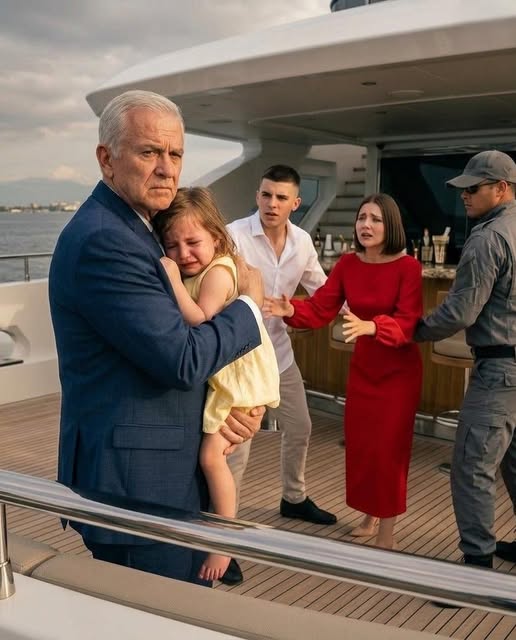
Usually, the solitude of my house at two in the morning was a haven, a time for restful sleep and the tranquility that comes with retirement. However, the silence was broken that evening by my phone’s piercing, repetitive trill. The blue light from the screen was blinding in the dark. A grandmother’s intuition is like a physical weight in the chest—a quick, heavy sinking that indicates the world has turned on its axis before you ever pick up the receiver—but I didn’t recognize the number. Daniel, my kid, was meant to be in the Caribbean. Just 48 hours earlier, he, his wife, and their kids had set out on a much-awaited luxury cruise. I thought they would be silent, or maybe a stray picture of a sunset over the azure lake. A call from a nearby emergency room caught me off guard.
The calm, clinical voice on the other end made me feel even more anxious. A triage nurse was there. She told me that Olivia, my seven-year-old granddaughter, had been admitted due to acute dehydration and a dangerously high fever. I gasped. I inquired as to whether Daniel was with her, thinking that maybe the ship hadn’t sailed or they had missed their flight. Although the nurse’s hesitancy was brief—just one second—it seemed to take forever. She informed me that Olivia was discovered by a hotel security guard close to a shuttle stop, shivering in spite of the humid night air while holding a little backpack. She was by herself.
Streetlights and hushed prayers blurred on the drive to the hospital. My thoughts raced over the past few days. From the terminal, Daniel had sent a swarm of pictures showing happy people, piled bags, and the enormous white ship’s hull in the distance. With a sickening start, I realized that Olivia wasn’t in those pictures. Although I had seen her parents, younger sister, and elder brother, I had unconsciously concluded that she was either out of frame in the commotion of boarding or behind the camera. I couldn’t even find the right words to express how deeply betrayed I felt to learn that my son had boarded a ship and sailed into the horizon while his middle kid was abandoned on a pavement.
The faint hum of monitors and the sterile smell of antiseptic did little to calm my worries when I stormed into the pediatric unit. She was in Room 412 when I found her. With an IV line attached to her delicate wrist and pale, waxy skin, she appeared incredibly little in the spacious hospital bed. Her eyes welled with tears when she saw me, but she was too feeble to do anything beyond extend a shaky hand. As the doctor described the seriousness of the situation, I sat next to her and stroked her hair. On the day of the departure, Olivia had a severe flu-like illness. Her parents were upset by the “bad timing,” she informed the nurses, despite the fact that she had been tired and throwing up. They didn’t want to miss the departure because they had paid thousands on this trip.
The narrative that surfaced was a nightmare of carelessness masquerading as a “misunderstanding.” A number of disastrous choices were made as a result of their frustration with Olivia’s illness and their haste to handle three kids and a ton of stuff. Olivia was supposedly instructed to wait outside the shuttle stop with a family friend who was meant to meet them there so they could return her to my house. But there was never a friend like that. It was a lie, an attempt to hide the “issue” so they could get on with their holiday without having to worry about a sick child. They had told her that someone would arrive in five minutes and had left her with her backpack and a bottle of water. Nobody showed up. Her fever had been rising while she waited there for hours until she finally passed out.
The hospital room became a center of social and legal activity as the sun rose over the city. Olivia’s abandonment set off the authorities. Sarah, a social worker, sat next to me with a veneer of professional worry on her face. They had already made touch with the cruise line, she clarified. The captain had been informed, but the ship was now at sea. My son’s “cheerful” vacation was about to come to an abrupt, legal end.
I experienced a mixture of feelings, including a deep sadness for Olivia and a furious, protective wrath toward my own kid. How could a parent view a child in pain as a hassle rather than a top priority? I glanced at the pictures Daniel had shared on social media a few hours prior, showing the vivid blue ocean and cocktails by the pool. He appeared carefree. The girl in front of me, who was now being watched for possible kidney problems because of the degree of dehydration she had attained while waiting for “help” that was never given, stood in stark contrast to this.
The fever started to subside by the second day. Olivia’s voice was a hoarse whisper, but she began to speak more. She inquired as to whether she had made a mistake. She believed that because she was ill and ruined the cruise, she was being punished. The toughest thing I have ever had to do was break that perception. I had to tell her that she was valuable, that none of this was her fault, and that she would never be abandoned once more. I silently vowed to provide her with a house where her needs would never be viewed as a luxury as long as I was alive.
Three days later, there was a conflict with Daniel and his wife. Under the shadow of a police inquiry, they had been compelled to depart at the first port of call and fly back. They attempted to portray it as a “he-said-she-said” argument about who was remaining behind with her when they entered the hospital. However, the evidence was unmistakable. Both of them had boarded that ship. Both of them had scanned their cards. In the middle of the night, they had both abandoned a sick seven-year-old on a bench.
The legal repercussions happened quickly. Olivia was temporarily placed under my legal custody after Child Protective Services launched a formal case. Rebuilding a broken spirit was more important to the transfer than paperwork. We relocated her belongings into my guest room, transforming it into a haven of books, cozy blankets, and the surety of her presence.
Our family’s fabric was permanently altered by this experience. It broke my naïve faith in my son and made me take on a role I hadn’t anticipated at this point in my life. However, I can tell that the 2 A.M. phone call was a turning point of mercy as I watch Olivia laugh once again, her color returning and her eyes leaving that haunted look of abandonment. In addition to saving her life, it allowed me to show her how valuable she is. Olivia’s safety was the only thing that ever really mattered, even though the cruise was ultimately just a ship on the water. We discovered a new way to be a family in the silence that followed the storm—one based on responsibility, intense protection, and the assurance that nobody is left behind.