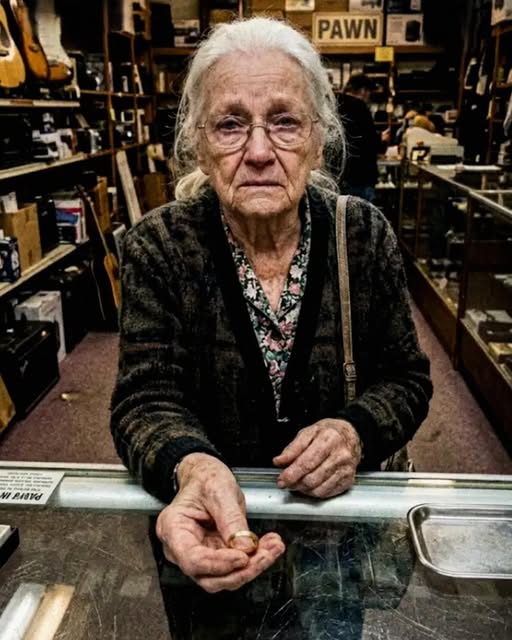
I work at a pawn shop on the outskirts of town, where the quiet desperation of people parting with their history permeates the air along with the smell of old oil. The majority of days have a steady, depressing beat. Consumers try to converse about things that seem to have no significance at all while sliding things across the scratched glass counter that they once vowed would remain in their families forever. While I try to keep a professional distance and weigh their gold or inspect their gems, they stare at their feet. However, that gap vanished a few days ago when an old woman entered through the front door and a bell sounded.
Despite her weakness, she exuded a calm, majestic grandeur that demanded no pity at all. She received mine for that exact reason. She approached the counter, put a simple gold band on the glass, and gave a faint, tired grin. It had the kind of sheen that only comes from a piece of jewelry that has endured a lifetime of prayers and memories; it was worn smooth and polished by decades of anxious rubbing. Her gaze fell to her bare hand when I asked whether she was certain she wanted to give it up. She warned me that her house would go dark if she didn’t pay her $300 power bill by morning.
I picked up the ring and tilted it under the harsh fluorescent lights to start a typical appraisal. My breath caught. O and E—Always was the delicate, worn engraving that peered back at me from inside the band. 1968.
The store vanished for a second. Suddenly, I was seated on the floor of my grandfather Oscar’s den and I was ten years old again. He was clearly visible to me as he turned the pages of his old notebooks, which had weather patterns and food lists. However, one letter—a lonely, repeating “E”—was strewn all across those pages. He never married her, never used her name, and never shared her story. “E” was the only ghost he permitted in the house during the years he reared me after my parents passed away.
With my heart pounding against my ribs, I glanced up at the woman. I inquired about her name and whether she had ever met an Oscar. The color faded from her face as her fingers clutched the edge of the counter. She asked me how I could possible know her name, Eden, in a whisper. She almost passed out when I told her Oscar was my grandfather. Since 1968, she had not seen him. He was the man who, in her opinion, had deserted her. He seemed to me like a man who had lived his entire life lamenting a lost aspect of himself.
I didn’t care that Neal, my supervisor, complained from the rear about the shop not being a counseling office. On my phone, I opened the picture of my grandfather in his garden, half-smiling. As she covered her lips, Eden’s palm shook, proving that it was, in fact, him. She sobbed as she told me their story. She worked at her aunt’s diner and he worked at a feed store when they were young and in love. Her family intervened because they thought Oscar was too impoverished for her, even though they had arranged everything. They had taken her to the city and assured her that Oscar would find her if he really loved her. She thought he had moved on when he failed to show up. For the next fifty years, she thought she wasn’t worth searching for.
That couldn’t be true, I knew. My granddad was a guy of quiet devotion. Eden was advised to wait there, and I assured her that I would show that dad had never abandoned her. I raced to his old room’s cedar cupboard after driving home like a crazy person. On the top shelf, I reached for a wooden box he had covered in a flannel shirt. Numerous notes addressed to “My beloved E” were found within.
I hurried back to the store and placed the letters on the counter. They chronicled a man’s frantic, fruitless search for his true love. He had been going back to the diner every day for weeks, according to one letter. Another described how her relatives had lied to him after he had ridden out to the city. The most devastating was the last, unsealed letter, which said, “If you ever hear that I failed to come, I need you to know I tried until trying was all I had left.”
With trembling hands, Eden read them, a bittersweet anguish taking the place of the weight of fifty years of miscommunication. She came to the realization that the life she had led, in which she was the “discarded” girl, was a fabrication. Driven by the same lost love, they had each lived in parallel shadows.
However, the present-day reality persisted. Eden was still without money and authority. I told her we were going to build a bridge after taking a look at the eighty-seven dollars she had managed to gather. I battled for an extension by calling the electric company and outlining the circumstances with a strong insistence that would not accept a no. Normally a man of stone, my employer Neal kept an eye on us from the register. He took twenty dollars out of his own wallet and threw it onto the counter “for the bridge” without saying anything. I took care of the rest.
I gently returned the gold band to Eden and said, “Keep the ring, Eden.” She simply nodded, her quiet expressing louder than any gratitude because she was at a loss for words.
I drove Eden to the graveyard as the sun started to drop, creating long, copper shadows throughout the village. To get to the old maple tree where my grandfather is buried, we strolled along the gravel road. She reached out as if to touch the granite as she saw the gravestone, Oscar: Beloved Father, Grandfather, and Friend. Eventually, the weight of the moment caused her shoulders to break. After speaking to the air for a considerable amount of time, she eventually closed the loop that had been open since 1968.
The mood changed as they drove back to her modest white home. A brittle calm had taken the place of the resentment that had led her into the pawn shop. She wanted to know if he had mentioned her. He never used her name, but he never forgot her, I told her; he planted the nicest roses on the block because they brought back memories of the diner where they first met.
She invited me to tea that Sunday before she entered her house with the letters pressed to her chest and her ring back on her finger. She warned that if we left stuff in a pawn shop, my grandfather would be upset. She informed me that for years, she believed her narrative was about being abandoned, but in reality, it was about being discovered at last. As I watched her enter, I realized that although a lifetime had been wasted to the false narrative, the truth had at last been given back to those who most deserved it.