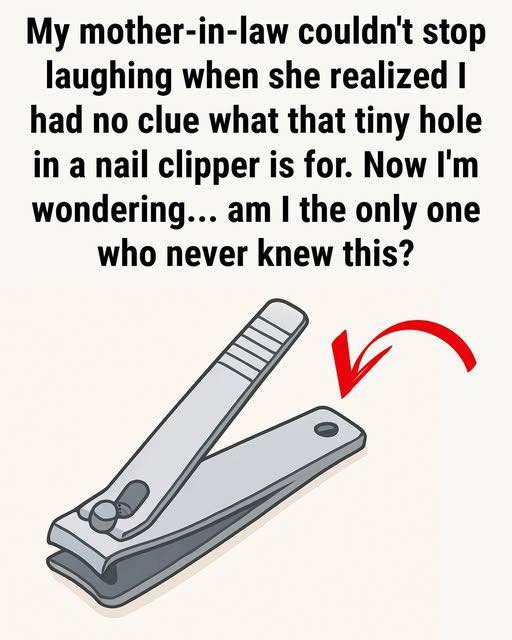
Most people interact with the everyday objects in their lives without ever pausing to consider the intricate engineering behind their design. We move through our grooming routines on autopilot, reaching for tools that have remained virtually unchanged for generations. Among them, the humble nail clipper stands as a quiet triumph of minimalist functionality. It is so ubiquitous that it can be found in nearly every household across the world, yet it contains a small design feature that most users overlook or misunderstand. Every time you trim your nails, you likely notice it—a tiny, perfectly round hole punched into the end of the handle. While many assume it is purely decorative or a byproduct of manufacturing, the truth is far more interesting. This small aperture is a testament to thoughtful engineering, designed to solve practical problems of accessibility, organization, and longevity.
The primary purpose of this hole is rooted in convenience and storage. Nail clippers are small, smooth, and notoriously easy to misplace, often slipping into the depths of bathroom drawers or disappearing inside travel bags. In a world where efficiency matters, designers recognized that a lost clipper is a useless one. The hole provides a universal attachment point, allowing the tool to be secured to a keychain, lanyard, or storage ring. This simple feature transforms a standalone object into a portable accessory, ensuring it remains within reach for travelers, students, or busy households. By allowing the clipper to be hung on hooks or tethered to other items, the design eliminates the frustration of searching for it when it is urgently needed.
Beyond portability, the hole offers several subtle but useful secondary functions. For those focused on hygiene, it allows the clipper to be hung on bathroom hooks, keeping it away from damp surfaces where bacteria may accumulate. It can also provide an unexpected ergonomic advantage: individuals with reduced grip strength or those trimming nails at awkward angles can insert a finger through the hole for added stability and control. This improves precision and safety during use. Additionally, the hole allows users to organize multiple clippers on a single ring, separating fingernail and toenail tools for better hygiene and more efficient access.
To fully appreciate this feature, it helps to consider the historical evolution of grooming tools. In the late nineteenth century, during the rise of industrial manufacturing, inventors sought to create tools that were practical for increasingly mobile lifestyles. Before modern storage solutions existed, personal items needed to be easy to carry and secure. Early designs of nail trimmers included such holes specifically for attachment to watch chains or travel kits. The fact that this feature has survived for over a century without significant change is rare in product design. It demonstrates that the hole was never an arbitrary detail, but a lasting solution to a practical problem that remains relevant today.
In today’s market, we are constantly surrounded by “improved” versions of everyday tools—clippers with LED lights, ergonomic grips, or laser-sharpened edges that promise innovation. Yet despite these variations, the classic lever-style clipper with its small round hole remains the global standard. This endurance highlights an important principle of design: true utility rarely needs constant reinvention. Sometimes, the most valuable features are the simplest ones—quiet, unobtrusive elements that perform their function without drawing attention.
The psychological aspect of this design should also not be overlooked. Familiar objects provide comfort, and the standardized shape of the nail clipper reinforces a sense of reliability. The presence of the hole subconsciously signals versatility, inviting users to adapt the tool beyond its primary function. It becomes more than just a grooming device; it becomes something that can be integrated into personal systems of organization and use.
Ultimately, understanding the purpose of the small hole in a nail clipper changes the way we view ordinary objects. It encourages a deeper curiosity about the world around us and challenges us to look more closely at things we normally take for granted. In a world dominated by complex technology, the nail clipper stands as a reminder that simplicity can be the highest form of design intelligence. The next time you pick one up, that small opening is no longer just a gap in metal—it is a piece of thoughtful engineering, a historical artifact, and a quiet example of functional perfection.