The narrative of success in the modern world is often told as a steady upward climb—a linear progression from ambition to achievement. However, the saga of Donald Trump defies this conventional structure, unfolding instead as a turbulent epic defined by catastrophic falls and seemingly impossible resurrections. For decades, he stood as a figure living on the jagged edge of public opinion—frequently declared finished, burdened by immense debt, and dismissed by the very elites he sought to surpass. Yet each time the ink seemed dry on the final chapter of his career, he managed to seize the pen, rewrite the story, and emerge not merely restored, but transformed. His journey from Manhattan skyscraper boardrooms to the highest office in the United States is often cited as a study in persistence, branding, and the force of a personality that refuses to accept defeat.
To understand the resilience that would eventually shock the world, one must return to the competitive crucible of his early years. Raised in an environment where business was framed as a battlefield rather than a marketplace, he developed a mindset that prioritized dominance and visibility above all else. This foundation shaped a commercial philosophy in which the appearance of success was nearly as important as the outcome itself. He learned early that in the court of public perception, the figure who projects the greatest confidence often wins the negotiation. It was never just about constructing buildings—it was about constructing a persona capable of enduring market volatility and public scrutiny.
When he arrived on the New York scene, he did not simply build a business empire; he constructed a public brand that became synonymous with extravagant ambition. The Trump name was stamped across skylines in gold and brass, representing a vision of success that was deliberately loud and unmistakable. In the competitive world of New York real estate, visibility itself became a form of currency. He understood that invisibility was more dangerous than criticism. By transforming his name into a global brand, he ensured that even when his projects faced scrutiny, his relevance remained intact. He became a constant presence in tabloids and on television—a figure simultaneously ridiculed and unavoidable.
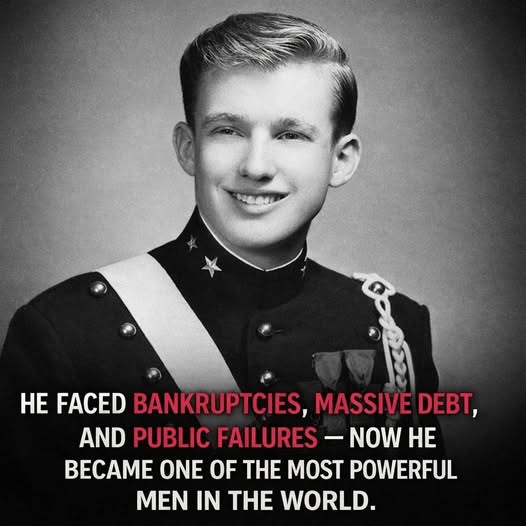
The true test of this confidence came when the financial foundation beneath him collapsed. The 1990s brought severe setbacks, including overwhelming debt and high-profile bankruptcies that would have ended many careers permanently. He was dismissed by much of the financial establishment, his reputation heavily damaged. Yet it was during this period of apparent ruin that his capacity for reinvention became most visible. Rather than relying solely on financial recovery, he leaned on the value of his brand. He convinced creditors that the Trump name was more valuable intact than dismantled. Through persistence and an ability to project strength even under pressure, he navigated the crisis and maintained his place in the global business landscape.
The turning point that ultimately led to the presidency did not come from real estate, but from television. His transition into reality TV with The Apprentice marked a fundamental shift in his public identity. No longer just a developer, he became a nationally recognized figure portrayed as decisive, authoritative, and uncompromising. The role reshaped his image for a new era, reinforcing his persona as a man of action who disregarded traditional decorum. The show provided him with a direct connection to millions who felt disconnected from polished political messaging.
This level of visibility became the foundation for his entry into politics—a move initially met with widespread skepticism and dismissal by the political establishment. However, he entered the arena with an unconventional strategy that bypassed traditional gatekeepers. His campaign became a phenomenon of media dominance and rhetorical disruption, challenging expectations of how political campaigns are supposed to function. He tapped into a significant portion of public sentiment that felt ignored by the status quo. By the time many recognized the seriousness of his candidacy, the momentum was already irreversible.
His presidency marked a period of intense polarization that divided public opinion both nationally and globally. Supporters viewed him as a disruptor willing to challenge entrenched systems and prioritize domestic concerns over global expectations. Critics saw his leadership as a break from traditional norms of governance and diplomacy, raising concerns about institutional stability. Regardless of perspective, there was no denying that the man once dismissed as a failed businessman had achieved one of the most dramatic reinventions in modern political history. The White House became the ultimate stage for his unique style of leadership.
The arc of rise, fall, and return illustrates how persistence can outweigh perfection in the modern age. It demonstrates how a carefully constructed public image, combined with constant media presence, can shape the trajectory of a life in ways that defy conventional logic. He showed that a major fall is not necessarily final if one has the determination to rise again—and the charisma to reframe the fall as part of a larger ascent. His story stands as a reminder that public narratives are often shaped not by those who follow rules, but by those willing to reshape them.
In the end, the man who lost billions and was widely dismissed became the man who reshaped the narrative of an entire nation. His journey reflects a distinctly American theme of reinvention, where the past remains unfinished and the future is always negotiable. Whether viewed as a symbol of success or controversy, his story remains one of the most striking examples of persistence in modern history. He demonstrated that even when a story appears to end, it can still be rewritten into an entirely new chapter—one that leaves a lasting imprint on history. He did not merely survive financial collapse and debt; he used them as stepping stones toward an ascent few anticipated, proving that the only true failure is the one that is accepted as final.