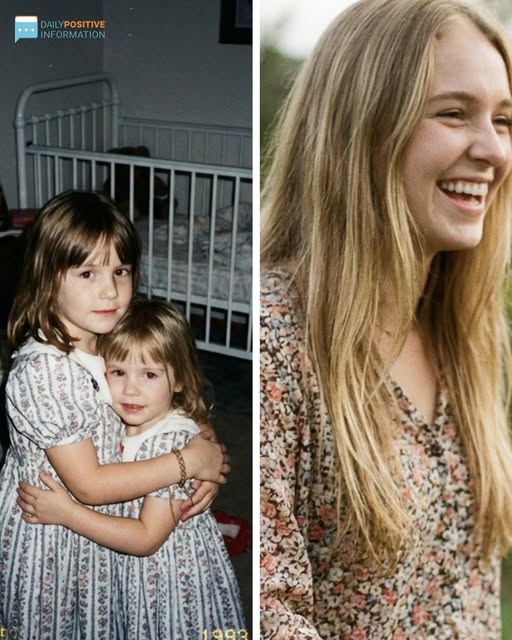
My name is Elena, and when I was eight, I promised my little sister that I would find her no matter what.
For the next thirty-two years, I failed.
The guilt of that broken promise followed me through three decades, two marriages, four cities, and countless sleepless nights, when I would wake up remembering her screaming my name as they pulled us apart.
Until one ordinary business trip—and a random grocery store trip—changed everything.
Growing up in the children’s home, we had nothing except each other
Mia and I grew up in a state-run children’s home in upstate New York. Not a Victorian orphanage with stone walls and cruel headmistresses—just a crowded, underfunded group home where twenty-three kids shared four bedrooms and staff rotated every six months.
We didn’t know our parents. There were no names in our files, no photos tucked away for “someday,” no comforting story of love lost.
Just two narrow beds against opposite walls in a room we shared with four other girls, and a couple of lines in a manila folder that might as well have said, “origin unknown.”
From the moment Mia arrived at two, and I was six, we were inseparable.
She followed me everywhere—down the hallways with peeling linoleum, into the cafeteria where we’d grab the best bread rolls, to the playroom corner where I read to her from books missing pages.
She cried if she woke up from a nap without seeing me, held my hand tightly when strangers came, and slept better if I sang to her—even though I can’t carry a tune.
I learned to braid her fine brown hair with just my fingers because combs were off-limits. I learned which staff would look the other way if I snuck her extra snacks. I learned how to smile and answer questions properly to make life easier for both of us.
We didn’t dream big. We didn’t imagine fancy houses or families. We just wanted to leave together. That was the dream.
Then, one Tuesday in March, everything fell apart
A couple came to tour the home that afternoon. I remember them clearly—the woman in a camel coat with pearls, the man with a deep, confident voice. They looked like people in the adoption brochures.
I was reading to Mia in our usual corner, acting out voices from Where the Wild Things Are. She laughed at my terrible monster impressions.
The couple stopped, whispering to each other. I forced my practiced smile, answered politely, and hoped they wanted both of us.
Three days later, Mrs. Patterson, the director, called me into her office.
“Elena,” she said, her smile too wide, “a family wants to adopt you. Isn’t that wonderful?”
My stomach sank. “What about Mia?”
“They’re not ready for two children right now,” she said. “Other families will come for her. You’ll probably see her again someday.”
“I won’t go,” I whispered. “Not without her.”
Her smile vanished. “Elena, you don’t get to refuse this opportunity. You need to be brave.”
I learned then that “be brave” was adult code for “do what we’ve decided, regardless of how you feel.”
The day they took me, my sister screamed so loud I can still hear it
Two weeks later, the Harpers came for me. I tried everything: begging, refusing to pack, hiding—but nothing worked.
Mia understood immediately. “No! Lena, you can’t go. You promised!”
“I don’t want to go, Mia. They’re making me.”
She wrapped her arms around me, screaming in a raw, desperate voice that made every adult flinch.
“I’ll find you,” I whispered, over and over.
A staff member pried her hands off me, Mrs. Patterson held her back, Mr. Harper guided me toward the door. Mia screamed my name as we left, and that sound followed me for thirty-two years.
My new family gave me everything—except permission to remember
The Harpers were good people. Nice neighborhood, good schools, a bedroom all my own. But my past was off-limits.
“You don’t need to think about the children’s home anymore,” my adoptive mother said. “We’re your family now. Focus on your future, not your past.”
I learned to stop mentioning Mia out loud, but in my head, in dreams, she never stopped existing.
At eighteen, I tried to find her. Sealed file.
At twenty-three, same result. Sealed file.
Meanwhile, I built a life: college degree, marketing career, two marriages, moving cities. From the outside, I seemed fine. Inside, I was still the eight-year-old who couldn’t protect her sister.
Random moments were the worst
Seeing sisters arguing over cereal, or a little girl holding her sister’s hand, would stop me cold. Mia became a ghost I couldn’t mourn.
Then, last October, everything changed
I was forty, divorced, childless, on a business trip to Rochester, New York.
I stopped at a Wegmans for dinner. Walking down the cookie aisle, I froze.
A girl, nine or ten, stared at two packages of cookies. Brown hair in a ponytail, purple jacket. And on her wrist—a thin red-and-blue bracelet.
It was identical to the one I had made for Mia thirty-two years ago.
I approached. “Hey, that’s a really cool bracelet.”
She smiled. “Thanks! My mom gave it to me.”
I asked, trembling, “Did she make it?”
She shook her head. “Someone really special made it for me when I was little. Now it’s mine.”
I looked up. A woman approached—dark hair in a messy ponytail, casual clothes. My chest tightened. Every detail felt familiar.
I said, shaking, “I grew up in a children’s home too. I made two bracelets like that, one for me, one for my little sister.”
The woman froze. “What was your sister’s name?”
“Mia.”
“What’s your name?”
“Elena.”
Her daughter gasped. The woman’s face went pale. “Elena?”
“Yes,” I whispered. “Are you—?”
“Yeah,” she said, tears streaming. “I’m Mia.”
And there we stood, crying in the cookie aisle, her daughter watching, oblivious shoppers giving us space, as thirty-two years of separation finally ended.
We moved our reunion to the tiny, sad café attached to the supermarket.
“Can we talk?” Mia finally asked.
“Not here?” I said.
“Yes. Anywhere,” she replied.
We checked out—I don’t even remember what I bought—and walked to the café. Laminate tables, stale coffee, the kind of place that doesn’t inspire conversation.
We sat at a wobbly table near the window. Lily got hot chocolate, completely absorbed as if she were watching the most important movie of her life. Mia and I ordered coffee that neither of us touched.
Up close, every doubt vanished.
Her nose, slightly crooked from falling off the playground equipment at three. Her long fingers, just like mine. Her nervous, higher-pitched laugh when anxious.
All Mia. Just older.
“What happened after I left?” she asked. “They told me you went to a good family and that was the end of the story.”
“I got adopted by a couple in Connecticut,” I explained. “They moved me out of state and didn’t want to talk about the children’s home or you. When I turned eighteen, I went back. They told me you’d been adopted, your name changed, your file sealed. I tried again at twenty-three. Same answer. I thought maybe you didn’t want to be found.”
Tears filled her eyes. “I was adopted about six months after you left. My last name changed to Morrison. We moved to Pennsylvania, then Ohio, then here. Every time I asked about my sister, they’d say, ‘That part of your life is over,’ and change the subject.”
“When I got older, I tried looking you up,” she continued. “But I didn’t know your new last name or state. I thought maybe you’d forgotten me.”
“Never,” I said firmly. “Not a single day.”
We laughed, that painful, relief-filled laugh that comes from something hurting but also feeling right.
“What about the bracelet?” I asked, nodding to Lily’s wrist.
Mia smiled at her daughter. “I kept it in a jewelry box for years. It was the only thing I had from before. When Lily turned eight—the same age you were—I gave it to her. I didn’t know if I’d ever see you again, but I didn’t want it to disappear.”
Lily held out her arm proudly. “I’m taking really good care of it. See? It’s still perfect.”
“You’re doing an amazing job,” I said, my voice cracking.
We talked until the café workers started mopping and giving us pointed looks.
We shared our lives—jobs, marriages, divorces, cities we’d lived in. Stupid little memories that matched perfectly: the chipped blue mug everyone fought over, our hiding spot under the back staircase, the volunteer who always smelled like oranges and sneaked us graham crackers.
Before leaving, Mia looked at me, tears streaming. “You kept your promise.”
“What promise?” I asked.
“You said you’d find me. You did.”
I cried again. Technically, I hadn’t found her—it was a random business trip and a bracelet—but I understood what she meant.
We hugged, awkwardly, like strangers, yet it felt completely right.
We exchanged every form of contact we could think of—numbers, addresses, emails—as if we needed to anchor ourselves to each other immediately.
Rebuilding a relationship after 32 years is harder than finding each other
We didn’t pretend the missing decades hadn’t happened.
We started small: texts during the day, calls on weekends, photos of our lives. The first video chat ended with both of us crying for ten minutes straight.
We’re still figuring it out. We’ve built lives apart, now trying to stitch them together without unraveling what already exists.
Mia lives in Rochester with her daughter; I live in Philadelphia. We visit when we can—Christmas, spring break, long weekends.
It’s not a fairy-tale reunion. She calls me Elena, not Lena. I remind myself she’s not four and doesn’t need me to protect her.
But she’s still Mia. Same expressions, same laugh, still my sister.
Lily asked if I’d come to her school’s family day. I cried for twenty minutes in a hotel bathroom before saying yes.
For thirty-two years, I carried the weight of that failed promise. Now, a new image layers over it:
Two women in a grocery store café, laughing and crying over terrible coffee, while a ten-year-old guards a faded red-and-blue bracelet like the world’s greatest treasure.
Because it is.
That bracelet was the thread connecting us across three decades, the promise that came true in its own time.
I didn’t find my sister through investigators or endless searching. I found her because she kept a bracelet I’d made as an eight-year-old, and she loved her daughter enough to pass it on.
Sometimes promises keep themselves.