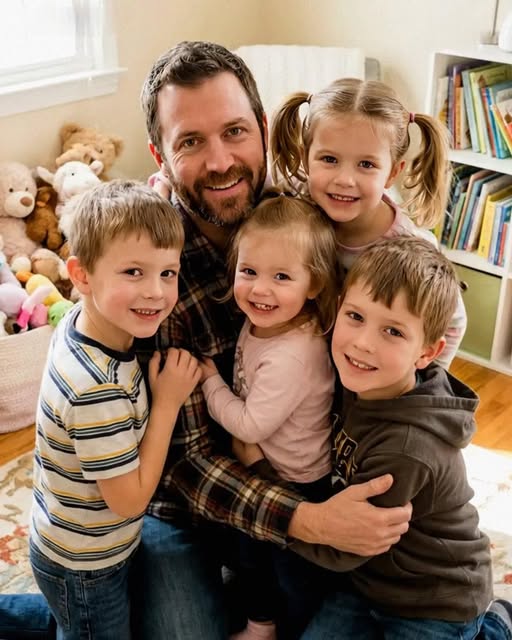
My name is Michael Ross, and for two long years, I lived as a ghost in my own home. My world ended in a sterile hospital hallway when a doctor said those three devastating words: “I’m so sorry.” A drunk driver had stolen my wife, Lauren, and our six-year-old son, Caleb, in an instant. After that, the silence of our house became a physical weight. Caleb’s sneakers still sat by the door, and his colorful drawings were pinned to the fridge, mocking the stillness of a life that had once been so vibrant. I survived on takeout and TV static, sleeping on the couch because our bedroom felt like a tomb. I was forty years old, but I felt like a century had passed since I last felt purpose.
Everything changed at two in the morning on a random Tuesday. While scrolling through Facebook in a grief-induced haze, I saw a post that stopped my heart. It was from a local child welfare agency, featuring four siblings—Owen, Tessa, Cole, and Ruby—huddled together on a bench. They looked less like children and more like refugees of a private war. The caption hit me like a punch: “Likely to be separated.” They had already lost their parents to a car accident; now the system was preparing to split them apart.
I couldn’t sleep. I kept seeing Owen’s arm protectively wrapped around his sisters. I knew what it felt like to walk out of a hospital alone, and the thought of these children being torn apart sparked something I hadn’t felt in years: righteous anger. Before sunrise, I called the agency. I told the social worker, Karen, that I wanted to take all four. Not one, not two—the whole lot.
The process was grueling. I had to prove to therapists and state officials that I wasn’t just trying to fill the hole in my heart left by Lauren and Caleb. I admitted the truth: I was still grieving, but I was still here, and I had a house that was far too quiet. When I finally met the kids in a fluorescent-lit visitation room, the tension was palpable. Tessa, seven, watched me like a hawk. Owen, nine, carried the weight of a father on his small shoulders. I told them simply, “I’m not interested in just one of you. I want all of you.”
The transition was chaotic. My house stopped echoing and started vibrating with spilled juice, stomping feet, and nightmares. Ruby cried for her mother in the dead of night, and I sat on her floor whispering that she was safe. Cole shouted that I wasn’t his real dad during temper tantrums, and I calmly held the line while still acknowledging his feelings. Slowly, “me” and “them” became “us.” I stepped on Legos, burned grilled cheese sandwiches, and learned the complex politics of elementary school. One night, Owen called me “Dad” by accident. He froze in embarrassment, but I felt a warmth settle in my chest, telling me we were going to be okay.
About a year after the adoption was finalized, just as we had settled into our messy, beautiful routine of soccer games and homework, a stranger arrived at my door. A woman named Susan, carrying a leather briefcase, introduced herself as the attorney for the children’s biological parents. My stomach dropped—I feared a legal loophole would take them away. But she pushed aside cereal bowls and revealed a secret that changed everything.
Before their accident, the parents had drafted a detailed will with Susan. Young and healthy, they planned ahead. The will included a trust, a small house, and a modest life insurance payout. But the most important part was their plea: their children must never be separated. If the unthinkable happened, the siblings were to stay together under one guardian.
Susan looked at me with tears in her eyes. “You did exactly what they prayed for,” she said. And she handed me the keys to their original family home—a beige bungalow with a maple tree in the front yard, frozen in time by the trust.
That weekend, I piled the kids into the car without telling them where we were going. As we pulled up to the bungalow, silence fell. Then recognition hit. “I know this house,” Tessa whispered. They ran through the rooms, rediscovering pencil marks on the walls and the swing set in the backyard—a time capsule of their parents’ love.
Owen came to me in the kitchen, wide-eyed. “Why are we here, Dad?” I knelt down and explained that their first parents had loved them so much they planned for their future, even beyond the grave. The house was theirs, and their parents’ greatest wish had been for them to stay together. Owen asked if we had to move back. I told him no—we would keep our current home, and this house would be part of their future.
That night, after tucking them in, I sat on the couch and realized the profound symmetry of our lives. I had lost my family, and they had lost theirs, but from that wreckage, we had built something new. I didn’t save these kids because of a house or a trust fund—I saved them because I knew what it felt like to be alone. The inheritance was just a silent “thank you” from two parents who could finally rest easy, knowing their children were exactly where they were meant to be: together. I am not their first father, and I will never replace the man they lost, but I am the one who showed up when the world wanted to tear them apart. We are a family not by blood, but by a choice made at two in the morning—a bond no system can ever break.