Living in a tiny house reshapes your entire relationship with the space around you. When your home is reduced to only what is essential, the boundary between shelter and the outside world becomes almost invisible. In a conventional house, a sound in the night feels distant—something happening down a hallway, behind another door, on a different floor. But in a tiny house, every noise feels immediate. The wind brushing against glass, the settling of wood, the snap of a twig outside—all of it feels like it is happening right beside you. On a quiet night in April 2026, I discovered that this closeness does not only apply to sound, but also to something far more unsettling: instinct itself.
The night had started in an almost unreal silence. It was the kind of deep, heavy quiet that only exists after two in the morning, when the entire world seems to have stopped moving. I was drifting between sleep and wakefulness when something broke through that stillness. It was faint at first—a soft, repetitive rustling near my window. In daylight, I would have dismissed it as an animal or a branch moving in the wind. But in the darkness, it felt different. Intentional. Unsettling. As if it didn’t belong to nature at all.
I lay still for several minutes, my heart beginning to beat harder with each passing second. I tried to rationalize it, telling myself my mind was exaggerating normal nighttime sounds. But the feeling didn’t fade. It wasn’t sharp fear—it was something quieter, more persistent. A sense that something was off, pressing gently at the edge of my awareness.
Almost without thinking, I reached for my phone. Every movement felt careful, deliberate, as though even the smallest sound might reveal me. I hesitated before dialing, worried I would sound foolish for calling about something so uncertain. But the feeling didn’t go away. I pressed call.
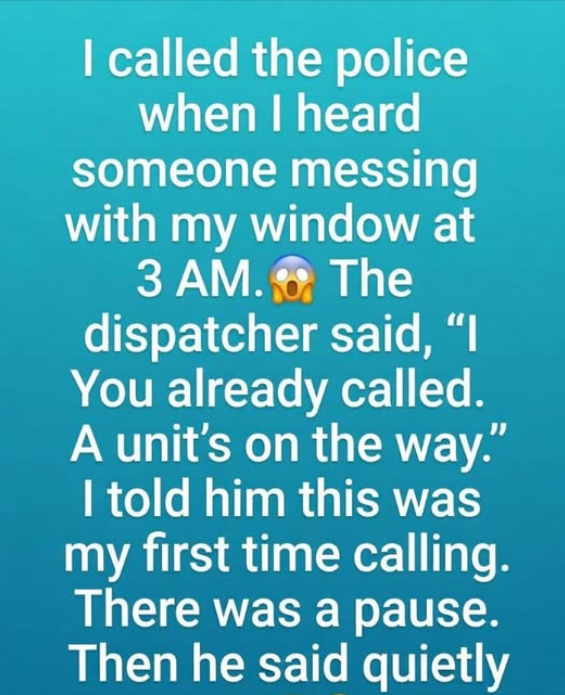
The dispatcher answered with a calm, practiced voice. I began explaining, my words slightly unsteady as I described the rustling and the feeling that someone was outside. I expected routine questions—my location, a description of what I saw. Instead, he interrupted me.
“You already called,” he said.
For a moment, everything inside me went still. I looked at my phone, confused, checking the call log. There was nothing except the current call. I told him I hadn’t called anyone before this, that I had only just picked up the phone.
There was a pause on the line—long and heavy. When he spoke again, his tone had changed. He told me that a call had come in minutes earlier from my exact number. The report described the same rustling at the window, the same feeling of being watched, and a request for immediate assistance. Even more unsettling, the voice and details matched what I was now telling him.
The words didn’t make sense. It was as if the call had arrived before I had made it, as if something had happened slightly ahead of time and left me catching up to it. The dispatcher assured me that officers were already responding based on that earlier call. I stayed on the line, frozen in place, listening to the sound of my own breathing in the dark.
When the police arrived, red and blue lights briefly filled the tiny house, turning every surface into shifting shadows. They searched the perimeter carefully. Near the window, they found disturbed earth—fresh marks suggesting someone had been standing there for some time. But there was no intruder. No explanation for the earlier call. The phone company found no trace of duplication or interference. Officially, the event could not be verified.
But something had been there.
By morning, everything looked normal again. The sunlight came through the window, the house was quiet, and the world behaved as if nothing had happened. Yet something in me had changed. I began to understand that instinct isn’t just imagination or coincidence—it is a form of awareness that works before logic catches up.
We often dismiss those inner warnings because they don’t come with proof. We wait for evidence, for clarity, for permission to trust what we feel. But that night made something clear: awareness doesn’t always speak in facts. Sometimes it speaks in pressure, in silence, in a sense that something is not right long before we can explain why.
Even now, I don’t try to solve what happened in technical terms. I don’t need a perfect explanation for the call or the timing or the gap in logic. What matters is that I listened. I didn’t ignore the feeling that something was wrong.
And now, when the night is too quiet or a sound breaks the stillness, I don’t immediately reach for certainty. I pause. I listen. Because sometimes, understanding doesn’t arrive first. Sometimes, instinct does.