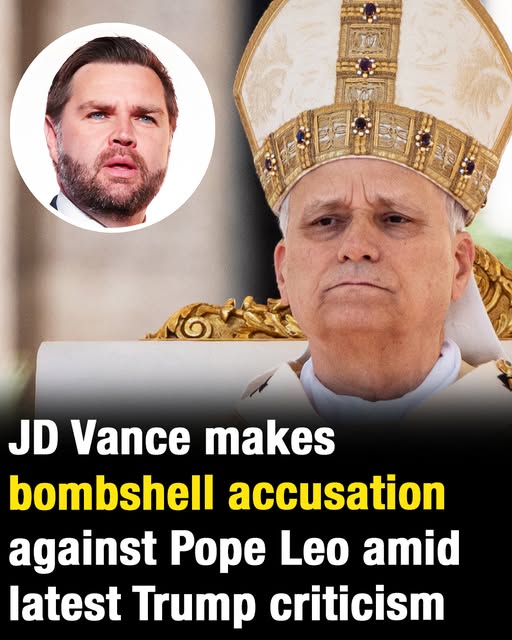
The corridors of power in Washington and the ancient halls of the Vatican have been drawn into a fast-escalating confrontation that is beginning to reshape how political and spiritual authority interact in the modern world. What initially surfaced as sharp public disagreements has developed into a deeper ideological clash over a single, enduring question: where does ultimate authority lie when moral conviction collides with state power? At the center of this unfolding tension is a rare and highly visible dispute involving Donald Trump and Pope Leo XIV, intensified further by controversial remarks from JD Vance. The situation has moved well beyond routine political disagreement; it now reflects a broader struggle over leadership itself, where national interest and religious moral teaching appear to be moving on a direct collision course.
The dispute began when Donald Trump issued a series of pointed criticisms of Pope Leo XIV, accusing him of political naivety on issues such as crime and foreign affairs. The sharpest friction emerged over the Pope’s outspoken opposition to escalating global military tensions, particularly in relation to the Middle East and rising conflict involving Iran. While the Pope maintained his consistent emphasis on peace and the moral costs of war, framing his position as a defense of human dignity, the administration interpreted his statements as an intrusion into sovereign decision-making. The rhetoric intensified further when Trump circulated an AI-generated image depicting himself in a Christ-like form, a move that provoked strong reactions across religious and political communities alike. Supporters dismissed it as symbolic or satirical expression, while critics and theologians viewed it as a troubling merging of political authority with sacred imagery.
The controversy deepened significantly following comments made by JD Vance. As a prominent Catholic convert, his intervention carried added symbolic weight. Vance publicly questioned the appropriateness of direct papal involvement in policy discourse, arguing that the Vatican should confine itself to broad moral reflection while leaving governance to elected leaders. Though framed as a statement about institutional boundaries, his remarks were widely interpreted as a forceful attempt to redraw the limits of religious influence in political affairs. In doing so, Vance highlighted a longstanding tension in Western political thought: the unresolved boundary between moral authority and democratic governance.
From the administration’s standpoint, the argument rests on accountability and expertise. Government officials maintain that decisions involving war, diplomacy, and national security must remain under the control of those elected by the public and responsible for immediate consequences. In this view, religious leaders—no matter how globally respected—do not operate within the framework of electoral legitimacy or classified intelligence, and therefore should not direct or constrain policy decisions. Vance’s position reflects a broader political current that prioritizes national sovereignty and institutional separation over transnational moral authority.
On the other side, the Catholic Church asserts that moral commentary is not only appropriate but essential to its mission. Historically, the papacy has positioned itself as a conscience of global affairs, speaking on behalf of human dignity, peace, and ethical responsibility. From this perspective, Pope Leo XIV’s engagement in geopolitical discourse is not interference but obligation. Silence in the face of war or humanitarian crisis would, in this view, represent a failure of spiritual leadership. The Church’s argument rests on the belief that moral law cannot be subordinated entirely to political convenience, especially when human lives are at stake.
Public reaction has mirrored the broader polarization of contemporary society. Supporters of the administration frame the confrontation as a necessary assertion of political autonomy and national interest, rejecting what they see as external moral lecturing. Critics, however, view the rhetoric as a dangerous erosion of respect for religious authority and a deliberate escalation of symbolic provocation, particularly in the use of sacred imagery for political effect.
What makes this moment especially significant is not simply the disagreement itself, but its visibility and intensity. While tensions between U.S. administrations and the Vatican are not new, the directness of this exchange marks a departure from the traditionally restrained diplomatic tone that has defined such relationships. It reflects a broader shift in global discourse, where institutional boundaries are increasingly tested by public, media-driven confrontation.
At its core, the dispute forces a difficult question into public view: whether moral authority and political authority can coexist without conflict in a world shaped by immediate crises and polarized narratives. Governments operate within the urgency of security and survival, while religious institutions speak in terms of universal ethics and long-term human consequences. When those perspectives intersect, disagreement is not only possible but structurally inevitable.
As the situation continues to develop, the outcome remains uncertain. What is already clear, however, is that the clash between Washington and the Vatican has become more than a political episode—it has become a reflection of a deeper global tension over who has the right to define what is right.