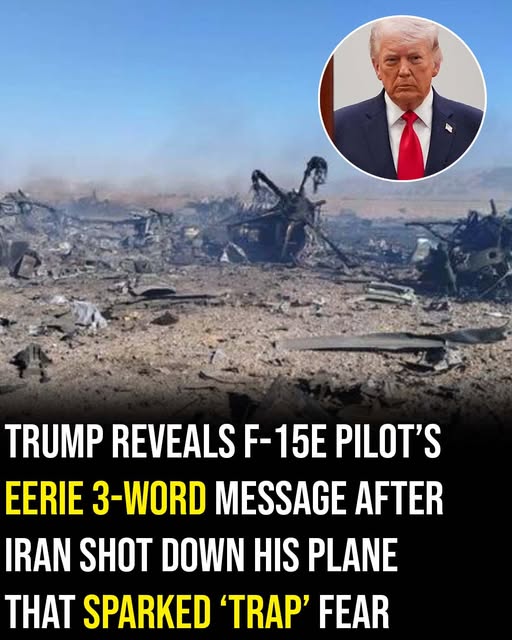
The roar of an F-15E Strike Eagle is normally a pilot’s reassurance—a vibrating confirmation of speed, control, and survival. But over the jagged mountains of Iran, that roar was suddenly replaced by silence and warning alarms, turning confidence into chaos in seconds. A routine mission transformed into a catastrophic descent into hostile terrain, where survival became a matter of minutes and uncertainty.
When the aircraft was struck and began to fall, both crew members were forced to eject into a world that no training fully prepares you for. One was recovered quickly, pulled from the mountains before the dust had even settled. The other—a seasoned colonel—vanished into the rugged terrain, swallowed by cliffs, shadow, and distance. What began as an air mission had become a desperate search-and-rescue crisis, as enemy forces and local militias closed in on the crash site.
Inside a narrow rock crevice, the colonel remained hidden with only a survival radio and a sidearm. Every transmission carried risk; every signal could reveal his position. Below him, search parties moved through valleys, tightening the net. Intelligence reports warned that bounties had been offered for his capture, turning the landscape into a hunting ground. The mountain was no longer terrain—it was pressure, silence, and survival.
Back in Washington, the situation unfolded inside the White House Situation Room. Screens flickered with fragmented data, thermal signatures, and conflicting intelligence. Leaders within the United States government debated a dangerous decision: whether to authorize a Combat Search and Rescue mission deep into hostile airspace, an action that could escalate into a wider conflict.
Then came the transmission.
A short, strained message broke through static—followed by what sounded like a quiet, devout prayer. The room froze. No one could immediately agree on what they had heard. Some believed it was a deliberate trap—enemy forces mimicking a distress call to lure rescue units into an ambush. Others feared it was genuine, the final words of a man alone in the dark.
The uncertainty forced an urgent reassessment. Analysts dug into the colonel’s background, searching for context beyond the signal itself. What emerged was a portrait of a deeply private man of faith. To those who knew him, his spirituality was not performative—it was personal, something he carried quietly rather than publicly. That detail reframed the transmission: not as a coded lure, but as a human response to imminent death.
Still, doubt remained. In modern warfare, certainty is rare, and hesitation can be fatal. Launching a rescue meant risking more lives and potentially igniting a broader confrontation. Waiting meant almost certain capture or death. The decision ultimately collapsed into a single doctrine: leave no one behind.
Units from Special Operations were deployed under extreme risk, flying low and fast to avoid detection. The mission unfolded in darkness, guided by fragile intelligence and shrinking time.
When they reached the coordinates, there was no ambush waiting. No deception. Only the exhausted colonel—still alive, still holding on. He had survived the night not through firepower, but through endurance and belief, clinging to the hope of extraction even as the world above him debated his fate.
The evacuation was swift. Within minutes, he was lifted from the mountains and flown toward safety, away from the hostile terrain of Iran. Back in Washington, tension gave way to exhausted relief.
In the aftermath, the mission became a case study in the limits of intelligence and the unpredictability of human behavior under extreme stress. Technology had tracked signals, heat, and movement—but it could not interpret faith, fear, or intention with certainty.
The incident left behind a lasting lesson: even in an age of satellites and precision warfare, the most critical variable remains human. A single fragmented message—half survival call, half prayer—had nearly altered the course of an international operation. And in the end, it was not just technology or strategy that brought the colonel home, but a decision shaped by trust in the unseen complexities of a human soul under pressure.