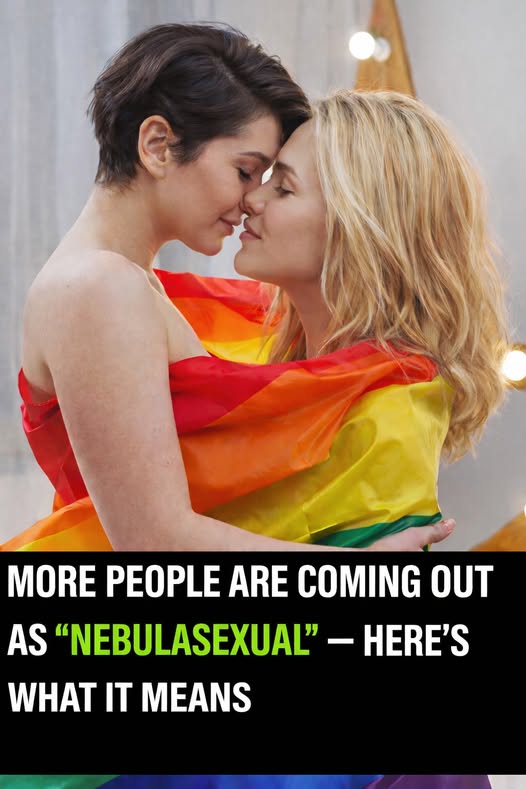
The landscape of human identity is shifting as society moves toward a more detailed understanding of how we perceive ourselves and our desires. While traditional labels have long served as a foundation for orientation, a new wave of terminology is emerging to bridge the gap between neurological functioning and romantic or physical attraction. Among the most discussed is the term nebulasexual, an identity that has sparked widespread debate about the intersection of neurodiversity and sexuality. For individuals living with ADHD, autism, or OCD, the way they process the world is fundamentally different, and many now argue that their experience of attraction is no exception. This shift is not simply about adding another word to the list; it is about validating a specific, “foggy” reality that millions of people experience every day.
To understand the rise of nebulasexuality, one must first examine its etymology and the gap it seeks to fill. Derived from the Latin word nebulosus, meaning cloudy or unclear, the term describes a state in which a person’s neurodivergence interferes with their ability to identify or categorize sexual attraction. It falls under the quoisexual umbrella—a category for people who find the concept of sexual attraction inapplicable, indistinguishable, or impossible to define in conventional terms. For a nebulasexual individual, the question of whether they feel attraction is not a simple “yes” or “no,” but rather a sense of “cannot process,” shaped by the way their brain interprets stimuli. This is not the same as being confused or uncertain in a typical sense; it is a persistent neurological filtering that makes standard neurotypical experiences of attraction feel distant or alien.
The neurodivergent community has been a major force behind the rise of this identity. On platforms like Reddit and Facebook, individuals on the autism spectrum have shared experiences of feeling “broken” because they do not experience the sudden, clear spark of desire that media and society often present as universal. For autistic individuals, sensory processing differences can blur the lines between physical attraction, sensory overload, and emotional connection. A person may feel drawn to someone but be unable to distinguish whether that feeling is sexual attraction, aesthetic appreciation, or a desire for companionship. By adopting the label nebulasexual, these individuals are reframing their experience—not as a failure to meet a standard, but as a different mode of perception. As one user explained online, it provides language for a reality that neurotypical frameworks often fail to capture.
ADHD and OCD also contribute significantly to this complex emotional landscape. People with ADHD often describe experiencing intense hyperfixations on specific individuals or traits. When this happens, the intensity can easily be mistaken for sexual attraction, only to fade once the fixation shifts elsewhere. In this way, the “fog” of nebulasexuality becomes a descriptive tool for understanding fluctuating attention and emotional intensity. Similarly, individuals with OCD may struggle with intrusive thoughts or mental compulsions that make it difficult to separate genuine desire from intrusive mental noise. For them, the term can offer relief by acknowledging that while they may desire relationships, the nature of attraction itself feels unclear or inaccessible in standard terms.
However, like any evolving social concept, nebulasexuality has faced significant criticism. Opponents often argue that the increasing number of identity labels reflects unnecessary overcomplication. Some believe that confusion about attraction is a universal human experience and does not require a specialized or clinical-sounding term. Social media has become a battleground for this debate, with critics referring to what they see as an overwhelming proliferation of labels. At the heart of the disagreement is a deeper philosophical question: is sexuality a fixed biological reality, or a fluid construct shaped by perception and experience?
The relationship between gender, sexuality, and biological sex is central to this discussion. Supporters of new identity frameworks argue that while biological sex is a physical fact, gender and sexuality are shaped by perception and lived experience. From this perspective, each person’s experience of attraction is as unique as a fingerprint. Since neurodivergent individuals literally perceive the world differently due to variations in brain function, it follows that their experience of intimacy and attraction would also differ. In this view, nebulasexuality is not a trend but a necessary expansion of language. As scientific understanding of the brain advances, so too must the vocabulary we use to describe human experience.
The broader implications of this movement are already visible in modern relationships and dating culture. For neurotypical partners, understanding that someone identifies as nebulasexual can shift relational dynamics significantly. Instead of asking, “Why don’t you feel the same way I do?” the conversation becomes, “How does your mind experience connection?” This shift can reduce shame and misunderstanding, especially in relationships involving neurodivergent individuals. Rather than forcing a standardized emotional model, people are increasingly embracing ambiguity and diversity in emotional experience.
Ultimately, the rise of nebulasexuality reflects a growing demand for authenticity in an increasingly complex world. Whether the term remains a niche identity or becomes more widely accepted remains uncertain, but the conversation surrounding it is unlikely to disappear. By challenging the assumption that attraction must be clear, immediate, and easily defined, nebulasexual individuals are encouraging a re-examination of what it means to be human in the 21st century. They argue that even if their feelings are unclear, their identity is still valid. In a world that often demands certainty, they choose to live in the grey—demonstrating that sometimes the most honest way to describe ourselves is to admit that things are a little foggy.