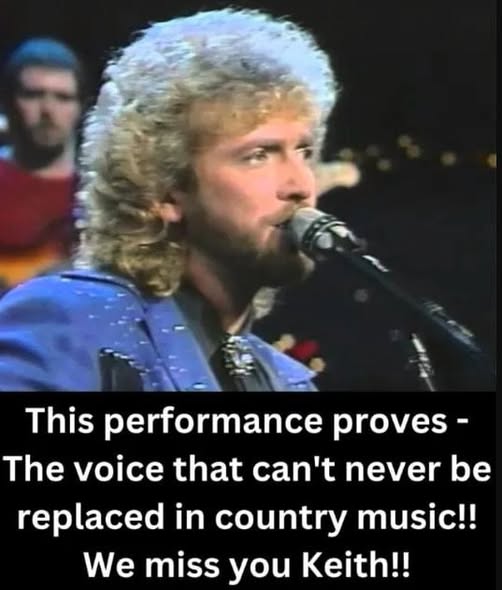
When Keith Whitley sang this song, he had no idea it would outlive him in the way it did. No idea it would quietly transform into an anthem of love, loss, and all the emotions people carry but struggle to express. One understated ballad, simple in its structure and unadorned in its delivery, eventually became something far larger than its original recording. The man was gone at 34, yet the song continued to move through time as if it had its own breath, refusing to fade into silence.
Keith Whitley’s “When You Say Nothing at All” has endured because it doesn’t feel constructed in the traditional sense of a performance. Instead, it feels like a private confession accidentally shared with the world. There are no dramatic vocal flourishes or overwhelming crescendos demanding attention. Instead, there is a quiet, almost fragile sincerity—a voice that feels tired in the most human way, resting gently over a soft and minimal arrangement. That restraint is what gives the song its emotional openness, allowing listeners to step inside it and fill the silence with their own memories.
Part of its lasting impact comes from how personal it feels to each listener. The pauses, the softness, and the simplicity all create space—space for reflection, for memory, for feelings that were never fully spoken. It becomes less of a fixed story and more of a mirror, reflecting whatever quiet moments of love or longing someone carries within themselves. In that way, the song doesn’t just describe emotion; it invites participation in it.
Whitley’s early passing added another layer of meaning that the song itself never explicitly carried. After his death, the lyrics began to feel even more fragile, as though they were not just about romantic stillness, but about time itself—how quickly it slips away, and how much can remain unresolved within it. The idea of unspoken love became intertwined with the reality of an unfinished life, turning the song into something elegiac without ever changing a single note.
Over the years, “When You Say Nothing at All” has continued to find new listeners across generations. It is not treated as a distant relic of country music history, but as something still emotionally present, still relevant. Each new audience discovers it in their own context—first love, heartbreak, reconciliation, or quiet understanding—and finds that it speaks to them as directly as it did decades earlier.
In the end, its endurance comes from its simplicity and emotional honesty. It reminds listeners that some of the most profound connections do not require explanation or elaborate expression. Sometimes, meaning exists most fully in what is left unsaid.