At thirty-three, I had become used to existing as the invisible strand woven through the Shockley family’s carefully curated image. My mother, Patricia, and my sister, Amanda, lived in a world defined by cashmere sweaters, country club luncheons, and a constant performance of success. For years, my work as a physician was reduced to a vague “she works in healthcare,” a phrase my mother used to soften what she saw as my failure to pursue something more “prestigious,” like neurosurgery. In her eyes, I was little more than a glorified babysitter. In reality, I was a high-risk maternal-fetal surgeon, working eighty-hour weeks to stand between life and death for mothers and babies in critical situations.
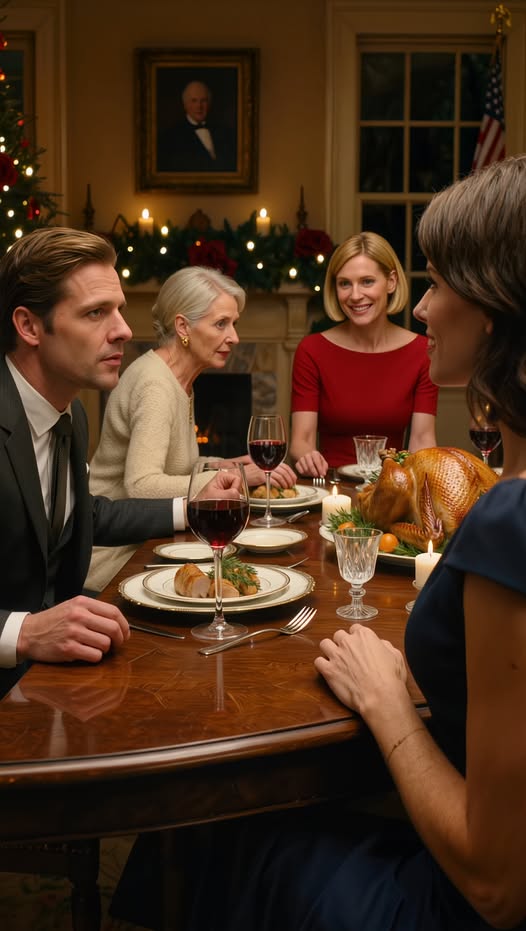
Thanksgiving was meant to showcase Amanda’s new boyfriend, Tyler Hutchinson. He fit seamlessly into the Shockley aesthetic: a commercial real estate developer in a perfectly tailored navy suit, a Rolex glinting with quiet wealth, and an effortless confidence that filled every silence in the room. Around the polished Thanksgiving table set with Lennox china, he entertained everyone with stories of high-value deals and frequent business trips, while Amanda looked at him like a prize she had successfully secured.
I sat at the far end of the table, near the kitchen entrance, half-obscured from the main conversation. From there, I noticed small details others missed—a faint tan line on Tyler’s ring finger, the kind left when a wedding band is recently removed. There was also something familiar about his cologne: Tom Ford Oud Wood. I had smelled it not long ago, though not in a setting like this.
When Tyler eventually turned to me and asked what I did at the hospital, the energy at the table subtly shifted. Before I could respond, Amanda laughed sharply, dismissing me as someone who “hands out stickers to sick kids,” reducing my entire profession to something decorative and insignificant. My mother quickly tried to smooth things over, insisting some topics were better left untouched, as if my work itself was something embarrassing.
I set my wine glass down carefully. The sound cut through the room like a warning. “That’s interesting,” I said calmly, my voice steady in the way it was when I’m in an operating room. “Because Tyler saw me every morning last month. He just never saw me without a mask.”
The room froze. I didn’t stop there. I introduced myself properly—not as a volunteer, not as a nurse, but as an attending maternal-fetal surgeon specializing in emergency obstetric cases. I outlined my training, my surgical experience, and the reality of the work I did: the cases that never made it into casual conversation because they were too serious, too urgent, too real.
“In high-risk obstetrics,” I continued, my eyes fixed on Tyler, “I handle the cases most doctors don’t get to the point of seeing in time. Hemorrhages, uterine ruptures, placental abruptions—situations where minutes decide whether a mother lives or dies.”
Then I leaned forward slightly. “Last October, I had a patient that I still remember clearly. Her name was Jennifer. She came in with a massive placental abruption and coded on the operating table. Her husband was in the waiting room, holding their eighteen-month-old daughter, Lily, not knowing if he was about to lose everything.”
My voice stayed even. “At 2:43 in the morning, I told him both his wife and their newborn son, Noah, had survived.”
The silence that followed was absolute. Even the smallest sounds seemed to disappear. Tyler’s fork slipped from his hand and struck his plate with a sharp clink. His attention shifted completely—not to Amanda, not to the table, but to me—with the dawning realization that the woman being mocked in front of him was the same surgeon who had saved his partner and child just weeks earlier.
My mother tried to speak, to reframe, to repair what had already broken, but there was nothing left to fix. For years, I had been minimized, edited out, and misunderstood in that room. That night, I didn’t shrink to fit it anymore. I wasn’t a stereotype, and I wasn’t an afterthought. I was the person who had kept his world intact while he sat at my family’s table, unknowingly connected to the very life I had fought to save.
As I stood to leave, I understood something clearly: silence can protect people—but sometimes, truth arrives exactly when it is no longer possible to ignore who has been standing quietly in the background all along.