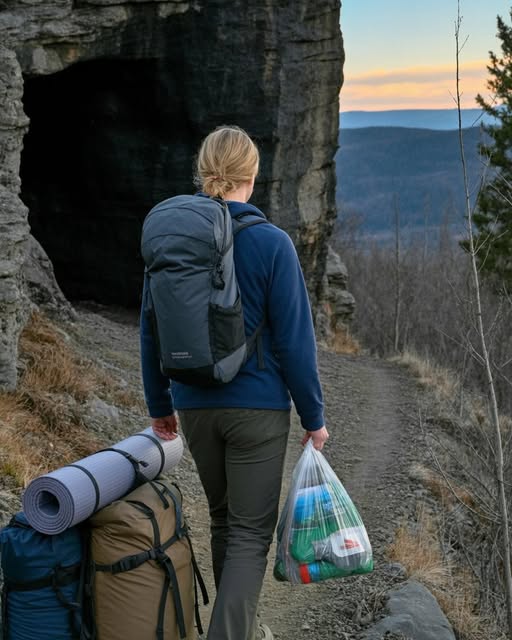
They were not the careless footsteps of someone wandering off a trail or stumbling through unfamiliar ground. They were slow and deliberate, placed with the careful intent of someone who knew exactly where they were going and had already weighed whether they truly wanted to arrive.
Aitana pressed herself against the back wall of the root cellar, holding the metal box tightly against her chest with both arms. The damp earth seeped cold through the knees of her jeans. Her heartbeat was doing something it had not done in eleven years—not the controlled, managed fear of a woman who had survived incarceration by reducing every emotion to its most functional form, but something rawer. Something that belonged to the girl she used to be. The girl who had once trusted people.
She stayed perfectly still.
The entrance to the cellar was a low, arched opening carved into a hillside on what had once been her grandfather’s property, a stretch of high desert land outside Tucson that Don Teodoro Ruelas had worked for forty years and left, in theory, to his family. The gray light of late afternoon formed a rectangle at the opening, just bright enough to silhouette the figure stepping inside.
A man’s shape. Moving carefully.
She saw his face.
“Don’t open it,” said a voice she recognized, rough with age and something deeper. “If you found that box, you’ve already started something you may not be able to stop.”
His name was Jacinto Ruelas. Her grandfather’s foreman for twenty-three years. A man who had once lifted her onto his shoulders at the county fair when she was six and had cried openly, without shame, at Don Teodoro’s funeral. He was older now, more bent at the spine, his beard gray at the edges, but she would have known him anywhere.
He was staring at the box as if it were something he had been watching from a distance for a very long time.
“How did you know I was here?” Aitana asked, rising to her feet.
Jacinto turned his hat in his hands. He looked at the box. Then at her.
“Because I’ve been coming up here for years,” he said. “Making sure it was still buried.”
The cold she felt had nothing to do with the cellar’s temperature.
“What is this?” she asked.
He took a long breath.
“The truth,” he said. “The one that cost you eleven years.”
To understand why she was in that cellar at all, you have to go back six days—to the morning she walked out of the correctional facility’s front gate for the first time since she was twenty-seven.
She had stood on the sidewalk in jeans and a gray jacket that hung slightly loose, her body still carrying the weight loss of years inside. She looked at the street, the sky, and tried to let the openness register in a body trained for eleven years to expect walls. The gate closed behind her with a sound she had imagined countless times. A guard handed her a bus ticket, sixty-five dollars in cash, and a slip of paper listing transitional housing programs.
She did not take the bus.
She had one purpose in Arizona, and it was not transitional housing. She had carried it through every failed appeal, every exhausted conversation with public defenders, every long institutional night when survival itself had become a technical exercise. She had promised herself that once she was free, she would return to the land. Not to reclaim it—she had already been told that was no longer legally possible—but to see it. To stand on it and let the ground confirm what she already knew.
That she had done nothing wrong.
The fraud charges that destroyed her life at twenty-seven had been built on forged documents, selectively presented evidence, and the kind of misplaced trust juries often extend to families who present themselves as victims of the very person they are harming. She had worked as a data entry contractor for Benjamin Cardenas’s notary practice the summer before her arrest. She had signed documents she was told were routine filings, entered records she was told were standard maintenance. She had been, unknowingly, a convenient piece shaped around a crime designed by others.
She had told this to lawyers, judges, and appeal boards. No one had been able to use it.
So she kept it alive inside her for eleven years, like a flame cupped against the wind, and drove back to the high desert to find whatever her grandfather had left behind.
He had owned the land for thirty years before his death, working it with the devotion of someone who understood that a place and the labor poured into it cannot be separated. Aitana had spent her childhood summers there, learning plants, repairing irrigation lines, listening to her grandfather’s stories on the porch, stories that made even small things feel significant. He had loved her in a precise way, attentive to detail, always saying she had her grandmother’s eyes and her great-uncle’s stubbornness, as if those traits were meant to matter.
He died four months after her conviction.
She had attended the funeral in restraints, two officers standing at the back of the church, staring at the silver chain on his burial suit and thinking she would not survive it. She was wrong, but only just.
The root cellar had been a childhood discovery, a hiding place she and her cousins had claimed one summer and guarded fiercely. She never expected it to still be there. She never expected it to hold anything beyond dust, earth, and time.
But the metal box was there, buried beneath a loose stone at the back wall, wrapped in yellowed plastic that still held. She found it with the instinct of someone who has learned that truth, if it exists, is usually small, specific, and hidden where no one thinks to look.
Jacinto lit an oil lamp and placed it on a flat rock. The light softened the darkness.
Aitana opened the rusted latch. The lid gave way with a dry, compressed sound, like something exhaling after a long time.
Inside, wrapped carefully in cloth, were a black composition notebook filled with her grandfather’s handwriting, a manila envelope, a stack of documents held together with a brittle rubber band, and a USB drive tied with a red ribbon.
And one more thing.
A silver chain.
She recognized it instantly—the weight, the length, the small cross she had seen around her grandfather’s neck her entire childhood. Her throat tightened. She set it aside and reached for the envelope.
On the front, in his firm handwriting, it read: For Aitana. Only to be opened if everyone has turned against her.
She opened it slowly.
Don Teodoro wrote with the careful clarity of a man without formal education but with a lifetime of knowing when words mattered. He wasted none.
Aitana, if you are reading this, then what I feared has happened. You must know the truth: you did not forge those documents. You did not steal anything. What was done to you was deliberate, and it was done by people who share your blood.
She read the paragraph more than once—not because she did not understand it, but because understanding and accepting it were two different things.
She kept reading.
Don Teodoro had discovered irregularities in the family’s communal property records months before her arrest. Land recorded as sold without authorization. Signatures that were forged. Transactions she never made. He traced the origin to a scheme involving Benjamin Cardenas, the family’s longtime notary, and two people within the family.
Aitana’s mother, Elvira.
And her brother, Fausto.
She sat down hard on the rock.
“He knew,” she said.
“He found out,” Jacinto replied carefully. “By then, it was already set against you.”
“He could have reported it.”
“He tried.”
“What stopped him?”
Aitana remained still for a long moment after the screen went dark, as if movement might fracture something already irreparably broken. The USB drive rested in her palm, suddenly lighter and infinitely heavier at the same time. Outside the cellar, the desert wind pressed softly against the earth like a living thing trying not to be noticed.
She finally spoke, her voice quiet in a way that didn’t belong to exhaustion so much as containment.
“So they all agreed,” she said. “Not just to lie… but to build it.”
Jacinto didn’t answer immediately. He leaned forward, elbows on his knees, looking at the floor between them as if the answer might be written in the dust.
“Yes,” he said at last. “That’s what it became.”
Aitana let out a short breath that almost became a laugh but didn’t find its shape.
“And they let me rot for eleven years so it would hold.”
Jacinto’s jaw tightened. “They needed a clean story. And you were the cleanest piece in it.”
Silence filled the space again, thick and close.
Aitana looked down at the composition notebook still open beside her. Her grandfather’s handwriting—steady, deliberate—felt now like something speaking from a place far removed from time. Not warning her anymore. Confirming her.
She closed it carefully, as if it might still feel pain.
“He didn’t just document it,” she said. “He prepared it.”
“He knew they wouldn’t stop,” Jacinto replied. “Once they realized he was onto them, they accelerated everything. Your arrest wasn’t the beginning. It was the end of their setup.”
Aitana’s fingers tightened slightly around the USB drive.
“And Teresa?” she asked.
Jacinto hesitated again, the kind of pause that carried weight even before words arrived.
“She was the last loose end,” he said. “She signed the statement. That made her dangerous.”
Aitana nodded slowly, but her eyes didn’t focus on anything in the room anymore. They had gone somewhere further away.
“So everyone who could confirm the truth…” she said.
“Is gone,” Jacinto finished.
That sentence didn’t land like shock. It landed like structure collapsing inward—quiet, complete, and already over before the sound arrived.
Aitana set the USB drive down on the lid of the metal box. Her hands stayed there for a moment afterward, as if they didn’t trust themselves to be empty.
Then she spoke again, softer this time.
“My mother looked at me in court,” she said. “Every hearing. Every appeal. She cried.”
Jacinto said nothing. There was nothing that could sit comfortably next to that statement.
Aitana exhaled slowly.
“She didn’t cry for me.”
“No,” Jacinto said, almost imperceptibly. “She didn’t.”
The lamp hissed faintly as the oil shifted. Somewhere above them, a small sound moved through the desert—wind, or an animal, or the land continuing its indifferent memory of time.
Aitana finally looked up.
“What happens now?” she asked.
Jacinto reached into his jacket and pulled out a folded sheet of paper, placing it carefully on the rock between them.
“I made copies,” he said. “Of everything. The drive. The notebook. The financial records your grandfather tracked. Teresa’s statement. I sent them to someone I trust outside the county system. A journalist who doesn’t forget things.”
Aitana stared at the paper, but didn’t touch it yet.
“And you?” she asked.
Jacinto gave a small, tired exhale.
“I kept a promise,” he said simply. “That’s all I was supposed to do.”
Aitana finally reached forward and picked up the paper. Her fingers trembled only slightly now—not from fear, but from the beginning of something else that didn’t yet have a name.
She looked at him for a long moment.
“You could have buried it again,” she said.
“I thought about it,” Jacinto admitted. “A few times.”
“And?”
“And I kept seeing your grandfather’s face the day he handed me that box. He said, ‘If she comes back, don’t make her alone in it.’”
That landed differently than everything else.
Not like revelation.
Like instruction finally being obeyed.
Aitana folded the paper once and held it.
Outside, the wind shifted again, carrying the dry scent of mesquite and stone and open distance.
For the first time since she had stepped out of prison, she wasn’t thinking about what had been taken from her in isolation.
She was thinking about what had been left behind on purpose.
And what it would cost to bring it into the light.
Fear.
It wasn’t dramatic. It didn’t look like collapse or pleading or anything that would make it easier to dismiss. It was something smaller and more dangerous than that—the moment a person realizes control is no longer on their side of the table.
Fausto adjusted his stance slightly, just enough for someone paying attention to notice. His men noticed. Jacinto noticed too.
Aitana noticed everything.
“You think this ends in Phoenix?” Fausto said, but the edge in his voice had changed. It wasn’t confidence anymore. It was pressure trying to reassert itself.
“It already ended,” Aitana replied. “You’re just watching the consequences catch up.”
Behind him, one of the men shifted his weight. Another glanced toward the trucks, like distance might still be an escape route if things went badly enough.
Jacinto didn’t move, but the rifle stayed steady in his hands. Not aimed. Not lowered. Just present—the kind of presence that didn’t need escalation to be understood.
Fausto looked past Aitana, toward him.
“You’re really going to do this?” he asked. “Over a box you don’t even understand?”
Jacinto’s answer came without hesitation.
“I understand it better than you do,” he said. “Because I understand what it cost.”
A beat of silence followed—heavy, suspended.
Aitana stepped forward slightly, just enough to be seen clearly in the headlights. The wind pushed loose strands of hair across her face, but she didn’t move them away.
“This isn’t a negotiation,” she said. “You don’t get to collect it, you don’t get to erase it, and you don’t get to decide who hears it.”
Fausto’s expression tightened again, but it wasn’t recovery this time. It was containment—barely holding.
“You walk away from this,” he said, “and I can make sure—”
“No,” Aitana interrupted, calm and absolute. “You can’t.”
That simplicity hit harder than escalation would have.
For a second, nobody spoke. Even the men behind him seemed unsure of which direction the ground under them was supposed to tilt.
Then Jacinto spoke again, quieter now.
“The journalist in Phoenix already knows your name,” he said. “She just didn’t know why it mattered yet. That changes tonight.”
Fausto turned his head slightly, like he was trying to locate the point where the situation had slipped past recovery.
“You planned this,” he said.
Aitana almost laughed—not because it was funny, but because it was late.
“No,” she said. “I survived it. There’s a difference.”
The words hung there longer than anything else had.
One of the trucks below idled louder, impatient or uncertain or both. Headlights flickered slightly as someone inside adjusted position.
Fausto looked at her for a long moment. When he spoke again, his voice was lower.
“You really think they’ll believe you over all of us?”
Aitana met his eyes.
“I don’t need them to believe me,” she said. “I need them to see everything.”
That was when Jacinto finally shifted his stance—not aiming, just repositioning, like a man preparing for a decision he had already made years ago but postponed out of obligation.
Fausto noticed.
So did everyone else.
And for the first time since they arrived, the hillside stopped feeling like it belonged to anyone in particular.
Aitana closed her hand around the USB drive again.
Not like holding evidence.
Like holding a beginning.
Some things, when they are finally uncovered, do not need to be opened again to be real.
They only need to exist where no one can bury them twice.
Aitana reached the car without looking back at the root cellar. She didn’t need to. The place was no longer a hiding place now. It was a beginning that had already done its work.
The engine started on the first turn of the key. She sat there for a moment with her hands on the wheel, letting the cold air from outside linger before she closed the door completely. The desert light spilled across the dashboard in pale strips, quiet and indifferent, as if nothing important had ever happened here and nothing ever would again.
But that wasn’t true anymore.
Nothing was buried correctly anymore.
Not the truth. Not the people who tried to hide it. Not the consequences that followed them out of the dark.
She drove slowly at first, following the narrow road down from the property, tires crunching over gravel that had once belonged only to wind and time. The mountains ahead stayed fixed in the distance, steady and patient, as if they had been waiting longer than anyone involved in the story.
Her phone buzzed once in the cup holder.
A message from Renata Cruz.
We’re moving ahead. They’re already trying to discredit it. That means it’s working.
Aitana read it and didn’t respond right away.
Instead, she glanced down at the silver chain beneath her shirt. It rested against her skin with a weight that no longer felt like memory alone. It felt like continuity. Like something that had survived being almost erased.
Behind her, far up the hillside, the root cellar sat unchanged. The lamp was gone. The box was gone. The silence remained—but it was no longer empty.
It was full of everything that had finally been spoken aloud.
She pressed her foot gently on the accelerator.
There would be courtrooms again. Depositions. Articles. Statements that would be picked apart by people trying to reduce them to uncertainty. There would be nights where the past tried to reassemble itself into something easier to endure by forgetting parts of it.
But not anymore on its own terms.
Now it had names.
Now it had records.
Now it had proof that could travel further than fear.
As the road widened and the desert opened around her, Aitana realized something she hadn’t been able to think clearly since the moment the sirens first appeared on the hill:
Justice, when it finally arrives, doesn’t feel like victory.
It feels like motion.
And for the first time in a long time, she let herself move forward without asking permission from the past.