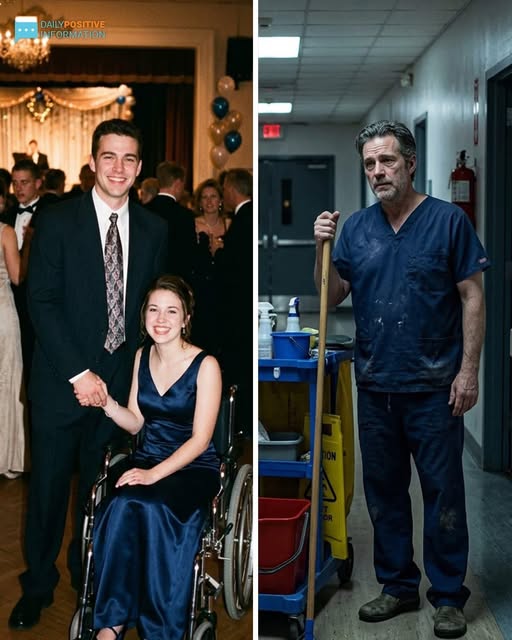
Emily never thought she would see Marcus again.
When she was seventeen years old, a drunk driver ran a red light on a Tuesday afternoon and changed the entire architecture of her life. Six months before prom — six months before she would have been arguing about curfew and trying on dresses with her best friends in somebody’s bedroom with the music too loud — she woke up in a hospital bed listening to doctors talk around her like she wasn’t lying right there in the middle of the conversation.
Her legs were broken in three places. Her spine was damaged. The words the doctors used had a quality she had never encountered before — careful, cushioned, noncommittal. Words like rehab and prognosis and maybe. She was seventeen and she had just learned that maybe was the most frightening word in the English language.
The months that followed were not a movie. There was no triumphant music, no training montage, no single moment where she stood up and everything snapped back into place. There was pain, and paperwork, and the particular exhaustion of being both a patient and a person simultaneously, which turns out to be one of the hardest things a human being can manage.
By the time prom came around, she had already made up her mind.
She wasn’t going.
Her Mother Stood in the Doorway With a Dress Bag and Said Four Words That Changed Her Mind — But Not in the Way You’d Expect
“You deserve one night,” her mother said.
Emily looked at her from the bed. “I deserve not to be stared at.”
Her mother didn’t flinch. “Then stare back.”
That was the whole argument. No tearful speech. No lengthy negotiation about what Emily owed herself or what life still had to offer. Just that — stare back — delivered with the matter-of-fact firmness of a woman who had spent the last six months watching her daughter disappear while still technically being present in every room.
Because that was exactly what Emily had been doing. Disappearing. Showing up to doctor’s appointments and family dinners and physical therapy sessions and being physically located in those rooms while retreating so far inside herself that her actual presence barely registered. She had become very good at being invisible without ever actually leaving.
“I can’t dance,” Emily said.
Her mother came closer. “You can still exist in a room.”
That landed harder than anything else could have. Because it named the thing nobody had named yet — that Emily hadn’t just lost mobility. She had lost her willingness to take up space. And her mother, without ceremony or drama, was telling her to go take some back.
So she went.
Her mother helped her into the dress. Helped her into the chair. Drove her to the gymnasium and helped her through the doors, where the music was already going and the lights were doing that thing gymnasium lights do when someone hangs enough streamers from them and calls it magic.
Emily parked herself near the wall and spent the first hour doing what she had promised herself she wouldn’t do.
Hiding in plain sight.
The People Who Came Over Were Kind — But the Kind That Leaves After the Photo Is Taken
They came in waves, the way people do when they feel obligated and also a little relieved to have somewhere to direct their discomfort. Former classmates who had signed her cast in the hospital and then gradually stopped visiting. Friends who had texted thinking of you so many times the phrase had lost all shape. Teachers who smiled too wide and squeezed her shoulder and said she looked amazing.
She did look amazing. Her mother had made sure of that.
“You look incredible.”
“I’m so glad you came.”
“We need to get a picture.”
And then they drifted back. Back toward the dance floor. Back toward the music and the movement and the ordinary business of being seventeen and healthy and uncomplicated. Emily watched them go each time and understood, without bitterness — well, maybe with a little bitterness — that her presence was a box they had checked, not a place they intended to stay.
She was fine with the wall. She had learned to be fine with the wall. She had spent six months learning to make peace with the edges of rooms because the centers of rooms had started to feel like they belonged to other people.
Then Marcus walked over.
He was not one of her closest friends. He was a boy she knew the way you know people in small schools — by name, by face, by the general shape of his reputation, which was kind and athletic and unremarkable in the best possible way. He was on the football team. He had dated a girl named Caitlin sophomore year. He sat two rows ahead of her in AP History and sometimes borrowed a pen.
That was the full extent of what she knew about Marcus.
He stopped in front of her and smiled.
“Hey.”
Emily actually glanced behind her. Because there was genuinely nobody else in that direction, and the alternative explanation — that he had come to talk to her specifically, on purpose, without being sent over by someone else as a charity mission — seemed so unlikely that she wanted to rule out the obvious first.
He noticed. He laughed softly. “No, definitely you.”
She looked at him. “That’s brave.”
“You hiding over here?” he said.
“Is it hiding if everyone can see me?”
Something in his face changed. Not pity. She had memorized pity’s face over the past six months and could identify it from across a room. This was something softer than that and more direct. “Fair point,” he said. Then he held out his hand. “Would you like to dance?”
Emily stared at him. “Marcus. I can’t.”
He nodded once, slow and deliberate, like he was considering the information and filing it appropriately.
“Okay,” he said. “Then we’ll figure out what dancing looks like.”
What Happened on That Dance Floor Lasted One Song — and She Carried It for Thirty Years
She laughed before she meant to. It surprised her — the laugh, not the offer, though the offer surprised her too. It was the kind of laugh that comes out when the situation is too absurd to process any other way, when someone has done something so unexpected and so earnest that your defenses don’t have time to organize a response before your body reacts honestly.
Before she could build any kind of argument, he wheeled her chair onto the dance floor.
She went rigid immediately. “People are staring.”
“They were already staring,” he said.
“That doesn’t help.”
“It helps me,” he said. “Makes me feel less rude.”
She laughed again. Twice in two minutes — a record for the past six months.
He took her hands. He moved with her instead of around her, which was the difference between inclusion and performance. He learned the chair in real time, without making a production of learning it, adjusting without commentary. He spun her once, then again — slower the first time, faster the second, after he saw that she wasn’t scared. His grin, both times, was the grin of someone who felt like they were getting away with something wonderful.
“For the record,” she said, “this is completely insane.”
“For the record,” he said back, “you’re smiling.”
She was. She could feel it — the unfamiliar pull of muscles she hadn’t used in that particular way in six months. Not a polite, photographed, I’m-doing-well smile. A real one. The kind that happens before you can decide whether it’s appropriate.
When the song ended, he wheeled her back to her table. He didn’t disappear. He sat with her for a while, and they talked about nothing important, which turned out to be the most important conversation she’d had since the accident. Then, before he left to rejoin his friends, she asked the question she couldn’t not ask.
“Why did you do that?”
He shrugged. There was something nervous in it — not embarrassed exactly, but genuine. Unperformed. “Because nobody else asked.”
That was all.
After graduation, Emily’s family relocated for extended rehabilitation programs. Whatever thread might have connected her to Marcus snapped cleanly with the distance, and she assumed that was simply how that story ended. A single good moment. One song. A boy who was kind once, exactly when it counted.
She carried it anyway.
What Happened to Her in the Years After Prom Was Not a Recovery Story — It Was Something Harder and More Honest Than That
Two years. That was the length of the cycle of surgeries and rehabilitation before she reached anything resembling a stable baseline. She learned how to transfer from the chair without falling. She learned how to walk short distances with braces, then longer distances without them. She learned, more slowly than any physical skill, how quickly people confuse surviving with being healed — how once you stop visibly struggling, others assume the internal work is finished too.
It wasn’t finished. It took years beyond that.
She also learned, with the particular anger of someone forced to navigate spaces never designed for her body, how poorly most buildings serve the people inside them. Ramps placed behind buildings beside loading docks. Accessible bathrooms that technically met code but practically humiliated the people who needed them. Entrances designed for compliance rather than dignity. She remembered every one of these failures with the precision of someone who had no choice but to notice.
That anger turned out to be useful.
She studied architecture because she was furious — and fury, she discovered, is an underrated form of fuel. She worked through school, taking drafting jobs nobody else wanted, fighting her way into firms that liked her ideas far more than they liked her limp, spending years learning where the doors were in spaces that kept insisting they didn’t exist for her. Eventually, she stopped asking permission and started her own firm, tired of having to explain why buildings should include the people who use them.
By the time she was fifty, she had achieved more financial stability than she had ever imagined at seventeen, a respected architecture practice, and a reputation for designing public spaces that didn’t quietly exclude entire categories of people.
And yet, she had never stopped thinking about one song at a high school prom.
Three Weeks Ago, She Walked Into a Coffee Shop Near a Job Site and Spilled Hot Coffee — and Then She Really Looked at the Man Who Came to Help
The lid slipped. Coffee spilled across her hand, the counter, and the floor in one sudden wave. She muttered something under her breath that was not meant for public hearing.
A man at the cleaning station turned, grabbed a mop, and walked over.
He wore faded scrubs under a black café apron. She would later learn he had come directly from a morning shift at a physical therapy clinic and worked café shifts afterward — two jobs a day, five days a week.
“Hey,” he said. “Don’t move. I’ve got it.”
He cleaned the spill, grabbed napkins, and asked the cashier to remake her coffee. When she insisted she could pay, he brushed it off, counting coins from his pocket until the cashier told him it was covered.
That was when she stopped watching his hands and looked at his face.
Older now, of course. Life had marked him — tired in the way that comes from constant postponement of rest. Broader shoulders. A permanent limp in his left leg. But the eyes were the same. That same steady attention. That same quiet warmth.
She returned the next day.
He was wiping tables near the window. When he reached hers, she said — as calmly as she could manage for a sentence she had been rehearsing all night —
“Thirty years ago, you asked a girl in a wheelchair to dance at prom.”
His hand froze.
Slowly, he looked up.
Recognition came in stages — her eyes first, then her voice, then the memory locking into place.
He sat down without asking.
“Emily?” he said, like the name had been waiting somewhere for decades.
She Learned What Happened to Marcus After Prom — and It Was Not the Story She Had Imagined
His mother became seriously ill that summer — not a short illness, but one that reshaped everything. His father was absent. Scholarships, plans, and the expected future of an eighteen-year-old disappeared in the face of immediate responsibility.
“I thought it was temporary,” he said. “A few months. Maybe a year.”
He gave a short, tired laugh.
“And then?”
“And then I looked up… and I was fifty.”
He worked whatever jobs he could find — warehouse work, delivery routes, care facility shifts, maintenance, café hours — anything to keep things going. Over time, his knee was damaged and never properly healed, becoming a permanent condition.
His mother was still alive, still sharp, still demanding.
Over time, Emily kept returning. Not forcing anything. Just present. Listening. He spoke in fragments — bills, exhaustion, responsibility, pain that had become normal because it never had time to heal.
When she finally offered help, he refused immediately.
“No.”
“It doesn’t have to be charity,” she said.
“That’s what people always say before it becomes charity.”
She Didn’t Offer Charity — She Offered Work That Needed Exactly What He Had
Her firm was designing an adaptive recreation center. They needed consultants — people who understood physical limitation from lived experience, not theory.
She asked him to attend one meeting. Paid. No conditions.
He resisted. Then hesitated.
What finally shifted him was his mother.
“She’s proud,” his mother told Emily. “And proud men will suffer before they accept help.”
So he came.
One meeting became two. Then he started arriving early.
In the third meeting, he studied the plans and said quietly,
“You’ve made it accessible. But not welcoming. A side entrance by dumpsters is still a side entrance.”
Silence followed.
Then the lead designer said, “He’s right.”
After that, nobody questioned why he was there.
The Medical Appointment She Took Him To Changed More Than His Knee — It Changed What He Believed Was Still Possible for Him
She never pushed him into seeing a doctor. Instead, she simply sent him the name of a specialist and left the choice entirely to him. He ignored it for nearly a week. Then, during a café shift, his knee gave out. Only then did he agree—quietly, almost reluctantly, like a man finally accepting reality—to let her drive him.
The doctor was straightforward. The damage was real, and some of it permanent. But not all of it. Pain could be reduced. Mobility could improve. Life in his own body didn’t have to stay exactly like this—not a miracle, but not hopeless either.
After the appointment, Marcus sat on a low concrete step outside the clinic, staring ahead for a long time.
“I thought this was just how things were now,” he said. “I stopped imagining anything different.”
Emily sat beside him. “It’s how things are now. It doesn’t have to be how they stay.”
He looked at her for a long moment, then said quietly, “I don’t know how to let people help me.”
“I know,” she replied. “I didn’t either.”
That was the real shift. Not the meetings. Not the work. Not even his mother’s approval. Just that moment on the curb—two people quietly understanding each other without needing to explain it.
The months that followed didn’t move in a straight line upward. He doubted the consulting work, then accepted it, then felt guilty for accepting it. Physical therapy left him sore and frustrated. He had to learn how to sit in professional rooms without assuming he didn’t belong there.
But he did belong.
He began helping train staff at the adaptive recreation center when it opened. Later, he worked directly with injured teenagers—young people trying to figure out who they were after losing the identities they once had. He understood them in a way no manual could teach.
One boy told him, “If I can’t play anymore, I don’t know who I am.”
Marcus replied without hesitation, “Then start by figuring out who you are when nobody’s clapping.”
The boy came back the next week. And again after that.
She Found the Prom Photo in an Old Box — and What He Said When He Saw It Changed Everything
Her mother wanted old prom pictures for a family album, so Emily went through a box she hadn’t opened in years. Inside, she found it.
The photo. Her and Marcus on the dance floor. His grin—wide, real, unguarded. Her own expression caught between surprise and something softer she hadn’t expected to see preserved like that.
She brought it to work the next morning without thinking much about it.
When Marcus saw it, he froze.
“You kept that?” he asked.
“Of course I did.”
He picked it up carefully, like it might disappear if he wasn’t gentle enough. After a long silence, he said,
“I tried to find you after graduation. I really did.”
Emily blinked. “You did?”
He nodded. “You were gone. Someone said your family moved for treatment. I asked around.” He paused. “And then my mom got sick… and everything got small very fast. But I tried.”
“I thought you forgot me,” she said softly.
He looked at her, almost confused by the idea. “You were the only person I actually wanted to find.”
Thirty years of timing never lining up. Thirty years of life pulling them in different directions before they had a chance to choose otherwise.
But not everything stayed lost.
They Are Together Now
Slowly. Carefully. Like people who understand that life doesn’t reset just because something finally works out.
His mother is now in proper care. Marcus works with Emily’s firm on accessibility and adaptive design, bringing lived experience into spaces that used to ignore it.
At the opening of the community center they built together, music filled the hall. People moved naturally, without thinking.
Marcus walked across the room toward her.
He held out his hand.
“Want to dance?”
Emily looked at him, then at the space around them—the ramps, the wide doors, the rooms designed for everyone, not just some.
“We already know how,” she said.
And they danced.