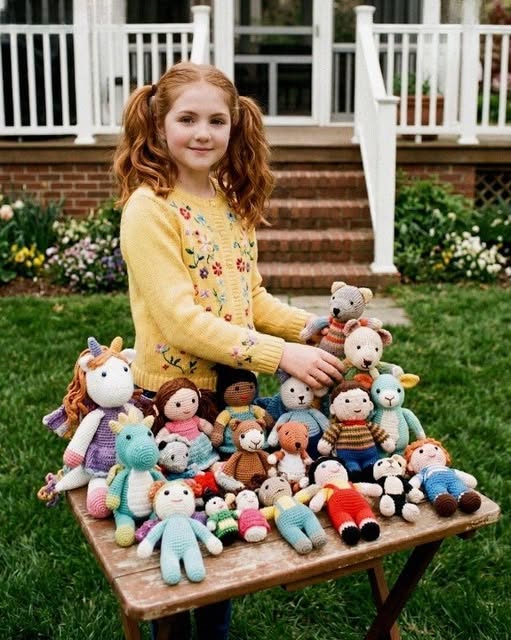
When my daughter set up a small table in the yard to sell the toys she had carefully made, I assumed she was simply trying to help ease the burden of my medical expenses. But everything changed the moment a stranger arrived on a motorcycle. What he revealed was something I could never have expected—and it brought a kind of justice we had unknowingly been denied for years.
Five years ago, hope sounded like Ava’s laughter echoing through the kitchen.
Now, hope looked different. It was my thirteen-year-old daughter sitting quietly, yarn looped around her fingers, her brows furrowed in deep concentration.
She called it crocheting. I saw it as her way of trying to keep our world from falling apart, one small stitched animal at a time.
My name is Brooklyn. I’m 44, a widow, and for the past year, I’ve also been battling cancer.
My husband, David, passed away when Ava was just two years old. He left behind a house, a mountain of bills, and a little girl who still carried the scent of baby shampoo.
From that moment on, it was just the two of us.
His family stepped in briefly after the funeral. For about a week, the house was filled with casseroles, polite offers of help, and hushed conversations that stopped whenever I entered the room.
I was barely holding myself together, overwhelmed with grief and exhaustion, trying to make sense of endless paperwork and legal documents they placed in front of me.
“Just sign here, Brooklyn,” my mother-in-law said, her tone calm but distant, her hands cold. “We’ll handle everything. You need to rest.”
So I signed.
Not because I fully trusted them, but because I didn’t have the strength to question anything.
They promised they would take care of everything.
That was eleven years ago.
After that, they slowly disappeared from our lives. No visits, no calls, no birthday cards—nothing.
When I was diagnosed, I told myself we would manage. Insurance barely covered half of my treatment, and most days felt like trying to drain the ocean with a spoon.
Ava had grown into a thoughtful, creative teenager. She noticed everything—every wince, every untouched meal, every moment I tried to hide the pain.
One afternoon, after coming home from chemotherapy, I found her sitting on the living room floor, completely focused, her tongue slightly peeking out as she worked.
“Did you make that fox yourself?” I asked, lowering myself carefully onto the couch.
She lit up, holding the bright orange toy proudly. “It’s for you, Mom. I wanted it to look cheerful.”
I smiled softly, feeling a brief relief from the exhaustion. “It definitely would brighten anyone’s day.”
Her cheeks flushed with pride. “Really? I keep trying to get the ears right. Grandma said it takes practice.”
“They’re perfect,” I assured her. “And even if they weren’t, I’d still love it.”
Then she showed me more—cats, rabbits, even a turtle with a slightly uneven shell.
“Do you think other people would want them?” she asked.
“I think you’d be surprised,” I said, remembering how she often gifted them to neighbors.
Later that week, I woke from a nap still drained from treatment to the sound of something scraping outside.
Looking through the window, I saw Ava dragging an old folding table into the yard. She carefully arranged her toys in rows, adjusting each one.
She had even made a sign in uneven purple letters: “Handmade by Ava – For Mom’s Medicine.”
I stepped outside, pulling my sweater tighter. “Ava, what are you doing?”
She paused, then said gently, “I want to sell them, Mom. So I can help with your treatment. Maybe if I help, you’ll get better faster.”
My throat tightened painfully. “You don’t have to do that—”
But she hugged me tightly. “I want to. It makes me feel like I’m helping.”
I held her just as tightly. “You’re helping more than you know.”
Soon, neighbors began to stop by, drawn in by her determination. Mrs. Sanders bought several toys, calling Ava the bravest little helper in town.
Even Mr. Todd, who rarely spoke, handed over money for one of her creations.
I kissed Ava’s head and went inside to rest, listening as her soft voice thanked each person.
Then the sound changed.
A deep rumble filled the air.
Through the curtain, I saw a motorcycle pull into our yard. The rider wore a worn leather jacket and a scratched helmet.
I stepped outside cautiously.
Ava spoke first, her voice polite but slightly nervous. “Hi, sir. Would you like to buy a toy? I made them myself. They’re for my mom’s medicine.”
The man crouched and picked up a small crocheted bunny.
“You made these?” he asked.
Ava nodded proudly. “My grandma taught me.”
He smiled faintly. “They’re beautiful. Your dad would’ve loved them. He once made me help him build a birdhouse so crooked birds wouldn’t go near it.”
Ava’s eyes widened. “You knew my dad?”
He nodded slowly. “Yes… I did. And I’ve been trying to find your mom for a long time.”
I stepped forward. “Ava, sweetheart, go inside for a minute.”
She hesitated but obeyed.
The man removed his helmet.
When I saw his face—older, worn, but unmistakable—my breath caught.
“Marcus?”
He nodded. “It’s me.”
I instinctively stepped back. “You don’t get to just show up here.”
Pain flickered across his face. “I know how it looks.”
“Do you?” I snapped. “David died, and you disappeared. Your parents said you left. That you didn’t want anything to do with us.”
“That’s not true,” he said firmly.
I froze.
“I tried to reach you,” he continued. “Letters, calls, visits. They told me you moved. That you didn’t want me around.”
A chill ran through me.
“They told me you abandoned us,” I whispered.
“I didn’t,” he said. “They kept me away.”
Silence stretched between us.
Then he added quietly, “And that’s not the worst thing they did.”
My voice faltered. “What do you mean?”
“Let me come inside,” he said. “You need to hear this.”
Inside, he took in my medications and the scattered bills.
“You’re really sick,” he said softly.
“It’s been a hard year,” I replied.
Ava checked in briefly, then left us to talk.
Marcus placed a folder on the table.
“I found out what they did,” he said.
A lawyer had contacted him months earlier, uncovering irregularities in David’s records.
“They forged your signature,” Marcus said quietly. “They took the life insurance David left for you and Ava.”
I couldn’t even touch the papers.
“No… I signed something,” I whispered.
“You signed some documents,” he said gently. “Not these.”
The realization hit like a wave.
“They watched me fall apart… and still did this,” I said.
Marcus nodded grimly.
When Ava returned, I pulled her close. “It’s okay. This is your uncle Marcus.”
He looked at her with emotion in his eyes. “Your dad was my brother. And you should’ve known the truth a long time ago.”
Ava asked softly, “Did someone lie to you?”
I nodded. “Yes. But we’re going to fix it.”
Over the following weeks, Marcus helped me take legal action.
The truth spread quickly, and soon, everyone knew what had happened.
When we faced my in-laws, they tried to justify everything.
But the evidence was undeniable.
For the first time, they were the ones facing judgment.
Marcus stayed in our lives. He shared stories about David, and together with Ava, they built a crooked birdhouse that made me laugh.
When the settlement finally came, it wasn’t just about money.
It was validation.
Proof that we hadn’t imagined the betrayal.
That Ava’s future could be different.
That night, as I tucked her in, she asked quietly, “Does this mean you’ll get better?”
I stroked her hair. “It means I can finally rest. And you don’t have to carry so much.”
Later, sitting on the porch, Marcus handed me the uneven birdhouse.
“It’s not much,” he said.
I smiled, holding it close. “David would’ve loved it.”
He looked at me, sincere. “I can’t change the past. But I’m here now.”
As the sun set, I realized something simple but powerful.
Ava had started making toys to save me.
But somewhere along the way…
She helped rebuild our life.
And for the first time in years…
I truly believed we were going to be okay.