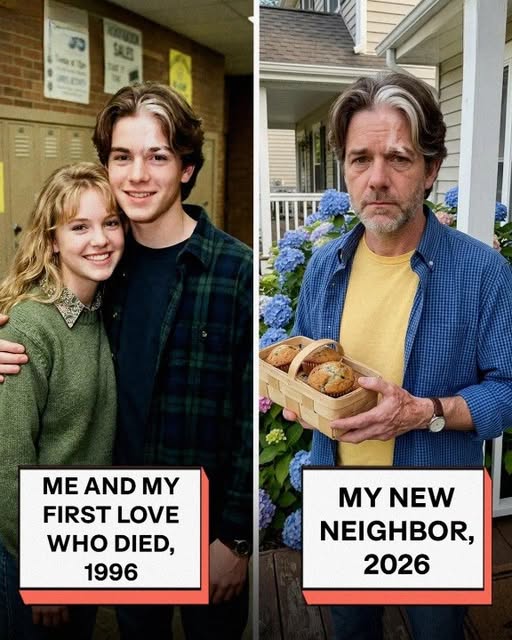
I spent three decades grieving the boy I believed had died in a fire that was meant to take both of us. So when the man next door knocked on my door—and I recognized him instantly, older, marked by time, but undeniably alive—I realized the truth had been buried far deeper than I ever imagined. And for the first time in years, I made a choice: I wasn’t going to run from it anymore. I was going to fight.
If I hadn’t been so stubborn about tending to my hydrangeas, I might never have noticed the man I had buried moving in next door.
That morning, my attention wasn’t on gardening. It was on the fire.
A moving truck was parked in the driveway beside mine. Men carried boxes inside without ceremony, just another arrival in a quiet neighborhood.
But the man stepping out of the driver’s side wasn’t ordinary.
He moved like someone who had carried years too heavy for one body. When the sunlight hit his face, something in me refused to accept what I was seeing.
Same jawline.
Same eyes.
Even the way he leaned forward when he walked, like he was always reaching for something just out of reach.
I went inside too quickly. Locked the door. Pressed my hand against it as if that could steady my breathing.
Three days passed like that—watching shadows through curtains, telling myself I was mistaken, that grief had finally started playing tricks on me in new ways.
On the third night, I found myself at the kitchen table, flipping through an old yearbook until Gabriel’s photo felt worn down by my fingertips.
By the fourth morning, I almost believed it had all been imagined.
Then came the knock.
Three slow taps.
“I’m Elias,” the voice said. “Your new neighbor. Thought I should introduce myself.”
I opened the door just enough to see him.
He smiled politely, holding a small basket.
“Peace offering,” he said lightly. “In case I forget to mow and you report me to the HOA.”
I tried to respond like this was normal.
Then his sleeve shifted.
The skin underneath didn’t match—too smooth in places, too tight in others.
And beneath it, partially exposed—
A scar.
An uneven infinity symbol.
My breath caught.
“…Gabe?”
The smile vanished.
“You weren’t supposed to recognize me, Sammie,” he said quietly. “But now that you have… you deserve the truth.”
My hand went numb on the doorframe. “How are you here?”
He swallowed hard. “That fire thirty years ago… it wasn’t an accident.”
The words didn’t land immediately. They sank.
I opened the door wider. “Come in.”
Inside, we sat at my kitchen table like strangers tied together by something neither of us had consented to carry for thirty years.
He couldn’t look at me at first.
“I don’t know where to begin,” he admitted.
“Start with the fire,” I said. “Start with why we buried you.”
His jaw tightened.
“It wasn’t an accident.”
The air shifted.
“What are you saying?” I asked. “There was a report. A body—”
“My mother controlled all of it,” he said. “The records. The identification. The story.”
I shook my head slowly. “So you’re saying you were declared dead… on purpose?”
“Yes.”
My chest tightened. “But there was a body.”
“There were remains,” he corrected quietly. “But they weren’t mine. The identification was manipulated.”
The room felt smaller with every sentence.
“You let me believe you were gone,” I said.
Something flickered in his expression—pain, regret, something older than both.
“After the fire, I had amnesia,” he said. “Smoke inhalation. Trauma. They said my mind shut parts of it down.”
I clenched my hands together to stop them shaking. “Then why come back now?”
“Because I finally got access to my records,” he said. “Because she can’t control me anymore.”
Hours passed like that—fragments of truth, gaps that refused to close neatly.
When he left that morning, I thought the world might finally stop shifting beneath me.
But it didn’t.
A black car arrived the next day.
Camille stepped out like she still owned every inch of air around her.
“Elias,” she called sweetly, as if nothing had changed. Then her eyes slid to me. “Sammie. Grief can be very persuasive. It makes people see patterns where there are none.”
“I know who he is,” I said.
Her smile stayed in place. Her eyes didn’t.
“Then for his sake,” she said softly, “you should step back. Or he disappears again.”
Gabriel appeared behind me.
“Stop talking about me like I’m not here.”
A week later, he showed me a photograph.
Us—before the fire. Young. Smiling. Tattoos matching on our wrists: infinity symbols.
“I kept this,” he said. “It was the only thing they didn’t erase.”
That was when I understood this wasn’t just about survival.
It was about ownership.
“Did you ever try to leave?” I asked.
“Twice,” he said. “They brought me back. After that… I stopped trying.”
“And you just accepted it?”
“I stopped when they told me you had moved on.”
Something in my chest shifted.
“You don’t have to live like that anymore,” I said. “We can fight it.”
His voice lowered. “She has power. Connections. Money.”
“She doesn’t have the truth,” I said. “And she doesn’t have us working together.”
For the first time, he looked less like a ghost and more like the boy I had lost.
“What do we do?” he asked.
“We expose her.”
Janet arrived within hours, and suddenly the plan had structure—documents, records, journalists, leverage.
When we finally stood outside Camille’s home, I wasn’t afraid anymore.
“You shouldn’t have come here,” she said sharply.
“I’m done being controlled,” Gabriel replied.
I placed the files on the table.
“We know everything.”
For the first time, her composure cracked.
“You think this will end well for you?” she asked.
“No,” I said. “I think it ends honestly.”
Later, as we stepped outside, the weight in the air finally changed.
Gabriel exhaled like he’d been holding his breath for thirty years.
“I couldn’t have done this without you.”
“You didn’t do it alone,” I said.
Janet nodded toward the street. “Now we make it public.”
I looked at him—not the boy I buried, not the stranger next door—but the man who had been stolen and found again.
“Let’s finish it,” I said.
And for the first time in three decades, the past stopped being something that happened to us.
And started becoming something we were finally ready to end.