I moved into my grandmother’s old house after my husband passed away. My son started leaving food for the man next door—and today, that man arrived at my door holding a photograph and telling me he had been searching for me his entire life.
I’m 34 years old. My husband died eleven months ago. My son, Eli, is seven.
After the loss, I couldn’t stay in our apartment. Every corner held him—his habits, his sounds, the small routines that made up our life together. It became unbearable, so I did what people often do when they run out of options: I went backward.
I moved us into my grandmother’s old house.
She had been gone for years, and the house had been sitting empty, occasionally visited by relatives who talked about renovating it someday but never did. When I asked if I could move in, everyone agreed quickly.
“It should stay in the family,” my aunt said.
At the time, I felt grateful.
Then there was the man next door.
In a neighborhood like ours, everyone knows everything but pretends not to. People described him as distant.
“He keeps to himself.”
“He doesn’t like noise.”
“He never comes around.”
But what unsettled me wasn’t his distance—it was the way he looked at me. Not constantly, not openly, but often enough that I noticed. It wasn’t curiosity or irritation.
It felt like recognition.
Then Eli noticed him too.
One day I caught him in the kitchen wrapping part of his sandwich in foil.
“Why are you doing that?” I asked.
Without looking up, he said, “Mr. Larkin eats dinner alone.”
That stopped me. “How do you know that?”
“He told me.”
Just like that.
Outside, he had apparently told Eli to stop kicking his ball near the fence because it scared his dog.
“He has a dog?” I asked.
“He used to,” Eli said.
Something about the way he said it made me uneasy.
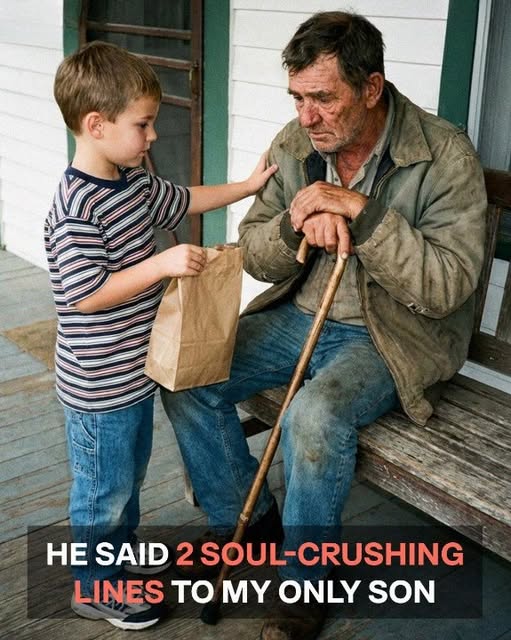
After that, Eli began leaving food on the man’s porch. Half his lunch. Cookies. Fruit. He would place it near a blue flowerpot, knock once, and run back.
The door never opened.
But the food always disappeared.
When I tried to stop him, Eli only said, “I think he’s sad all the way inside.”
I didn’t know how to respond to that.
So I stopped stopping him.
And still, occasionally, I would catch Mr. Larkin watching me with that same unsettling recognition.
Then today, everything changed.
A knock came in the late afternoon. When I opened the door, he was there—pale, shaking, holding an old photograph.
“I’ve been searching for you for years,” he said. “Your son helped me understand.”
The photograph showed my grandmother, a teenage girl, and a young man beside her holding a baby wrapped in a yellow knitted blanket.
A blanket I recognized instantly.
My hands went cold.
“That baby is your mother,” he said quietly.
The world tilted.
What followed came in fragments—truths about my grandmother, about a hidden pregnancy, about a child raised under a false identity, about a young man pushed out of the story and a history carefully buried.
I couldn’t accept it all at once. I went to the attic and searched through what my grandmother had left behind.
Inside an old tin box, I found documents—birth records that didn’t match what I had been told, and letters that confirmed what he said: my mother had been hidden, her identity rewritten, her real father erased from her life.
When I returned downstairs, he was still on the porch. Eli sat nearby, watching quietly.
I confronted him, expecting denial or manipulation. But he didn’t offer either.
He simply said, “I didn’t know the full truth until recently. I thought I had lost everything.”
And for the first time, I believed he wasn’t trying to control the story—he was trapped inside it as much as I was.
The truth didn’t fix anything. It didn’t erase grief or confusion. It only expanded the space I had to carry.
But in the middle of it, Eli looked up and asked, “Is he in trouble?”
I almost laughed through tears. “No.”
Then he turned to the man and asked, “Do you want a sandwich?”
And something in the air broke—not into pain, but into something softer.
Later that night, we sat together in uneasy silence. Not a family yet. Not strangers anymore either.
Just people sitting in the aftermath of a truth that had taken too long to arrive.
And for the first time since my husband died, the house didn’t feel like an escape from my past.
It felt like the beginning of something I hadn’t been able to name yet.