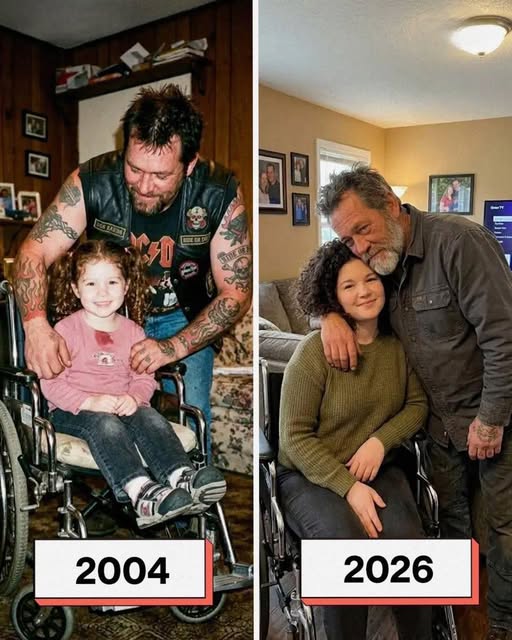
The truth didn’t arrive gently—it exploded in the quiet aftermath of my uncle’s funeral. I sat in his study, surrounded by the scent of old tobacco and the remnants of a man who had devoted thirty years of his life to keeping me alive. On the desk lay a single envelope containing eight handwritten pages. As I read them, everything I thought I knew about my childhood began to collapse, replaced by a version of the past that felt like a crime scene.
For thirty years, I had believed a simple story. There had been a devastating accident that killed my parents and left me paralyzed from the waist down. In that version of events, my uncle was my savior—the man who pulled me from the wreckage, who learned how to care for me when I could no longer care for myself, who fought hospitals and insurance systems and turned me every few hours through endless nights so I wouldn’t suffer further injury. He was my protector, my constant, my hero.
But the letter fractured that narrative completely. In his own handwriting, my uncle admitted what he had never said aloud. He hadn’t simply arrived after the tragedy—he had been present before it. On the night everything changed, he had watched an intoxicated man take his car keys and leave. He could have intervened. He could have stopped him. Instead, he let him go. And that decision set the chain of events in motion that ended in the crash that destroyed my life.
The weight of it was unbearable. The man who had spent decades helping me rebuild my body was also the man who had allowed it to be broken. Every hour of rehabilitation, every painful attempt to regain strength, suddenly felt entangled with his guilt. His devotion hadn’t just been love—it had been penance. He had spent his life trying to repay a moment he could never undo, carrying his shame by carrying me.
In the weeks that followed, I returned to rehab. The treadmill’s steady hum became a backdrop to a mind struggling to reconcile two truths at once. My legs trembled not just from exertion, but from everything they now represented.
Forgiveness didn’t come as a single decision. It came slowly, in fragments. In the garden he had tended for me. In the memory of his uneven attempts at braiding my hair when I was a child. In the realization that whatever his motive had been at the start, his care had been consistent, physical, and real. He had spent decades trying to repair a moment he could never change.
I am still learning how to move forward. I don’t erase what he did, and I don’t excuse it. But I refuse to let it define every step I take now. I carry a complicated inheritance—one where love and guilt are tangled together, where a person can be both the source of your deepest loss and the reason you survived it.
The past cannot be rewritten. But I am no longer standing still inside it.