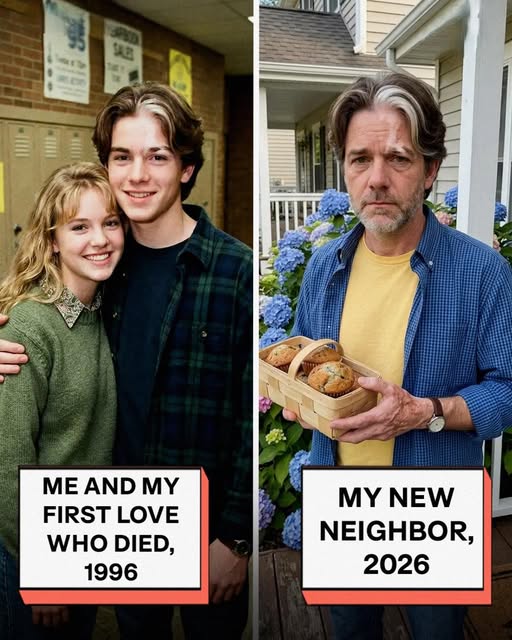
If I hadn’t been so fixated on my hydrangeas, I might never have noticed the “dead man” moving in next door. A moving truck sat in the driveway—nothing unusual for our quiet suburb—until the driver stepped out. The way he moved, slightly hunched and hurried in a way I hadn’t seen in decades, made something in my chest tighten. I spent three days behind my curtains, half convinced I was losing my mind. I kept pulling out my old yearbook, staring at the face of a boy named Gabriel, who had supposedly died in a house fire thirty years ago.
On the fourth morning, there was a knock at the door—measured, careful. When I opened it, a man stood there introducing himself as Elias. He offered a basket of muffins like it was the most normal thing in the world. But when his sleeve shifted as he reached forward, I saw it: skin stretched tight and uneven from severe burns, and beneath it a distorted tattoo in the shape of an infinity symbol. It matched the one Gabriel and I had gotten as teenagers.
“Gabe?” I whispered, his old name slipping out like a prayer. His expression changed immediately. He told me he hadn’t planned for me to recognize him, but that I deserved the truth.
The fire thirty years ago, he said, hadn’t been what anyone believed. Gabriel’s mother, Camille, had engineered an elaborate deception to separate us, convinced that I wasn’t worthy of her son. She had used falsified dental records to misidentify remains and quietly removed him from the country, sending him to Switzerland under the guise of severe trauma recovery and memory loss.
For three decades, Gabriel lived as “Elias,” monitored by private nurses and controlled by lawyers, his identity carefully managed and rewritten. Every attempt he made to reclaim his past was met with new restrictions or the reassurance that I had long since moved on. Camille controlled his medical records, his inheritance, even his name.
But something had finally changed. Gabriel had regained access to his documents and escaped the tightly controlled life she had built around him.
The confrontation came faster than we expected. A black sedan rolled into the cul-de-sac while we stood in the yard. Camille stepped out with the same cold composure I remembered from years ago. She immediately tried to frame him as unstable, warning me to stay away and threatening that he would disappear again if I interfered.
But I wasn’t the same girl she had once intimidated. “I know who he is,” I said firmly.
Gabriel stood beside me, shoulders straight for the first time in years, and told her he was done being erased. In that moment, we chose to fight back together.
With the help of my friend Janet, we began gathering proof of Camille’s decades-long manipulation—documents, medical inconsistencies, financial control, and the trail of Gabriel’s hidden identity. We moved quickly, preparing to bring everything before the board of the pharmaceutical company she had kept him from leading.
When we confronted her at her home with news of an emergency board session, her composure finally cracked. For the first time, she saw that the story she had built could no longer contain the truth.
As the doors closed behind her, Gabriel let out a breath that sounded like it had been held for thirty years. The past no longer owned him—or us. We weren’t just survivors of something that had been taken from us; we were people reclaiming what had been stolen. I held his hand, knowing the fight wasn’t over, but for the first time in decades, the man I had lost was no longer a ghost next door.