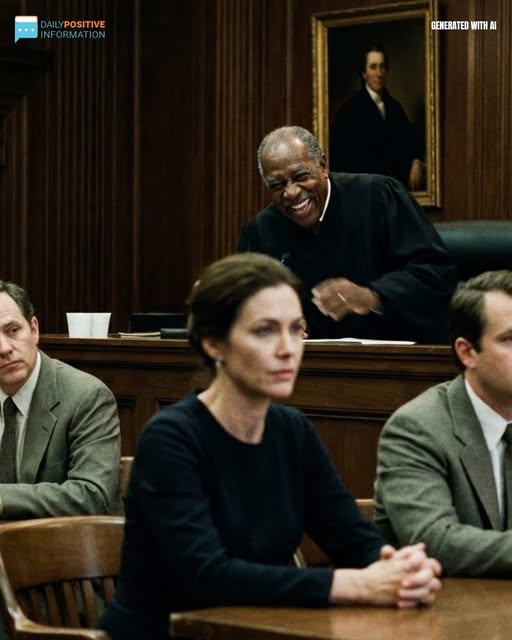
The mahogany rail of the witness stand felt cool and slick beneath my sweaty palms. I pressed my fingers into the wood until my fingertips blanched white, using the sensation to anchor myself and stop the tremble building in my body. The courtroom felt like a cavern of beige walls and fluorescent lights, humming with a dull, headache-inducing buzz. It smelled of floor polish, old paper, and that sharp, bitter scent of lives quietly falling apart.
Judge Morrison sat elevated above us, a man with a granite-carved face and eyes that suggested he had witnessed every form of human deceit and found them all equally draining. He looked down over his glasses, his gaze heavy and unreadable.
“Dr. Bennett,” the judge said, his voice low and resonant, filling the silence between the oak tables. “You may proceed with your statement.”
Trevor stood. His movement was smooth, rehearsed, almost elegant. He adjusted the lapels of his charcoal suit—a tailored Italian wool piece I knew had cost three thousand dollars, because I had seen the charge on the credit card statement I had paid off months ago. He didn’t look at me. Instead, he looked past me, at some fixed point on the back wall, as though I were merely a stain on the surface of his carefully ordered life.
“Your Honor, I need you to understand the fundamental incompatibility here,” Trevor began. His voice was calm, deep, and reassuring—the same “doctor voice” he had perfected during residency when delivering bad news to families. It was a voice that said: I understand more than you, so just accept it.
“My wife, Relle… she is a simple woman. A good woman, in her own limited way, but fundamentally simple.”
The word lingered in the air, suspended in the drifting dust caught in the window’s light. Simple. It wasn’t just an adjective—it was a judgment. A quiet erasure of every complex thought, every calculated decision, every sacrifice I had made over six years.
“She works as a nurse,” he continued, a faint, pitying curl at the corner of his mouth betraying his superiority. “She clips coupons on Sunday mornings. She watches reality television to unwind. She has no ambition, no drive to improve herself or elevate her position. When I was a struggling student, buried in books for eighteen hours a day, that simplicity was… comforting. It was a place of rest. But now—”
He finally turned. His hazel eyes, once the ones I had loved most in the world, met mine. There was no warmth there anymore. No memory of the nights I had held him while he broke down from exhaustion before his board exams. Only cold detachment.
“Now I am a physician, Your Honor. I attend galas. I network with hospital administrators and renowned surgeons. I need a partner who can stand beside me in that world, not someone who embarrasses me at professional events by wearing clearance-rack dresses and ordering tap water to save money.”
I didn’t react. Not a blink. Not a flinch. I had rehearsed this moment for months in front of a mirror. My expression stayed still, my breathing controlled, while rage burned quietly in my stomach like a buried coal.
Trevor’s lawyer, Helen Rodriguez, nodded gravely from her seat. Her navy suit radiated expensive authority, and her pearl necklace likely cost more than a semester of tuition. She looked at me with the practiced sympathy of someone delivering a verdict.
“Dr. Bennett has tried, Your Honor,” Helen said smoothly, flipping through a binder. “He offered image consultants. He suggested etiquette classes. He even recommended therapy to help Mrs. Bennett adjust to their new tax bracket. She refused all assistance. She refuses to grow. She prefers to remain stagnant.”
A lie. Clean, polished, convincing—but still a lie.
Trevor had never offered me consultants or classes. He had offered silence, late nights alone, unexplained absences, and eventually, divorce papers handed to me in the hospital cafeteria while I ate a cold tuna sandwich between trauma cases.
“I see,” Judge Morrison said, leaning back as his chair creaked in the quiet room. “And your proposed settlement?”
Trevor straightened his tie—the same silk tie I had bought for his residency interviews years ago, paid for on a credit card I had carefully managed. I could still remember calculating the interest as I bought it.
“A clean break, Your Honor. We rent our apartment, so there is no property to divide. The car is in my name. We have a joint account with about three thousand dollars. I am willing to give Relle half—fifteen hundred dollars. And my blessing for her to find someone more suited to her pace of life.”
“And spousal support?” the judge asked, pen poised.
“Unnecessary,” Trevor said quickly, confidence rising. “She is a registered nurse. She supported herself before marriage; she can do so again. Our marriage produced no children. There is no reason for me to subsidize a life she is fully capable of maintaining.”
I felt the eyes of the courtroom pressing into me. The bailiff looked bored, glancing at his watch. The court reporter typed in a steady rhythm, capturing every word, every insult. In the back row, Vanessa Hunt sat like a queen on a throne. She wore a cream-colored cashmere dress that looked like it would stain if even the air touched it wrong. She caught my eye and offered a small, pitying smile—the kind you give a stray dog you have no intention of ever feeding.
“Mrs. Bennett,” Judge Morrison said, turning his heavy gaze toward me. “You have been very quiet. Do you have a response to your husband’s characterization of your marriage?”
I stood and smoothed the skirt of my red dress. Trevor hated this dress. He said it was too loud, too cheap, too “waitress at a diner.” Today, I wore it like armor. It was the color of blood. The color of a warning.
“Your Honor,” I said, my voice steady—surprising even myself. “I don’t have a prepared speech. I am, as my husband said, a simple woman. But I do have documents I would like the court to review.”
I walked forward. My heels struck the floor like a metronome counting down something inevitable. I handed a thick envelope to the bailiff, who passed it up to the judge.
“These are financial records from the last six years,” I continued, my voice carrying clearly through the room. “Along with several legal documents that I believe clarify the true nature of our… partnership.”
Judge Morrison opened the envelope and slid out the contents. He adjusted his glasses and began reading.
Silence settled over the courtroom. The only sound was paper turning—page after page after page.
Trevor shifted beside his attorney. He leaned in and whispered something to Helen. She barely reacted, just gave a small shrug and glanced at her phone beneath the table. They thought this was desperation. A wife scrambling for alimony. They thought I was handing over grocery receipts.
But the minutes kept passing. Five. Ten. The air in the room grew heavier, charged—like it was waiting for something to break.
Then the judge stopped.
He held up a single sheet of paper between his fingers. He studied it, narrowed his eyes slightly, then looked directly at Trevor.
And then he laughed.
It was not a warm laugh. It was short, dry, disbelieving—like something breaking loose in spite of itself. He covered his mouth, but his eyes betrayed him, sharp with incredulity and dark amusement.
“I apologize,” Judge Morrison said, clearing his throat as the faintest smile remained. “In twenty years on this bench, I thought I had seen every form of arrogance. But this… Dr. Bennett, this is remarkable.”
Trevor stiffened. His composure cracked just slightly. “Your Honor? I don’t understand.”
“Sit down, Dr. Bennett,” the judge said sharply. “We will take a thirty-minute recess. I need to review these figures in detail. And I strongly suggest you use that time to consult your attorney about the legal definition of a promissory note.”
Trevor’s face drained of color. “A promissory note?”
But the judge was already standing, gathering my documents with an unexpected protectiveness that made my chest tighten.
I turned and walked back to my seat. I didn’t look down. I looked straight at Trevor.
He looked like a man who had just realized the floor beneath him had already been removed.
I sat, folded my hands over my lap, and waited for the collapse.
The Night the Deal Was Struck
To understand why I was sitting in that courtroom holding the detonator to my husband’s life, you have to go back six years. Back to the antiseptic smell of County General’s break room, to stale coffee and exhaustion so deep it lived in your bones.
I met Trevor when he was nobody.
He was twenty-seven, a pre-med student on a gap year because he was broke. He came into the ER with a roommate who had sliced his hand open during a party they couldn’t afford to be throwing.
Trevor wore jeans torn at the knees—not the fashionable kind, but the kind that come from wearing the same pair until they give out. He looked hungry. Not just for food, but for something larger. A future. A way out. Someone to believe in him.
“I’m going to be a doctor,” he told me that night while I stitched his friend’s hand. His eyes were bright, almost feverish. “I just need to save enough for tuition. My mom helps when she can, but she works at a grocery store in Nebraska. It’s all on me.”
We got coffee the next day. He paid in coins he counted carefully from his car’s cupholder. I pretended not to notice how he sorted them under the table, making sure he had enough for tax. I thought it was endearing. I thought it meant he understood struggle. I thought I was meeting someone with character.
I fell in love with his ambition. With the way he looked at me like I made him feel seen. With the idea of what we could become.
“We’re a team, Relle,” he told me six months later when we moved into my apartment because he couldn’t afford his studio anymore. “I’ll make it big, and I’ll take you with me. You won’t have to work these double shifts forever. You’ll be a doctor’s wife. An easy life.”
I believed him. I wanted to believe him. I needed to believe that all my sacrifices were building toward something shared.
When he got into medical school, reality set in like frost spreading across glass.
We sat at my kitchen table—the one with the uneven leg we kept meaning to fix. The acceptance letter lay between us like something volatile.
“The books are two thousand dollars,” he said, staring down at the syllabus. “Just for the first semester. And the tuition deposit… Relle, I can’t work. They said if I do, I’ll fail. The workload is too intense.”
His voice cracked as he looked up at me, eyes shining with panic. “I have to decline. I can’t afford it. I’ll end up a waiter forever.”
I looked at my savings account.
It was my future.
Fifteen thousand dollars. Money I had built slowly over years of overtime shifts, skipped holidays, missed meals. Money meant for my master’s degree—to become a Nurse Practitioner, to specialize in cardiology.
I looked at him. I saw his dream dying before it had even taken its first breath. And I saw my own dream, still safely sitting in the bank.
“I’ll pick up extra shifts,” I said, the words slipping out before I could stop them. “We can do this.”
“Are you sure?” he asked, looking at me with those wide, grateful eyes. He reached across the table and took my hands. His palms were sweaty.
“I’m sure. We’re investing in us. You get your degree, then I get mine. We take turns.”
“I promise,” he whispered, kissing my knuckles. “I promise, Relle. You carry me now, I’ll carry you later.”
That was the beginning of the erasure of Michelle Bennett.
The Long Grind of Invisibility
For four years, I became a ghost inside my own life.
I worked day shifts. I worked night shifts. I worked weekends. I took holidays—Christmas, Thanksgiving, the Fourth of July—because they paid time and a half. I missed my best friend’s wedding because I couldn’t afford the flight and couldn’t afford to lose the shift.
I stopped buying clothes. I stopped getting haircuts. I dyed my own hair in the bathroom sink to cover the premature grays that stress was bringing in early. I learned to cook beans and rice in a hundred different ways. I became an expert in the clearance aisle, memorizing which days the grocery store marked down meat.
Trevor, meanwhile, lived the life of a scholar.
I paid his tuition. I paid his rent. I paid his car insurance. I paid his gym membership. (“I need to stay healthy to study, Relle—the brain needs oxygen.”) I paid for his high-speed internet. I paid for his professional clothes for clinical rotations—suits I bought on sale while he critiqued the fit, saying the sleeves were a quarter-inch too long.
I kept a ledger. Not because I didn’t trust him—at least, that’s what I told myself—but because I had to know, down to the penny, whether we could afford electricity that month. I needed to know if we were still solvent.
Every receipt went into a shoebox under the bed. Every tuition transfer went into a spreadsheet on my laptop. Every time I swiped my debit card for his textbooks, I wrote it down.
The turning point came in October of his first year. It was raining—cold, relentless Ohio rain that seeped into your bones. Trevor suddenly had to pay an unexpected lab fee and housing costs for a rotation in another city. It was $8,000 we didn’t have.
I had to take out a personal loan. The bank required a signature. My credit was strong; his didn’t exist.
We were sitting at the kitchen table again. The rain hit the window like scattered stones.
“I feel terrible,” Trevor said, pacing the small kitchen floor. “This debt… it’s all in your name, Relle. What if something happens to me? You’ll be responsible for everything.”
“Nothing is going to happen to you,” I said, signing the loan papers. My hand shook slightly. This was the point of no return. I was betting my entire future on his success.
“I want to write something down,” he said suddenly, stopping. “I want to sign something. A promise. Something official so you know I’m serious.”
He opened his laptop and typed it up right there: a promissory note.
It wasn’t casual. It was formal, precise. It stated clearly that Trevor Bennett acknowledged a debt to Michelle Bennett for educational expenses, living costs, and accrued interest, to be repaid within five years of graduation. It even listed an interest rate.
He printed it on our cheap inkjet printer and signed it with a flourish using the expensive pen I had bought him for his birthday.
“Frame this,” he joked, handing it to me. “It’ll be worth a fortune one day. This is my bond. My word is gold, Relle.”
I didn’t frame it. I stared at it, feeling something between relief and dread. Then I placed it in the shoebox with the receipts. And I forgot about it. I was too exhausted to hold onto anything else. I had another double shift in four hours.
The Slow Poison of Success
By his third year, the dynamic had changed. Subtly at first—like a crack in glass—then all at once.
He wasn’t the grateful student anymore. He was the rising star. Dr. Bennett, almost. Top of his class. Favorite of the attendings. His ego expanded like something growing too large for its container, pushing me out of it.
He started criticizing my appearance.
“Do you have to wear those scrubs home?” he’d say, wrinkling his nose when I walked in after a 14-hour shift. “You smell like bleach and hospital. It kills my appetite.”
“I worked twelve hours so you could study,” I’d snap, exhausted. “That smell is the reason you have electricity to read those books.”
“You don’t understand the pressure I’m under,” he’d say, already turning back to his studying. “I’m dealing with complex pathology. Life and death. You’re just… following orders. It’s different. Intellectual versus manual work.”
“Just following orders” stung the most. He wasn’t just dismissing my work—he was rewriting our history.
Then came fourth year. The residency match. And Vanessa.
She was a vascular surgery resident, a year ahead of him. Old money. Her father was a department chair. She drove a Mercedes convertible and wore jewelry worth more than my annual salary. She was everything I wasn’t—polished, effortless, untouchable.
Trevor talked about her constantly. Vanessa said this. Vanessa thinks that. Vanessa knows the best wine bar. Vanessa says I have surgeon’s hands.
“She’s just a colleague,” he said when I asked about texts at 11 PM. “She’s helping me network. You want me to succeed, don’t you? It’s for us.”
He made my discomfort feel like ignorance. Like I didn’t understand how that world worked.
The graduation party was the final break.
I took an unpaid day off. I wore my best dress. I curled my hair. I felt proud. We made it, I thought.
We went to a downtown restaurant with his study group. Vanessa was there in silk and diamonds, glowing with ease.
“So you’re the wife,” she said, looking me over like something outdated. “Trevor says you’re very… frugal.”
“I’m supportive,” I said tightly.
“Right,” she smiled, sipping champagne. “Someone has to keep things grounded while the intellectuals rise. Very 1950s.”
I looked at Trevor. I waited for him to defend me. To say I was the reason he was here.
Instead, he laughed. He actually laughed. And clinked his glass against hers.
“To the intellectuals,” he said.
That night, he ended it.
We got home, and he didn’t even remove his tie.
“I’ve outgrown this, Relle,” he said, standing in the middle of the living room I had paid for and kept alive. “I’m going to be a surgeon. I need a partner who fits that world. Vanessa understands it. She pushes me forward. You… you hold me back. You’re an anchor when I need a sail.”
“I paid for your world,” I shouted. “Every book, every bill, every step of it. I’m not an anchor—I built the boat.”
“And I’m grateful,” he said coldly, checking his watch. “But gratitude isn’t love. It’s a debt. And I don’t want to be married to a creditor. I’m filing for divorce. You can keep the checking account. It’s the least I can do.”
He moved out the next day. Packed his clothes—the ones I bought—into suitcases I paid for, and left for Vanessa’s condo.
The Lawyer Who Smelled Blood
I spent a week crying.
I lay on the floor of the empty apartment and let grief wash over me. I mourned the marriage. I mourned the baby we never had because “now wasn’t the right time.” I mourned the master’s degree I never finished. I mourned the woman I used to be before I became Trevor’s bank account.
Then the tears stopped.
And the math began.
I went to see Patricia Aong Quo.
Patricia was a legend in the city—a shark in a silk blouse, a woman who ate ungrateful husbands for breakfast. Her office smelled of polished mahogany and quiet justice. She listened without interrupting. She studied my story. She examined my spreadsheet. She looked at Trevor’s divorce offer: $1,500.
“This is good,” she said, tapping a manicured nail against the numbers. “You have records. That puts you ahead of ninety percent of clients. Most people don’t keep receipts. They trust. But… it’s tricky. Courts usually treat spousal support as a gift, not a loan. A contribution to the marriage. Unless…”
“Unless what?”
“Unless there’s a specific agreement. A contract. Something proving this wasn’t marital duty, but a financial arrangement. Something that overcomes the presumption of a gift.”
I went still.
The rainy night. The kitchen table. The printer humming. The joke about framing it.
“I have a note,” I whispered.
“What kind of note?”
“A promissory note. He typed it. He signed it. He said it was his bond.”
I went home and tore through the shoeboxes. Panic set in when I couldn’t find it at first. I emptied drawers, pulled apart closets, searched until my hands shook. Finally, tucked inside a cardiology textbook I had once bought him for Christmas—the one he never opened—I found it.
The paper was slightly yellowed, but the signature was still bold and unmistakable.
Trevor Bennett.
I brought it to Patricia.
She read it slowly.
Then a smile spread across her face—calm, sharp, dangerous. The kind of smile that belongs to someone who has just found a fatal weakness in an opponent.
“Oh,” she said softly. “Oh, he is going to regret this.”
She looked at me.
“This isn’t just divorce anymore, Relle. This is breach of contract.”
We spent three months preparing. We calculated everything—tuition, books, rent, food, insurance, interest, inflation, legal fees. Everything.
We didn’t warn him.
We let him file his insulting divorce petition. We let him call me “simple.” We let him build his case on arrogance. We let him walk straight into the trap he didn’t see.
And then we waited for court.
The Trap Snaps Shut
Back in the courtroom, the recess ended.
“All rise,” the bailiff called.
Judge Morrison returned. He didn’t look tired anymore. He looked alert. Focused. Almost eager.
He sat down and placed both hands on the file.
“Dr. Bennett,” he began, his voice filling the room. “I have reviewed the evidence submitted by your wife. It is… exhaustive.”
Trevor stood, suddenly uneasy. He shifted his weight, sweat gathering at his temples. “Your Honor, she just likes to collect documents. She’s obsessive. That doesn’t mean—”
“Silence,” the judge said sharply.
He lifted a document.
“I am looking at a promissory note dated October 14th, six years ago. Signed by you. It explicitly acknowledges funds provided by Mrs. Bennett as a loan to be repaid. Do you deny your signature?”
Trevor hesitated. “I… I signed it to reassure her. She was anxious. It wasn’t meant to be a legal contract. It was just—between spouses.”
“It is a contract,” the judge replied coldly. “It contains offer, acceptance, and consideration. You signed it voluntarily, of sound mind. And in addition, I have reviewed hundreds of messages in which you repeatedly refer to this as a debt, a loan, and an obligation to repay.”
The judge turned a page. The sound echoed through the silent courtroom.
“Mrs. Bennett has provided a forensic accounting of your education,” he continued. “Tuition: $212,000. Living expenses: $96,000. Books, fees, insurance: $40,000.”
He looked up slowly.
“You did not enter a marriage, Dr. Bennett. You entered a funded investment.”
Trevor’s lawyer said nothing. She was already looking down, mentally withdrawing from the case.
“You treated your wife like a venture capitalist,” the judge said. “You accepted her investment, built your career on it, and then attempted to exit without repayment.”
A pause.
“In this court, we do not allow unjust enrichment.”
Trevor’s breathing quickened.
“I am granting the counterclaim in full.”
The courtroom shifted. A sound—small, disbelieving—came from the back row.
“Dr. Bennett,” the judge continued, “you are ordered to pay Mrs. Michelle Bennett three hundred forty-eight thousand dollars in principal, plus interest. Total judgment: four hundred eighty-five thousand, two hundred seventeen dollars.”
Trevor’s chair scraped back violently.
“I don’t have that money,” he said, voice cracking. “I’m a resident. I make sixty thousand a year. That’s—this is impossible.”
“Then I suggest you adjust your lifestyle,” the judge replied. “Sell assets. Work extra shifts. Or consult your partner, Dr. Hunt. I understand she comes from wealth. Perhaps she can support your ambition.”
At that, I turned.
Vanessa’s face had gone pale. Not shocked—calculating. Reassessing. Recalculating him.
Not a man.
A liability.
A debt.
The kind you walk away from.
The judge closed the file.
“Additionally, Mrs. Bennett is awarded full legal fees. Judgment entered. Court adjourned.”
The gavel struck.
It didn’t sound like wood.
It sounded like an ending.
The Collapse of the Narcissist
The hallway was chaos.
Trevor was red-faced, shouting at his lawyer, gesturing wildly.
“You can’t do this, Relle!” he grabbed my arm as I walked past, his grip desperate. “This ruins me! I’ll be paying this for twenty years! I won’t be able to buy a house! I won’t be able to travel! This isn’t fair!”
I pulled my arm free and smoothed the sleeve of my red dress where his hand had been.
“You’re a doctor, Trevor,” I said, smiling. It was a real smile. “You’re smart. You’ll figure it out. You always said you were going to make something of yourself. Now’s your chance to prove it. You wanted the real world? This is it. Debts get paid.”
Vanessa stepped out of the courtroom.
She didn’t wait for him.
She walked straight to the elevator and pressed the button repeatedly.
“Vanessa!” Trevor called after her, running down the hall. “Vanessa, wait! We can fix this! My mom can co-sign! We can appeal!”
She turned slowly. Her eyes were like ice.
“I didn’t sign up for this, Trevor,” she said. “My father warned me about men with debt. You’re insolvent. And frankly… you’re embarrassing. Don’t call me.”
The elevator doors slid shut on her perfect face.
Trevor stopped moving.
For a moment, he just stood there, hollowed out, like something had been removed from inside him.
Then he looked at me.
“I loved you once,” he said quietly, as if it might still unlock something. “Doesn’t that count for anything?”
I shook my head.
“No,” I said. “You loved what I could give you. There’s a difference. And honestly, Trevor… you were right about one thing.”
He looked up, hopeful for a second.
“I am a simple woman,” I said. “I simply wanted what was mine.”
Then I walked away.
The Sweet Taste of Solvency
It took six months for the money to come through.
Trevor tried to appeal, but the promissory note held. It was airtight. He eventually took out a massive consolidation loan, co-signed by his mother—who called me screaming that I was a gold digger, though I hung up halfway through.
When the final deposit hit my account—four hundred eighty-five thousand dollars—I sat in my kitchen and cried.
Not from sadness.
From release.
Six years of exhaustion, sacrifice, and invisible labor lifted off my shoulders in one breath.
I paid off my debts. I cleared my credit cards. I bought a bottle of champagne for a hundred dollars and drank it from a mug because I still hadn’t unpacked my glasses.
And then I kept the promise I had made to myself six years earlier.
I enrolled in a Nurse Practitioner program. Paid in full. No loans. No debt.
I bought a small condo with a balcony overlooking the city. Walk-in closet. Deep soaking tub. Furniture I chose myself—not bargains, not leftovers, not survival purchases.
I heard about Trevor later from a colleague.
He works at a suburban walk-in clinic now, picking up weekend shifts. He drives a used Honda. He looks tired. He’s thinning. He’s still single. He tried to return to the social circles he once moved in, but without Vanessa’s connections—and with a mountain of debt—he’s just another overworked doctor trying to outrun his past.
Last week, I went on a date with a teacher named Martin.
He was kind. He asked questions and actually listened to the answers.
At dinner, he looked at the wine list.
“What would you like?”
“I’ll have the Cabernet,” I said. “The expensive one.”
He smiled. “Celebrating something?”
I raised my glass.
“Just celebrating simplicity,” I said. “And good record keeping.”