What started as a brief moment of cautious relief soon escalated into a wave of outrage, tension, and public confrontation. A fragile ceasefire between the United States and Iran temporarily paused a conflict that had been building for over a month, but the statements exchanged leading up to it have left an impact that extends far beyond the battlefield.
At the heart of the situation was a high-stakes diplomatic effort and a response that quickly cut through political noise.
After weeks of rising hostility, both sides agreed to a two-week ceasefire. The deal followed intense behind-the-scenes negotiations involving several international actors, including officials from Pakistan, who reportedly pushed for restraint at a critical moment. A key condition of the agreement was the reopening of the Strait of Hormuz, a crucial route for global oil transport and international trade.
The importance of that waterway cannot be overstated. Any disruption there sends shockwaves through global energy markets and supply chains, affecting economies worldwide. Its reopening would therefore represent not only de-escalation but also an attempt to restore stability in a highly sensitive region.
Reports at the time indicated that the United States had received a detailed proposal from Iran containing ten conditions for a ceasefire. Officials described the framework as potentially workable, suggesting that despite deep tensions, there remained a possible path toward agreement. Many of the major points of disagreement, according to these reports, had been addressed in principle, leaving room for final talks during the temporary pause.
On paper, it appeared to be progress.
However, the atmosphere around the agreement remained highly tense.
Just before the ceasefire announcement, remarks attributed to Donald Trump sparked widespread criticism. In setting a deadline for Iran to comply, he warned of severe consequences if no agreement was reached, using language that many interpreted as threatening catastrophic destruction. The tone of those comments triggered strong reactions across political and public spheres.
For some, the remarks were seen as a negotiating strategy. For others, they went too far.
Criticism emerged from a wide range of voices, including former supporters, media commentators, and analysts who questioned the implications of such rhetoric in an already unstable situation. The concern extended beyond strategy, focusing instead on what this type of language could mean in a volatile geopolitical climate.
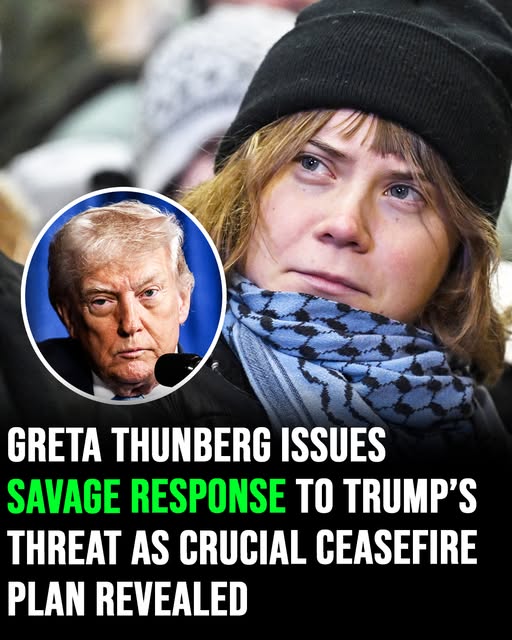
One of the most direct responses came from Greta Thunberg, who is widely known for her climate activism and outspoken criticism of global power structures. In a video shared online, she reacted strongly, expressing frustration and disbelief at the statements.
She highlighted what she saw as the normalization of extreme language surrounding war and destruction, questioning how such rhetoric could be used without immediate global condemnation. Her tone was sharp and unfiltered, reflecting urgency rather than diplomatic restraint.
In her view, the issue was not limited to one leader or one conflict, but part of a broader pattern involving the acceptance of violent rhetoric and its consequences. She connected this to wider concerns about human rights, environmental damage, and unchecked political power.
Her message emphasized a central point: silence in moments like these is not neutral.
Reactions to her comments were divided. Supporters praised her for speaking out and challenging powerful figures, arguing that such voices are necessary during moments of global tension. Critics, however, dismissed her intervention as exaggerated or misplaced, questioning whether a climate activist should weigh in so strongly on international conflict.
Regardless of perspective, the exchange highlighted a growing reality: the boundaries between political decision-making, public discourse, and activism are increasingly overlapping.
This was not the first time Thunberg and Trump have found themselves at opposite ends of a global debate. Their past exchanges have often reflected deep ideological differences, and this moment only intensified that contrast against the backdrop of real-world conflict.
Meanwhile, the ceasefire itself remains fragile.
Two weeks is not a resolution, but a pause—a narrow window for negotiation and reassessment. Whether it leads to a more lasting agreement will depend on factors far beyond public statements or media reactions.
Significant issues remain unresolved, and long-standing mistrust continues to shape relations between the two sides. A temporary halt in fighting does not erase years of tension or disagreement.
Still, for now, the immediate risk of escalation has eased.
That alone carries weight.
However, the controversy surrounding the events leading up to the ceasefire continues to shape how the situation is understood. In moments of global tension, language matters deeply. Words from leaders influence diplomacy, public opinion, and international stability.
In this case, the statements made before the agreement may end up echoing long after the ceasefire itself.
The world continues to watch closely—not only to see what happens next between the United States and Iran, but also to observe how global leaders communicate during moments of crisis. The balance between deterrence and escalation remains delicate, and missteps can have far-reaching consequences.
At the same time, voices like Thunberg’s continue to challenge official narratives, pushing for accountability not just in actions but in language as well. Whether one agrees or disagrees, her response reflects a growing expectation that global discourse be scrutinized as closely as decisions themselves.
As the two-week ceasefire unfolds, attention will turn toward negotiations and outcomes. But the tension, reactions, and controversies surrounding its creation are unlikely to disappear quickly.
Because in a world already under strain, even a temporary calm can feel uncertain—and deeply fragile.