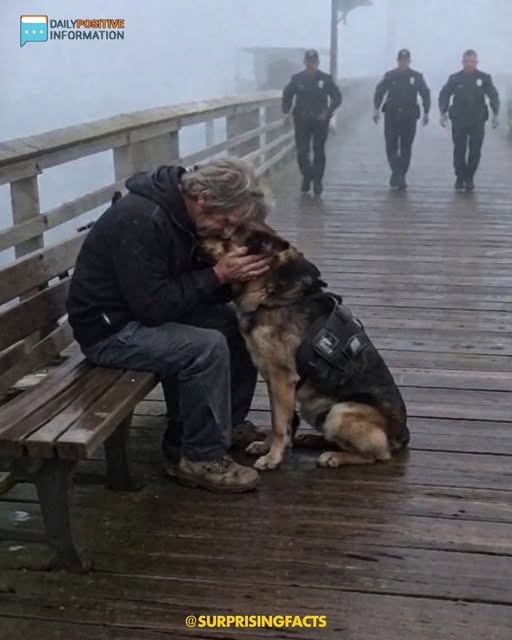
The Santa Monica Pier was waking slowly that morning, wrapped in a thick fog that turned the Pacific Ocean into little more than a faint whisper of waves—audible, but invisible. The old wooden boards were damp and slick, creaking under their own age and the weight of countless footsteps over decades. There were no tourists yet, no street performers, no laughter echoing near the Ferris wheel—only silence, broken occasionally by the distant cry of a seagull cutting through the gray air.
On a weathered bench near the edge of the pier sat an elderly man.
His posture remained military-straight despite the years that had bent so many other parts of him. His name was Ernest Salgado, and even in his late seventies there was something about him that suggested he had once been a man who commanded rooms—who gave orders that saved lives, who carried burdens far heavier than time itself.
Pressed against his leg was a German Shepherd.
The dog lay close, its body perfectly aligned with his side, breathing slow and steady. No leash. No visible collar beneath its thick fur. Yet there was nothing stray or wild about it. Its eyes carried something deeper than obedience—something shaped by experience, loyalty, and memory carved into bone.
Ernest ran trembling, age-spotted fingers through the dog’s fur, feeling the warmth of another living being in a way he had not felt in a long time.
“You’re safe now,” he murmured softly. “I don’t know why you came to me, boy… but you’re safe.”
The German Shepherd closed its eyes for a brief moment, as if those words had unlocked something it had been searching for without knowing.
Then the stillness shattered.
A siren wailed in the distance. Then another. Then several more in quick succession.
The sound tore through the fog—sharp, urgent, and growing closer. Heavy boots struck the wet wooden planks. Radio static crackled. Voices overlapped in controlled chaos.
“There—by the benches near the end!” someone shouted.
Ernest looked up, startled and confused.
Through the mist emerged figures—Los Angeles County Sheriff’s deputies forming a wide perimeter. Three patrol cars blocked the pier entrance, red and blue lights flashing against the gray morning fog. At the front stood a woman in tactical gear, dark hair pulled tightly back, eyes fixed and unblinking.
Commander Valeria Robles, head of the LASD K9 unit.
She stopped about twenty feet away, her attention locked not on the elderly man—but on the dog pressed against his leg.
“There he is,” she said quietly, almost to herself, her hand instinctively moving toward her radio.
The deputies spread out in precise formation. Hands hovered near weapons. One of them, a younger officer named Mateo Rios, stepped forward carefully.
“Sir,” he called out, voice firm but controlled. “I need you to move away from that dog. Slowly. Keep your hands where I can see them.”
Ernest frowned—not in defiance, but in confusion.
Why were they treating him like a threat? Why were their hands near their weapons? What had he done wrong by sitting on a bench and feeding pigeons, finding unexpected company?
At the sound of approaching footsteps, the German Shepherd lifted its head. Its ears flicked forward—alert, focused—but it did not growl or bare its teeth. Instead, it pressed closer to Ernest’s leg, instinctively positioning itself between him and the approaching officers, its body language shaped by training—and something deeper.
Commander Robles’ jaw tightened.
“That dog is an active K9 unit asset,” she announced, her voice carrying across the pier. “His designation is Delta. He disappeared from our training facility approximately ninety minutes ago. If he’s with you, sir, protocol requires us to treat this as a potential incident until we determine otherwise.”
Ernest raised his trembling hands slightly in a gesture of surrender.
“I—I didn’t take him, I swear,” he said. “I come here most mornings to watch the sunrise. He just… he ran straight to me. Like he recognized me or something.”
His voice faded.
Because at that exact moment, Delta gently rested his snout against Ernest’s thigh—not aggressive, not submissive.
Familiar.
Commander Robles raised a hand sharply, halting her team’s advance.
“Prepare for potential hostile response,” she ordered, though something in her expression betrayed uncertainty. “If the dog shows any aggression, nobody moves forward. Understood?”
The tension in the air grew heavy enough to feel physical. A safety catch clicked somewhere in the formation. Radio static hissed. Somewhere in the fog, another seagull cried.
“Commander,” Mateo whispered, eyes wide, “that dog isn’t showing aggression. He’s… completely calm.”
Valeria didn’t look away from Delta.
“That’s exactly what concerns me,” she said quietly. “Delta doesn’t behave like this with strangers. Ever.”
She took a single measured step forward—slow, precise, controlled.
But for the first time in her fifteen-year career, she wasn’t entirely sure who was in control of the situation.
Because some bonds aren’t trained.
They’re remembered.
They’re built in scars, midnight operations, and moments when death was close enough to breathe down your neck—and only one presence stood between you and the end.
When the Command Became a Question Instead of an Order
The fog seemed to hold its breath. Beyond the pier, the Pacific Ocean fell completely silent. Even the wind stopped moving.
But the dog did not attack.
Instead, Delta turned his head toward Commander Robles with an expression that wasn’t fear or confusion—it was something closer to defiance. A silent warning that said: You’re making a mistake.
Then, with sudden certainty, he stepped fully between Ernest and the officers. His paws pressed hard into the wet wood. His stance locked. The fur along his spine rose.
And he growled—low, deep, unmistakable.
Not at Ernest.
At them.
“What the hell…” one of the younger deputies whispered, his hand drifting toward his weapon.
“Delta, heel! That’s a direct order!” Valeria shouted. For the first time, her voice lost a fraction of its control. There was something raw underneath it—alarm.
The dog did not obey.
Instead, he pressed closer to Ernest, shielding him as if the old man mattered more than protocol, training, or the voice of authority itself.
For a brief, chilling moment, everyone understood something unspoken:
The threat in this situation wasn’t the elderly veteran sitting quietly on the bench.
It was the truth they hadn’t understood yet.
Ernest slowly raised both hands higher, palms open.
“Please,” he said, voice shaking not from fear but confusion. “Just… look at him. He’s not doing anything wrong. Neither am I.”
The German Shepherd glanced at Ernest, as if checking he was still there, still safe. Then he turned back toward the armed officers, unwavering.
Valeria swallowed and lowered her weapon slightly. Her trained eyes dropped to the dog’s tactical harness—and noticed something in the morning light.
A scar.
Deep, old, and deliberate in its presence. Not the kind earned in training.
Ernest reached out instinctively, fingers trembling, and lifted part of the harness. He touched the scar.
The color drained from his face.
“No…” he whispered. “That scar… it can’t be…”
Mateo frowned, easing his grip on his weapon. “Sir? Do you know this dog?”
Ernest struggled to breathe.
“I had a partner,” he said slowly. “Years ago. Back when I served. Not police—military. Special operations. A German Shepherd. We called him Shadow.”
Valeria’s expression shifted. “Sir, this dog’s designation is Delta. He’s been in our K9 program for eight years.”
“Delta was his radio call sign,” Ernest replied, voice breaking. “But when we were alone… I called him Shadow.”
Silence spread across the pier. Even the ocean seemed to pause.
Ernest closed his eyes.
And the pier vanished.
The Memory That Had Been Buried for Twelve Years
In his mind, he was no longer in Santa Monica.
He was back in the mountains of Afghanistan.
Gunfire cracked through the night like breaking bone. The air smelled of dust, metal, and burning earth. He was younger then—stronger, convinced in the way soldiers are that nothing could touch him.
Shadow moved ahead of him, reading terrain no human could interpret, guiding him with instinct and precision earned through countless missions.
Then came the explosion.
The IED detonated without warning.
White light. Deafening silence. The world flipping upside down.
Dirt filled his mouth. His body slammed into the ground.
And the last thing he saw before darkness took him was Shadow launching himself toward him—pushing him out of the blast radius, taking the impact meant for Ernest.
Three days later, in a military hospital in Germany, they told him the dog hadn’t survived.
He carried that loss for twelve years.
Every sunrise since had been heavier.
Ernest opened his eyes on the pier. Tears ran down his face.
“They told me he died,” he said quietly. “They said he took the blast for me. I believed it… all this time.”
Valeria’s expression broke slightly as she checked the file on her phone. Her hands trembled as she read.
“Post-blast trauma… emergency veterinary intervention… transferred to rehabilitation…” she read aloud. “He survived.”
She looked up.
“He was never lost. He came back.”
Mateo went pale. “Commander… that means—”
“That means he isn’t just a K9,” Valeria said softly. “He’s a survivor.”
Ernest looked at the dog as if seeing him for the first time in twelve years—and yet recognizing him instantly.
“Shadow?” he whispered.
At the sound of that name, everything changed.
The German Shepherd relaxed. The tension left his body. He stepped forward and pressed himself against Ernest’s chest, grounding him with familiar weight.
Then he lifted one paw and rested it gently on Ernest’s knee.
A gesture he had used a thousand times before.
Ernest broke.
“I taught him that,” he said through tears. “When I couldn’t breathe… when the nightmares came… he would do that. To tell me I wasn’t alone.”
Around them, armed deputies stood frozen—witnesses to something they had no training for.
Valeria slowly lowered her weapon. “Stand down,” she said quietly. “All units. Stand down.”
One by one, the officers complied. Weapons lowered. Shoulders softened.
The standoff dissolved.
What remained wasn’t a threat.
It was recognition.
A reunion twelve years in the making.
The Documentation That Proved an Impossible Truth
Valeria approached Ernest with none of the aggressive posture of law enforcement. Instead, she moved with the careful respect reserved for a veteran at a memorial.
“Mr. Salgado,” she said gently, “can you prove you were involved in that operation? Do you have any documentation—service records, anything that confirms your story?”
Ernest nodded slowly, his hands still trembling as he reached into the inside pocket of his worn jacket. He moved deliberately, carefully, as though afraid any sudden motion might break the moment.
He pulled out a faded military ID card, worn and creased from years of carrying, and a metal whistle hanging from a lanyard—the kind used for K9 commands in the field.
The moment the whistle caught the light, the German Shepherd made a sound that froze everyone in place.
Not a bark. Not a growl.
A whimper.
High-pitched, almost human in its emotion. The dog moved forward urgently, pressing its nose against the whistle as if the metal itself carried memories it had been searching for across years, training programs, and unfamiliar handlers who never knew its true name.
Valeria felt as if she had been punched in the stomach.
Because she, too, remembered something.
Her father—a retired Marine who had worked with K9 units during Desert Storm—once told her about a dog that saved an entire platoon before disappearing in the chaos of evacuation.
“I never found out what happened to him,” he had said quietly. “But if that dog is still alive… I hope he found his way back to the man he loved most.”
Valeria took a slow breath, feeling protocol and humanity pulling her in opposite directions.
“I need to do this properly,” she said, more to herself than anyone else. “For the department. For the dog. For you.”
Mateo stepped forward cautiously. “Commander, we can bring them both back for full evaluation and documentation. But…” He glanced at the German Shepherd still pressed tightly against Ernest. “I don’t think Delta is going to allow separation.”
As if understanding, the dog pressed closer to Ernest’s leg.
Valeria knelt, gear creaking softly.
“Delta,” she said. Then she paused. “Shadow… if that’s truly your name… you’ve earned the right to choose. No one will harm you or the man you came to find. You have my word.”
The German Shepherd looked at her with deep, knowing eyes. Then slowly, he lowered his head—not in submission, but in acceptance.
Ernest let out a sob he had been holding for what felt like a lifetime. He wrapped his arms around the dog’s neck, shaking uncontrollably.
“I thought I lost you forever,” he whispered. “I was so empty… I was left without a shadow.”
The fog began to lift. For the first time that morning, the world no longer felt gray.
It felt new.
The Truth That Changed Everything
Three hours later, at the Los Angeles County Sheriff’s Department K9 facility, everything was confirmed.
The scar matched military veterinary records Valeria recovered after urgent calls to the Department of Defense. The current microchip had been added during civilian service, but older identification traces remained—linking the dog to a military K9 designated “Shadow/Delta,” severely injured in an IED explosion in Afghanistan in 2012.
At the bottom of a faded archived file, a signature read: E. Salgado, alongside a note:
“Exceptional handler bond. Recommended for continued partnership.”
That partnership had been interrupted by an explosion—and twelve years of believing Shadow was gone.
But apparently, no one had told the dog.
Valeria entered the conference room carrying a thick folder. The German Shepherd—still refusing to leave Ernest’s side—rested with its head on the old man’s foot.
“Legally speaking,” Valeria said carefully, “Delta is department property. But there are provisions for early retirement and reassignment based on welfare considerations.”
She looked at the dog. “And this is clearly one of those cases.”
Mateo leaned against the doorframe. “Also… Delta escaped on his own. No one opened anything for him. He broke through his kennel fence and jumped a six-foot barrier with razor wire. He ran straight to Santa Monica like he already knew the way.”
Ernest lowered his gaze, gently stroking the dog’s ears.
“I go to that pier every Sunday,” he admitted. “It’s the only place the memories quiet down.”
Valeria swallowed. “Then he smelled you. Or heard you. Or remembered.”
She placed a document on the table.
“Mr. Salgado, Delta is officially retired from active service and reassigned to your permanent care. Not as property. Not as equipment. As family.”
Ernest said nothing at first. He simply held the paper with shaking hands and pulled the dog closer.
“Thank you,” he whispered. “I stopped believing anything good would ever happen again.”
The German Shepherd rested his head against his chest.
The Sunrises They Would Finally Share Again
Six weeks later, the Santa Monica Pier woke again beneath a thin fog.
But this time, everything was different.
An elderly man walked slowly along the boards with a simple leash in hand. Beside him, a German Shepherd moved calmly—no harness, no insignia, only peace.
Ernest sat on the same bench where it had all begun. The dog settled beside him without hesitation.
“Look at that,” Ernest whispered, pointing toward the horizon. “The sun always comes back, Shadow. Always.”
The dog closed his eyes, breathed in the salt air, and gently placed his paw on Ernest’s knee.
The same gesture from years ago.
I’m here. You’re not alone.
And in that quiet moment, with the ocean breathing below them and sunlight breaking through the fog, the past finally stopped bleeding and became something softer.
A memory.
Not a wound.
Epilogue
Ernest began sleeping again.
The nightmares didn’t vanish—but they lost their grip. And when they returned, there was always a warm weight beside him, a steady presence reminding him that he was no longer alone.
Commander Robles visited sometimes, always out of uniform, sitting quietly with them at sunrise.
One day she brought an old photograph—her father’s military service photo. In it, a German Shepherd with a familiar scar stood beside soldiers.
“My father never stopped telling the story,” she said softly. “The dog who saved them all and disappeared.”
Ernest studied the photo, then Shadow.
“He didn’t disappear,” Ernest said quietly. “He just took the long way home.”
The dog’s tail tapped gently against the wood.
Mateo also came, bringing a young K9 in training. Shadow tolerated him with calm authority, occasionally correcting him with a gentle nudge.
“Still teaching,” Mateo said. “Even now.”
“Some things never leave you,” Ernest replied. “Some bonds don’t break.”
And slowly, word spread.
Veterans began arriving at the pier on Sunday mornings. Men and women carrying invisible wars. Dogs in training. People looking for something they couldn’t quite name.
The pier became a place of quiet healing—where broken things learned how to exist without breaking further.
And at its center, every sunrise, an old soldier and his dog watched the horizon together.
Not as owner and animal.
But as two survivors who had finally been given something most people never get:
A second chance to come home.