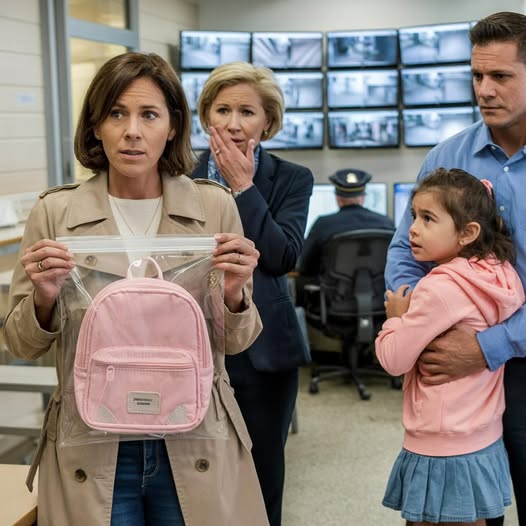
I was halfway through what had been a rare, ordinary Saturday—the kind that feels like a small blessing when you have an eight-year-old. We had nothing urgent planned, just a short list of errands, and Lily was happily pulling things off shelves while I tried to remember which shampoo we were out of. The outdoor mall was busy in that relaxed weekend way: families drifting past storefronts, the smell of pretzels and sunscreen hanging in the air.
Lily had been narrating everything since we parked, as usual. I was only half listening, in that familiar parental state where you filter noise from actual information.
Then she grabbed my wrist.
Not a tug—a firm grip that left a mark I didn’t notice until later.
“Mom,” she said. Her voice was completely different. No excitement, no playful tone. Just urgency. “Bathroom. Now. Quickly.”
Lily is eight and usually lives in a world of dramatic complaints—broccoli is offensive, bedtime is a negotiation. But this wasn’t that voice. This was the one she used when she was genuinely scared.
I dropped the items I was holding and took her hand immediately, no questions asked.
We found the nearest restroom inside the department store. She pulled me straight into the last stall, locked the door, and pressed her back against it for a moment, breathing hard. Then she leaned close to me.
“Don’t move,” she whispered. “Look.”
Confused, I followed her gaze to her backpack—the bright yellow one with embroidered flowers her grandmother Diane had given her just the night before. It was sitting on the floor between her shoes. Lily pointed to the bottom corner, near the seam.
The lining was slightly torn. Something small and round was pressing through from the inside.
It took my mind a moment to understand what I was seeing. A white edge. A coin-sized device. Clear tape holding it tightly against the inner fabric.
An AirTag.
A cold shock moved through my body before I could even fully process it.
I turned the backpack carefully, opening the seam just enough to see inside. This hadn’t been slipped in by accident. It had been deliberately hidden—taped and wedged deep into the lining, concealed as if someone had wanted it to stay unnoticed.
Lily’s voice dropped to almost nothing. “It beeped in the shoe store. I thought it was a toy at first. Then I felt it move, and I remembered from the safety video at school.”
My stomach tightened. My eight-year-old had recognized an AirTag from a safety lesson. I wasn’t sure whether to feel relieved or disturbed by that later.
Right then, I forced myself to stay steady. She needed calm, not panic.
I pulled out my phone and started documenting everything. Photos of the seam, the tape, the device, the backpack label. I asked Lily, gently, to explain exactly what she noticed and when. Her voice was clear, precise—too calm for a child describing something like this.
Then I checked my notifications.
The Find My alert I had dismissed earlier was still there.
An unknown AirTag had been traveling with us since that morning.
Since before we had even left the house.
I opened our family group chat.
At 11:14 that morning, Diane had sent a message: casual, cheerful, the kind she sent all the time. “How’s shopping going? Find anything cute for Lily?” I hadn’t told her we were shopping. I hadn’t mentioned the mall, or even our plans for the day. She knew where we were because she already knew where the backpack was.
My hands went still.
I texted Mark with a calm I didn’t feel: Call me. Now. Emergency. Your mother.
He picked up within a minute. I kept my voice low and told him exactly what we had found, what the phone alert showed, and what Diane had messaged. There was a long silence on his end—the kind where you can almost hear someone’s reality shifting. Then he said, “Stay where you are. Go to security. I’m coming.”
I took Lily to the family restroom and asked a staff member to contact mall security. I told them not to touch the backpack. Lily sat on the counter, swinging her legs, trying too hard to look fine. She was performing bravery the way kids do when they don’t want their parents to fall apart.
I kissed her forehead. “You did exactly the right thing,” I said. “I’m proud of you.”
“Are we in trouble?” she asked quietly.
“No,” I said. “Not even close. You told the truth. That’s all that matters.”
A security officer, Mr. Hernandez, arrived and escorted us toward the office near the food court. I kept the backpack inside a shopping bag, careful not to disturb it.
That’s when I saw a blue SUV pull into the fire lane.
Diane stepped out, smiling, dressed neatly like she was arriving somewhere pleasant. She walked toward the entrance with complete confidence. Then she saw the bag in my hands.
Her expression changed instantly.
Not slowly. Not gradually. It shut off.
She hurried inside. “What’s going on? Mark called me—he said emergency. Is Lily okay?” But she wasn’t looking at Lily. She was looking at the bag.
Mr. Hernandez stepped in front of her. “Ma’am, please wait here.”
Four minutes later, Mark arrived, still in his work clothes, moving fast. Lily saw him and broke—running into his arms, finally letting go of everything she’d been holding in. He held her tightly, then looked at me over her shoulder. I handed him my phone with the photos.
He turned to his mother.
“Mom,” he said. “Why is there a tracker sewn into Lily’s backpack?”
Diane didn’t answer. She folded her arms. “That’s dramatic,” she said. “It’s a safety device. Children go missing every day. I was protecting her.”
“You put a tracker in my daughter’s bag without telling us,” I said evenly.
“You both work,” she replied. “You get distracted. I did what needed to be done.”
The air in the room changed. Mark went completely still.
I asked Mr. Hernandez to call the police. Not to escalate—but because I knew exactly how easily this could be rewritten later: as an overreaction, a misunderstanding, a “concerned grandmother.”
I wasn’t going to let that happen.
While we waited, security reviewed the footage. Lily had left the house with the backpack already altered. Diane had given it to her the night before.
When the officer arrived, he was calm and professional. He examined the device, the photos, the Find My alert, and the timestamped message in the group chat. He explained that secretly placing a tracking device on a child without the parents’ consent could carry legal consequences, depending on jurisdiction. He advised us to preserve everything and document all communication.
Diane tried to interrupt several times, each time starting with, “I’m her grandmother,” as if that alone settled the matter.
Then Lily spoke.
Softly, clearly: “Grandma told me not to show Mom the inside pocket because she said she sewed a surprise charm in there.”
Silence followed.
I watched Diane in that moment. Something shifted in her face—not guilt exactly. More like recalculation. The realization that her version of events no longer fit.
Mark stared at her for a long time. When he finally spoke, his voice was quiet.
“Mom… why did you tell our daughter to hide something from her mother?”
Diane looked at him, then at me. Finally, she said, “I needed to know where she was. You don’t understand what it’s like to worry about someone.”
I almost laughed—not because it was funny, but because of how far removed that statement was from reality. “You weren’t worried,” I said. “You were tracking her. That’s not the same thing.”
This wasn’t the first boundary she had crossed in the past year. Not even close. Over the last six months, there had been the time she showed up at Lily’s gymnastics class without telling anyone, acting like it was casual. There had been the phone calls to Lily’s school asking about pickup schedules—calls the school later mentioned to me because they assumed I already knew. There had been the afternoon I was sick in bed and came downstairs to find Diane inside our house, using an old spare key to leave soup on the counter, as if letting herself in was completely normal. Each time I raised it with Mark, we ended up in the same place: that’s just how she is, she means well, let it go.
Now, standing in that security office, I understood what “let it go” had really been. It had been permission. Every ignored boundary had taught her that boundaries weren’t real.
Before we left, I looked directly at Diane and said, clearly, with Mark and Lily and witnesses present, “You will not have unsupervised access to my daughter until I decide otherwise.”
Diane opened her mouth to respond.
Mark stood up beside me. “No, Mom,” he said. “We’re done calling this normal.”
It was the first time I had ever heard him speak to her like that—without softening it, without cushioning it, without leaving her room to reinterpret it. I didn’t cry, but it took everything in me to stay steady. I think it cost him even more to say it.
The drive home was almost completely silent. Lily fell asleep before we reached the highway—exhausted in the way children get after fear finally runs out of energy.
That night, Mark went through all the formal steps. He removed Diane from pickup lists, emergency contacts, and school authorization. I called the pediatrician and added a password to Lily’s file. Mark found Diane’s spare key and went out to change the locks. When he came back, he looked different—like something heavy had finally been set down.
Later that night, I built a document. Not an emotional account—just facts. Dates, times, locations, screenshots, photos, and the mall incident report. Everything arranged in order. Clean. Precise. Verifiable.
I had learned enough about Diane to know what would come next. When she lost control of the narrative, she would try to rewrite it.
And she did.
By Monday morning, Mark received a message from her: I was unstable, I was turning Lily against family, I had overreacted to a “safety device” because I couldn’t handle things properly. She called Mark’s sister with a completely different version of events in which I had caused a scene over nothing. I assumed there were more calls I never heard about.
I sent one message back to Diane, with Mark copied: You secretly placed a tracking device in Lily’s backpack and instructed her not to tell me. Until further notice, contact will be supervised. Then I stopped responding.
No debate. No emotional back-and-forth. Just the documented facts.
The hardest part was Lily.
She wasn’t hysterical. She was careful. Quiet. At bedtime, she asked questions like she was trying to understand a system that suddenly didn’t make sense anymore. Was Grandma angry with her for telling the truth? Was she allowed to use other gifts from her grandmother? Should she check them first before showing us?
Each question hit harder than the last.
Children shouldn’t have to evaluate whether honesty will get them in trouble. They shouldn’t have to manage adult secrets.
Mark and I reassured her again and again, in different words and moments: she was never in trouble. She did the right thing. Adults who are safe to trust do not ask children to keep secrets from their parents. What she did was brave.
Slowly, she began to settle into that truth, even if it didn’t feel familiar yet.
To Mark’s credit, he didn’t treat this as a one-time conflict. He started to see what had been building for years. He admitted that he had spent a long time minimizing his mother’s behavior because confronting her meant being seen as disloyal, and that was something he had always been trained to avoid.
He started therapy. Not long after, we began couples therapy together—not to fix a single incident, but to understand how so many small compromises had allowed things to escalate this far.
We had a lot to rebuild.