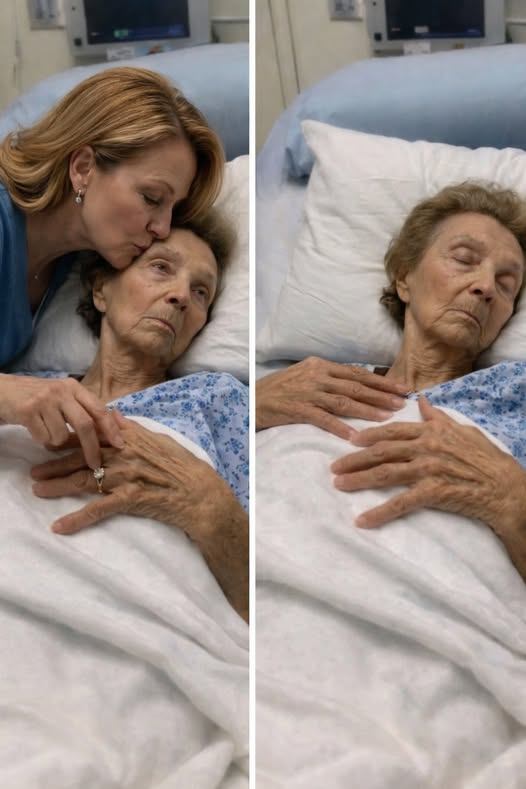
Grandma was still breathing when Aunt Linda reached for her ring.
She didn’t say anything—but she saw it happen. And she saw that I saw it too.
Two days after the funeral, a package arrived with clear instructions: open it in front of everyone.
Linda grabbed it immediately, like it belonged to her.
Seconds later, all the color drained from her face.
Aunt Linda had wanted that ring for as long as I can remember.
Grandma was the heart of our family—the kind of woman who held everything together with quiet strength, Sunday dinners, and a single look that could silence a room. But as she lay in hospice, weak and fading, Linda seemed focused on only one thing:
The ring.
A vintage two-carat diamond Grandpa had given her after returning from WWII. It wasn’t just jewelry—it was a piece of history. A symbol. Something everyone in the family knew.
And Linda always believed it should be hers.
We were gathered around Grandma, saying our goodbyes. I sat near her feet, holding her hand, whispering that I loved her.
Linda leaned in, saying she wanted to kiss her forehead.
But her hand moved differently.
It slid across Grandma’s left hand.
One smooth motion.
One second, the diamond sparkled in the light.
The next—it was gone.
Straight into Linda’s cardigan pocket.
I froze.
Then Grandma opened her eyes.
She looked at me.
Then at Linda.
And gave the faintest, saddest smile.
She didn’t stop her. Didn’t say a word.
She simply closed her eyes again.
Grandma passed away twenty minutes later.
At the funeral, Linda cried louder than anyone. She kept calling herself “Mom’s favorite”—all while hiding the ring in her pocket.
I almost spoke up.
But that look Grandma gave me stopped me.
Two days later, the doorbell rang.
A courier. Signature required.
That’s when I realized—this had been planned.
Linda took the package right away, smiling to herself.
“Mother always loved me most,” she said, holding it like a trophy.
We all gathered in the living room as she opened it.
Inside was a velvet pouch.
And a letter.
She read the first line—and everything changed.
Her face went pale. Her hands started shaking. The letter slipped from her fingers.
“No… no, Mom,” she whispered. “That’s cruel.”
I stepped forward. “Read it.”
“It’s private,” she snapped.
My mom shook her head. “It says to open it in front of everyone.”
Uncle Ray added, “Out loud, Linda.”
She hesitated, then began:
“Linda… if you’re holding this, it means you did exactly what I knew you would do.”
The room fell silent.
“I saw you take my ring in hospice. I chose not to stop you. I didn’t want a scene at my bedside. And I didn’t want Kate blamed for telling the truth.”
Hearing my name made my stomach drop.
Linda rushed ahead, voice shaking.
“I sold the real diamond ten years ago.”
Gasps filled the room.
I reached into the box and pulled out a receipt. Pawn shop. Date. Amount.
Uncle Ray stared. “You’re serious?”
Linda kept reading, barely holding it together.
“I used the money for your rehab. You called me crying, saying you were ready to change.”
My mom whispered, “She gave up her diamond for you.”
“I didn’t ask her to!” Linda snapped.
“Yes, you did,” I said quietly.
She turned on me. “Shut up.”
“No,” I replied. “You stole from her while she was dying.”
“It was mine anyway!” she shouted.
My mom cut in sharply. “Stop saying that.”
Ray pointed at her. “Then what’s in your pocket?”
Linda pulled out the ring and slammed it on the table. “Fine! Take it!”
The stone caught the light.
Too bright.
Too perfect.
Wrong.
Ray let out a short laugh. “You carried that through the funeral.”
My mom shook her head. “You embarrassed yourself.”
I picked it up and turned it slightly.
“It’s glass.”
Beneath the papers was another envelope.
FOR KATE — OPEN IN FRONT OF EVERYONE.
Linda lunged for it, but I pulled back.
“Give it to me,” she said. “It might be for all of us.”
I turned it so everyone could read the front.
“If anyone but her opens this, you’ll prove my point.”
Ray exhaled slowly. “She knew everything.”
My hands were shaking as I opened it.
Inside was a single sheet and a folded bank slip.
I read aloud:
“Kate, you are the only one I trust to do what needs to be done.”
Linda scoffed.
“There is a small account for funeral expenses and your grandfather’s headstone. This is not an inheritance—it is a responsibility.”
The amount wasn’t huge, but it was enough.
Linda’s eyes locked onto it immediately. “That’s money.”
“Linda will try to turn this into a prize. She will cry, threaten, or promise. Do not give it to her.”
“Are you serious?” Linda snapped.
My mom didn’t even look at her. “I’m listening to Mom.”
I kept reading:
“Within 24 hours, at Sunday dinner, you will read both letters out loud. Not to shame her—but to stop the lies that have divided this family.”
Linda pointed at me. “You’re putting me on trial?”
Ray spoke calmly. “We already knew. We just stayed quiet.”
“Take the account to the bank. Put it under your mother’s name. Two signatures required—yours and hers. Linda gets no access.”
Linda tried to grab the paper again, but Ray stepped in.
“Kate,” she said quickly, her tone changing, “we should talk privately.”
“No,” I said.
“You’re going to destroy this family.”
“No,” I repeated. “This has been happening for years.”
At the bank, I followed Grandma’s instructions exactly.
Two signatures. No exceptions.
That evening, we gathered for Sunday dinner.
Linda arrived late, tense and quiet.
I stood at the end of the table and began reading.
The first letter.
The truth about the ring.
The receipt.
The rehab money.
The glass stone.
No one interrupted.
Then the second letter.
When I finished, the room felt heavy—but clear.
My mom spoke first.
“We’re done rescuing you.”
Linda gave a bitter laugh. “So now everyone hates me?”
“We don’t hate you,” my mom said. “We’re just done enabling you.”
I looked at her.
“Then tell the truth.”
For a long moment, she said nothing.
Then, quietly:
“I took the ring.”
My mom closed her eyes.
And just like that, something shifted.
Linda started crying—not loudly this time, but honestly. She admitted everything: the guilt, the resentment, the need to hold onto something that made her feel important.
Then she left.
The door closed softly behind her.
Later that night, after everyone had gone, I sent her a message:
You told the truth tonight.
Keep going.