The winning numbers etched themselves into my memory the moment they appeared on the screen: 4-12-28-35-42, Mega Ball 11. I was sitting in my basement—though calling it a “room” was generous; it was more like a converted storage space with a camping cot and a space heater that only worked when it felt like it—watching the lottery draw on my worn-out laptop. When all six numbers matched, I didn’t make a sound. I didn’t jump. I didn’t even smile.
I sat there under the flickering blue light of the screen, listening to laughter drifting down from upstairs where my family entertained guests, and felt a strange shift in my chest. Four hundred and fifty million dollars. After taxes and taking the lump sum, I’d walk away with about two hundred and eighty million in cash. Enough money to buy and sell my family’s world a hundred times over.
But I didn’t move. Not yet.
That rainy Tuesday morning, three years ago, while my family still slept upstairs in their comfortable beds, I drove my rusting 2005 Toyota Corolla to the office of Maxwell & Associates, the most prestigious and discreet law firm in San Diego. I handed over a fifty-thousand-dollar cash retainer—money I’d scraped together from years of overtime and side jobs they knew nothing about—and explained exactly what I needed.
“I want a blind trust. Completely anonymous. I want my name buried so deep it would take an army of accountants to find it. And I want to know every legal way to protect my identity as the winner.”
The lawyer, a silver-haired woman named Patricia Maxwell, studied me across her mahogany desk. I was still in my janitor uniform, smelling faintly of industrial cleaner and wax. To her credit, she didn’t even flinch.
“May I ask why the secrecy, Mr. Miller?”
I looked down at my rough hands. “Because I need to know if the people who are supposed to love me actually do. And I already know the answer. I just need to see it for myself.”
She nodded slowly, asked no more questions, and got to work.
By the time I claimed my prize two weeks later, I was officially a ghost. The trust had a name—Meridian Holdings—and a registered agent who wasn’t me. California would release a statement saying a San Diego resident had claimed the jackpot but wished to remain anonymous. And I continued to wake up at five each morning, put on my blue uniform, and mop floors at Intrepid Tech.
Why Intrepid Tech? Because that’s where my father worked.
Frank Miller was a regional sales manager who had spent the last decade watching younger, hungrier salespeople climb past him. Bitter, desperate to maintain the illusion of success, everything about him was performance: a leased luxury car he couldn’t afford, a country club membership paid with credit cards, constant name-dropping of business contacts who barely remembered him.
My mother, Martha, was his perfect counterpart. Once beautiful, decades of chasing status had hardened her. She measured people by labels and neighborhoods. Conversations were social climbing disguised as small talk.
And then there was Brad, my younger brother by two years. The golden child. The favorite. He could do no wrong in our parents’ eyes, though in reality he had plenty of secrets: gambling debts, lawsuits over real estate deals, constant borrowing.
I knew all of this because I had been watching. Quietly. For three years, I had been their invisible guardian angel.
When my mother maxed out her credit cards, an anonymous payment would arrive before collection agencies called. When my father’s sales numbers fell for twelve straight months and retirement rumors began, I intervened. Through my blind trust, I quietly purchased 51% of Intrepid Tech, becoming the majority shareholder. My father kept his job. And Brad? Sweet, foolish, criminal Brad? I had saved him from prison twice.
The first time, he’d sold a property using forged documents, not realizing the buyer was a lawyer. The lawsuit could have ruined him. Through a careful series of maneuvers, I had bought out the contract, settled the claim, and buried the case so deep it never appeared on any public record. Brad thought he’d gotten lucky when the suit mysteriously vanished. He celebrated by buying a Rolex on credit.
The second time was worse. He had scammed an elderly couple out of their retirement savings in a reverse mortgage scheme. When their adult children came after him with lawyers—and threats of physical violence—I stepped in again. I paid restitution, and I even bought the couple a new home outright, in cash, through an “anonymous benefactor.” The children dropped their pursuit, and Brad? He told everyone at Sunday dinner that he’d “smoothed things over with his excellent negotiation skills.”
I had paid for all of it. Every debt, every lawsuit, every disaster they stumbled into with their eyes wide open and hands out. And I did it from the shadows, dressed in my janitor uniform, living in their moldy basement, paying them eight hundred dollars a month in “rent” for the privilege.
Why did I do it? That’s the question I asked myself every night as I lay on that camping cot, listening to the house settle around me. Was it love? Some pathetic hope that they’d wake up and see me as a person worth caring about? Or was it something darker—a need to prove I was better than them, even as they ground me into the dirt?
I think it was simpler than that. I wanted to see if there was anything real beneath the surface. If, stripped of their manufactured superiority, there might be human beings who could love someone without conditions, without qualifications, without measuring worth in dollars and social standing.
For three years, I conducted my experiment. I watched, I waited, I paid their bills, and they repaid me with contempt.
At family dinners—which I was expected to attend despite being “an embarrassment”—I was seated at the far end of the table, often in a mismatched chair because there weren’t enough of the “good” chairs for everyone. They would talk over me, around me, through me, but never to me. When Brad launched into another fabricated story about his real estate triumphs, everyone hung on his every word. When I tried to share something about my day, my mother would literally stand and walk away mid-sentence.
“Arthur, we’re trying to have a pleasant dinner,” she’d say over her shoulder. “Nobody wants to hear about mopping floors.”
My father was worse in his own way. About a year into my employment at Intrepid Tech, he spotted me emptying trash bins on the third floor while walking with a client. His face went through an extraordinary range of expressions—shock, recognition, and finally, pure mortification. He grabbed his client’s elbow and practically sprinted in the opposite direction.
That evening, he was waiting for me at the basement door, his face purple with rage.
“You work at MY company?” he hissed. “Do you have any idea how this makes me look? My own son, cleaning toilets where I work? What if someone sees you? What if they connect us?”
“I needed a job,” I said simply. “I’m sorry if it bothers you.”
“Bothers me? It humiliates me! Couldn’t you have found work somewhere else? Anywhere else?”
I could have. I had two hundred and eighty million dollars in the bank. I could have bought the entire office building and turned it into a museum dedicated to my father’s mediocrity. Instead, I said: “I’ll try to stay out of sight.”
And I had. For three years, I’d perfected the art of invisibility. I worked the early morning shift, arriving at 5 AM and leaving by 2 PM, before most office workers even showed up. When I crossed paths with my father, I ducked into supply closets or took the stairs in the opposite direction. I became a ghost in his world—which was fitting, since I had always been invisible in his eyes anyway.
But yesterday—yesterday was different.
It was their thirtieth wedding anniversary, and my mother had been planning the party for months. She’d rented vintage china, hired a catering company, and sent out engraved invitations on card stock so thick you could build a house with it. The guest list read like a who’s who of people desperate to impress each other: junior executives, Brad’s real estate colleagues, country club acquaintances, and a few distant relatives with money.
The house had been transformed. White roses everywhere, real crystal champagne flutes, a string quartet playing in the backyard. I watched the preparations from my basement window—the catering trucks arriving, the staff setting up tables, my mother directing traffic like a general commanding troops.
I hadn’t been invited, of course. The party was happening above me, around me, despite me. But I wanted to do something. Some foolish, naïve part of me, the part that hadn’t learned its lesson in thirty years, thought that maybe—just maybe—if I showed up with a sincere gesture, something might change.
I had baked a cake. Nothing fancy—I’m not a baker—but I followed a recipe for their favorite, a lemon pound cake my grandmother used to make. I spent the afternoon mixing and measuring, trying to get it right, trying to create something that might remind them of better times, of a family that actually meant something.
At seven PM, I climbed the basement stairs, cake in hand, still wearing my work uniform because I didn’t own anything appropriate for their party. The smell of bleach and industrial cleaner clung to my clothes, clashing horribly with the catered hors d’oeuvres and expensive wine.
The kitchen was bustling with staff. I tried to slip through unnoticed, but my father spotted me immediately. His face shifted from jovial host to barely concealed horror in a fraction of a second.
“What the hell are you doing here, Arthur?” He grabbed my elbow with surprising strength and yanked me into the corner, away from the curious glances of the catering staff. His grip left marks that would purple into bruises by morning. “Look at you. You smell like a public restroom. You want to embarrass me in front of my business partners? In front of Sterling?”
Richard Sterling. The CEO of Intrepid Tech. The man who took orders from the mysterious chairman—from me—without knowing it. He was here somewhere in the crowd, making small talk with people desperate for his approval.
“I just wanted to congratulate you both,” I said, holding up the cake. “It’s Grandma’s recipe. I thought—”
“You thought wrong.” My mother’s voice cut through the kitchen chatter like a knife through silk. She materialized beside my father, resplendent in a dress that cost more than most people’s monthly salary—a dress I had indirectly paid for when I’d cleared her Nordstrom credit card bill six months ago. She looked at me, at the homemade cake, and curled her lip in disgust.
She took the cake from my hands—not gently—and walked it straight to the trash. I watched it drop, container and all, listening to the hollow thump as it hit the bottom of the bin.
“You’re a magnet for bad luck, Arthur. An anchor around this family’s neck.” Her voice was cold, clinical, like she was discussing a malfunctioning appliance. “You’re thirty years old and still cleaning toilets. Look at your brother Brad. Look at him! That’s what a real son looks like. That’s what success looks like.”
Brad leaned against the doorframe, smirking, wearing a new suit—Armani, if I wasn’t mistaken—that he absolutely couldn’t afford. His champagne glass was crystal, probably from the rented set. He raised it in a mock toast.
“Come on, Mom, don’t be too hard on him. Arthur was born to be the background character. Someone has to clean up the trash so the rest of us can shine, right?” He laughed, and my parents joined in, sharing a moment of family bonding at my expense.
The sound of their laughter was the final weight on a scale that had been tipping for three years. Something inside me—the last thread of hope, of desperate loyalty, of pathetic longing—finally snapped.
“Pack up your things.” My father’s voice was flat, final. “I’m tired of explaining to the neighbors that that piece of junk in the driveway belongs to my son. I’m tired of wondering if a colleague will see you scrubbing floors. I’m tired of you, period. Get out of my house. Now. You’re an embarrassment.”
I looked at them. Really looked. My father, red-faced and self-righteous. My mother, already turning back to the party, dismissing me as easily as she’d dismissed that cake. Brad, smirking, delighted.
Three years of secret generosity. Three years of anonymous bailouts. Three years of playing guardian angel to people who never once wondered where their good fortune came from. And this was my reward. This was what they really thought of me.
“Fine,” I said, my voice sounding strange to my own ears—calm, almost serene. “I’ll go. But I’ll need to come back tomorrow to collect my things. Grandpa’s box is in the basement, and I’m not leaving it behind.”
My father waved dismissively, already turning back to the party. “Come at ten AM. I’m having very important guests—Sterling and some potential investors. I want you to see what real success looks like. Maybe it’ll inspire you. But use the side entrance, and for God’s sake, don’t park that eyesore where anyone can see it.”
I nodded, turned, and walked out. I didn’t look back.
That night, I didn’t sleep in my car or on a friend’s couch. I drove my Toyota to the Ritz-Carlton, where I maintained a penthouse suite under an alias—one of several properties I owned but never used. I parked in the underground garage where no one would see my rusting vehicle, took the private elevator to the forty-fifth floor, and stepped into a world they couldn’t even imagine.
The penthouse was three thousand square feet of floor-to-ceiling windows overlooking the San Diego harbor. The furniture was custom Italian. The bathroom had heated marble floors and a shower with six heads. The wine fridge was stocked with bottles that cost more than my father’s monthly salary.
I poured myself a glass of Château Margaux—$3,500 a bottle—and stood at the window, looking out at the glittering city below. Tomorrow, I thought, sipping wine that tasted like liquid gold. Tomorrow, they’ll learn the truth. And I’ll see if there’s any remorse in them, any capacity for real emotion beyond greed and status anxiety.
Somehow, I already knew the answer.
The next morning, I made a series of phone calls.
The first was to my lawyer, Patricia Maxwell. “Execute the plan,” I said simply.
The second was to Richard Sterling. “I need you at the Miller residence at 10 AM. Bring the termination paperwork we discussed. Yes, for Frank Miller. It’s time.”
The third was to the bank holding the third mortgage on my parents’ house—a mortgage they’d secretly taken out to cover Brad’s gambling debts, not knowing I had quietly purchased it months ago through one of my shell companies. “Prepare the foreclosure notices. Three days to vacate.”
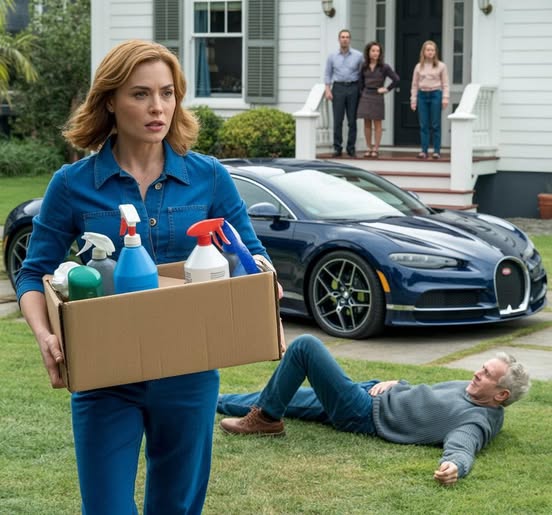
And the fourth call was to Premier Motors, San Diego’s exclusive Bugatti dealership. “I’m coming to pick up the Chiron. Matte black. Full tank.”
At 9:45 AM, I walked into the dealership wearing a custom Tom Ford suit that cost more than my family’s anniversary party, and slid behind the wheel of four million dollars’ worth of engineering perfection: the Bugatti Chiron Super Sport. Sixteen cylinders, 1,600 horsepower, top speed 304 mph. Butterfly doors that opened like wings. Paint so deep and flawless it looked like liquid darkness.
“Enjoy, Mr. Miller,” the salesman said, unaware that the man who had once test-driven this car in a janitor’s uniform and claimed to be “just looking” was now its owner.
I drove out of the dealership, feeling the raw power beneath me, and headed toward my family’s quiet suburban neighborhood. There they were, hosting Richard Sterling and trying to impress him with their middle-class success story.
They had no idea what was coming.
The Bugatti’s W16 engine announced my arrival three blocks away. This wasn’t the obnoxious roar of a modified exhaust—it was power with purpose, a deep, thunderous symphony that rattled windows and set car alarms off. In a neighborhood of sedans and SUVs, it sounded like the apocalypse.
I watched them through the windshield. My father, mother, and Brad stood on the lawn with Sterling. Dad gestured enthusiastically, likely exaggerating his sales achievements. Mom smiled that brittle, practiced smile. Brad checked his phone, probably tracking his bets.
The lawnmowers stopped. Neighbors emerged on their porches. A kid on a bicycle literally toppled over in awe. The quiet Tuesday morning became something else entirely as the Bugatti rolled up like a matte black spacecraft.
“Oh my God,” I heard Brad whisper. “That’s… that’s a Bugatti. A Chiron. That’s like four million dollars. Who the hell…”
My father froze mid-gesture, mouth open. His eyes calculated: Who owns this? How do I know them? How can I leverage this?
“Hello, sir! Sir!” Dad hurried toward the car, abandoning Sterling, hand extended. “Welcome to our neighborhood! I’m Frank Miller, I work at Intrepid Tech—perhaps you’ve heard of it? If you need assistance, or are looking for property, my son Brad is an excellent real estate agent…”
I let him talk, let him walk up to the car, watched his reflection in the tinted window as he adjusted his tie. This was Frank Miller in his element: sensing money, hunting advantage, ready to perform for anyone who might elevate him.
The butterfly doors hissed open. Silence fell. All eyes on the figure emerging from the driver’s seat.
I stepped out slowly, deliberately. Berluti leather shoes, $3,000. Tom Ford suit, $8,000. Aviator sunglasses, $600. I removed the glasses carefully and looked at my father.
His face went through a series of rapid emotions: confusion—who is this? Recognition—wait… Denial—no, it can’t be. Shock—complete, overwhelming shock.
“Hi, Dad,” I said quietly. “I came to get my things, like I promised.”
The orange juice slipped from my mother’s hand, shattering on the walkway. Brad’s phone hit the grass. Sterling’s eyebrows rose—the only hint of surprise from a man who’d seen it all.
“Ar… Arthur?” Dad stammered, face draining of color. “What… what is this? Did you steal this car? Are you… are you driving for someone? Where’s your boss?”
He searched frantically for the real owner. The idea that I might own this car, that I might be the person of actual importance, simply couldn’t compute.
I didn’t answer. I walked past him—close enough that he could smell my cologne, probably recognizing it as a brand he wore, but somehow richer—and approached Sterling.
Sterling straightened, a small, knowing smile at the corners of his mouth.
“Hello, Mr. Chairman,” he said, bowing slightly. “I brought the termination papers as requested. Everything is in order.”
The world stopped.
“Mr… Mr. Chairman?” Dad’s voice cracked. “Sterling, what are you talking about? That’s Arthur. He… he cleans toilets on the third floor. He’s a janitor. He’s… he’s nobody.”
“Not nobody, Frank,” I said, turning fully to him. “I’m the majority shareholder of Intrepid Tech. I’m the mysterious chairman Mr. Sterling reports to. I’ve been the one signing approvals that kept you employed for three years, despite twelve consecutive months of missed sales targets.”
I watched as reality crashed into him, contradicting everything he believed about the world, about me, about himself.
“Three years ago,” I continued, “on a rainy Tuesday morning, I won four hundred and fifty million dollars in the lottery. After taxes and the lump sum, I walked away with two hundred and eighty million in cash. I set up a blind trust, bought controlling interest in several companies—including Intrepid Tech—and kept working as a janitor. I wanted to see something, Dad. I wanted to know if you were capable of loving someone without conditions. If you could value family over status. If there was anything real beneath all the performance.”
My mother made a strangled gasp. Brad went from red to white to faint green.
“I’m the one who paid Mom’s credit card bills,” I said, pulling out my phone and showing a folder of transfers. “Every time she maxed them out buying things she didn’t need to impress people she didn’t like. Eighteen anonymous payments over three years. Total: $247,000.”
The waves crashed below like applause for a final act long overdue. The wind whipped around me, salty and sharp, cutting through the lingering tension in my chest. For the first time in my life, I didn’t feel small. I didn’t feel invisible. I felt… untouchable.
The Pacific Coast Highway stretched before me, ribboning along cliffs and beaches, empty in the morning light. I let the Bugatti breathe, engine thrumming like a living thing, and with every curve, every apex, every burst of speed, I felt layers of the old life peeling away.
I thought about the years of invisibility, of being ignored, dismissed, reduced to a punchline in my own family’s narrative. All of it had led here. Every small act of quiet generosity, every hidden bailout, every anonymous gesture of love—it had been mine to give, and mine to keep secret. And finally, it had been acknowledged, in the only way that mattered: by me.
The sun rose, spilling gold across the cliffs, illuminating a horizon I’d never known I was meant to chase. I didn’t need their approval. I didn’t need their pity. I didn’t even need their love. I had autonomy. I had choice. I had the chance to write the next chapter of my life without the weight of their judgment pulling me down.
The road stretched on endlessly, and I accelerated, not toward revenge or spectacle, but toward something infinitely rarer: a life truly my own.
And for the first time in decades, I smiled—not because they were finally humbled, but because I was free.
Freedom tastes like asphalt under tires, salt in the wind, and the infinite possibility of what comes next. I was ready.
I let the Bugatti roar into the horizon, and for the first time, I felt like the person I had always been, hidden in plain sight.
The past was a closed door behind me. Ahead, the world waited—and I was unstoppable.