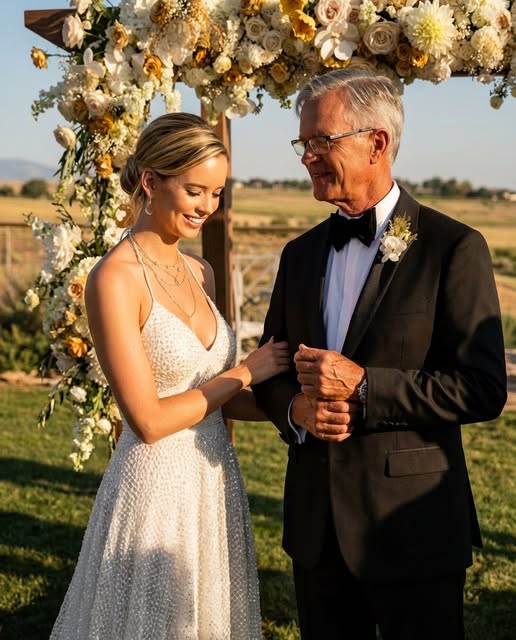
I was fully aware of the whispers that would follow me the moment I said “I do.” To the outside world, my marriage to my best friend’s wealthy grandfather wasn’t a romance—it was a transaction. A calculated move by a desperate woman trying to secure a future. From afar, it looked like a cliché of greed, but from where I stood, it was a lifeline.
For years, I had lived in a constant state of survival, counting every expense and trying to hold my life together before it all fell apart. When he offered stability, I didn’t see a husband—I saw an end to exhaustion. I accepted the proposal thinking I was choosing a quiet, secure life.
But on our wedding night, after the guests had left and the silence of his massive estate settled around us, he led me to his private study, in front of a heavy, locked safe. As he turned the dial and looked at me with a seriousness I hadn’t seen before, I realized I hadn’t entered comfort—I had entered a war zone.
Before that night, my life had always existed in contrast to my best friend’s world. She was born into comfort and certainty; I had learned early how quickly life could unravel without a safety net. When I first met her grandfather, I expected a cold, distant patriarch—a man who would see me as a curiosity at best, an interloper at worst. Instead, I found a man who offered a kind of respect completely foreign to me. He didn’t just hear me; he listened. He asked questions that showed he saw beyond my worn shoes and carefully maintained facade. He saw the survivor beneath the struggle.
Yet I held no illusions. The proposal was pragmatic, a complicated agreement under the shadow of a family that had already judged me for being poor long before I walked down the aisle.
Everything changed when the safe opened. Instead of wealth, he pulled out folders—investigative reports, legal testimonies, evidence. What he revealed wasn’t about money as a “gold digger” might imagine; it was about the rot inside his family.
He told me about the treachery of his children and grandchildren—not waiting to honor him after his passing, but actively working to dismantle everything he had built for their own gain.
His decision to marry me wasn’t senility or a quest for a trophy wife. It was a strategic move to protect his empire. He needed someone who understood the value of a dollar because she had lived without one. He needed someone whose character was forged in adversity, not softened by privilege. He chose me because I wasn’t looking at him as a bank account.
Suddenly, it wasn’t about what I would gain—the luxury cars, the designer clothes, the effortless travel. It was about what I was being asked to carry. I became the guardian of a legacy, responsible for protecting a vulnerable man from his own family. It was a weight I hadn’t anticipated.
In the months that followed, the soft life I had imagined disappeared, replaced by a grueling crash course in corporate law, estate management, and high-stakes family politics. I realized that choices are rarely as simple as they appear. What began as survival became a test of my integrity. I faced relatives who sneered at me until they understood that I held the keys to the kingdom. I learned that respect cannot be demanded—you earn it through competence.
I discovered a version of myself long suppressed by poverty. The woman who once worried about late fees became the woman deciding the future of foundations and corporations. My voice, once quiet and accommodating, became a tool of precision and power. I wasn’t just “getting by”; I was navigating a web of trust and resilience, making decisions that impacted thousands.
The grandfather I had married for “security” became my greatest mentor and confidant. Our relationship, born of pragmatism, grew into a bond rooted in shared understanding. He was an outsider in his family due to principles; I was an outsider because of my past. Together, we created a front his predatory heirs couldn’t breach.
The “security” I thought I was buying with a wedding ring turned out to be the security of knowing exactly who I am and what I am capable of under pressure.
Looking back, I realize the world’s judgment was a small price to pay. They saw a woman trading youth for a fortune; I saw a woman trading fear for purpose. The safe didn’t contain jewels—it contained the truth about wealth’s fragility and the enduring power of character.
I didn’t marry for money.
I married into a mission.
And today, I don’t feel like a guest in that world. I feel like the architect of a future no one anticipated.
I no longer calculate survival—I calculate impact. The struggle made me strong enough to handle wealth, and wealth gave me the platform to prove that struggle was never who I was—it was the training ground for the woman I was meant to become.