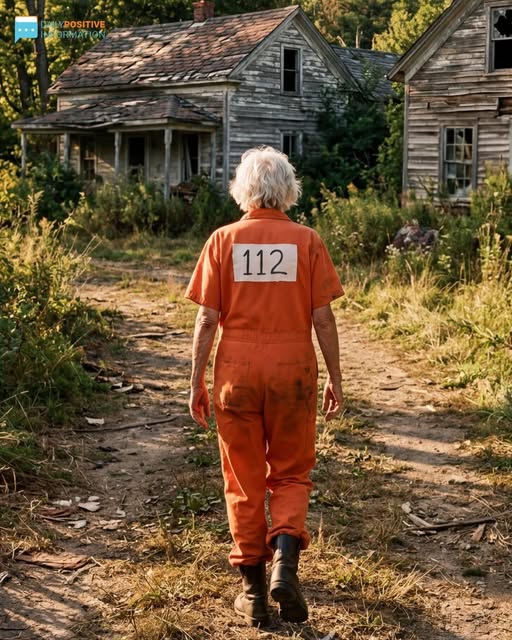
Margaret Ellis walked through the doors of the Deborah K. Johnson Rehabilitation Center for Women in Nashville, Tennessee, on a Friday morning in March, holding everything she owned inside a clear plastic bag.
Forty-seven dollars. A worn-out photograph. A small wooden cross she had been wearing since she was sixteen.
Twenty years behind bars had reduced her life to almost nothing.
She had been fifty-two when she went in. Her hair still had color. She could carry groceries without losing her breath. Old enough to know better—but she didn’t. Back then, she didn’t really understand anything.
Now she was seventy-two. Her hair was gray, her posture bent, arthritis in both knees, and a heart that sometimes skipped beats when she climbed stairs too quickly. Those twenty years had taken her health, her youth, and the final years of her husband. Robert had died in 2011—suddenly, from a heart attack—and Margaret wasn’t there. She wasn’t even allowed to attend his funeral. Her sister Diane was supposed to take care of everything.
She was the one who had to handle it all.
Margaret had spent her entire life protecting her younger sister—and never once realized what was hiding behind that sweet smile.
Margaret Rose Ellis had worked as an English teacher at Grover’s Mill High School, a small town about forty miles east of Nashville, where people waved at every passing car and the same families had lived on the same land for generations. She and her husband Robert had a home there since 1987—or more accurately, they inherited it. It was her grandmother’s white, two-story farmhouse with a wide wraparound porch on three acres of land, passed down to her mother, and then to Margaret when her mother passed away in 1995.
Diane received the life insurance money. Margaret received the house.
That was their mother’s decision. That was the way things were.
Robert worked as a carpenter—a quiet, honest man who built furniture in a workshop behind the house. Tables, chairs, cabinets—beautiful pieces made from local wood that drew customers from several counties away. He wasn’t wealthy, but he was a good man. Reliable. They had tried for years to have children and eventually accepted that it wouldn’t happen. They still had each other. They had their home. They had their work.
And Margaret had Diane.
Five years younger. The pretty one. The wild one. The one who could talk her way into—or out of—anything. Their mother used to say Diane could charm birds right out of the trees. And that was true. But it was also the problem. She had a way of making people believe anything, feel anything, do anything—while making them think it had been their idea all along.
Margaret never saw that side of her. She only saw her little sister. The girl she had protected all her life. The one who cried in her arms when her first husband left her. The one who called in the middle of the night when she felt scared, lonely, or broke.
The girl who needed her.
That was the only version Margaret saw. What she failed to notice was the quiet calculation underneath it all.
It was a Tuesday night in September 2006 when Diane showed up crying—and that’s when everything in Margaret’s life began to fall apart.
Margaret was sitting at the kitchen table grading papers when she heard loud knocking on the door. Robert was already asleep; he had an early delivery the next morning—three dining tables going to a client in Memphis.
She opened the door and saw Diane standing on the porch, mascara running down her face, her hands trembling, looking like she hadn’t slept in days.
“They’re going to kill me, Maggie,” Diane said. “They’re going to kill me and I don’t know what to do.”
Margaret quickly brought her inside, made her some tea, sat her down, and waited for her to calm enough to explain.
The story Diane told was this: she had gotten involved in gambling—not casually, but seriously. It had started in casinos and escalated to underground poker games with dangerous people. She had borrowed money from the wrong men. She owed them $140,000, and they had given her thirty days to pay it back—or they would make an example out of her.
“I’ve seen what they do to people who don’t pay,” Diane whispered. “There was a man last month. They found him in a ditch outside Memphis.” She couldn’t even finish the sentence.
Margaret believed every word. Why wouldn’t she? This was her sister—her own blood. The girl she had shared a room with for eighteen years, the one she had taught to ride a bike, the one she had supported through two failed marriages. Why would she lie?
So when Diane explained a way out, Margaret listened.
Diane worked as a bookkeeper for a property development company in Nashville. The owner was a man named Gerald Whitmore. According to Diane, he was involved in a massive financial fraud—stealing from investors and hiding money offshore—and Diane had discovered everything. She had documents. Records. Proof.
“He found out I know,” Diane said. “That’s why he sent those men after me. It’s not gambling debt, Maggie. It’s him. He’s trying to silence me before I go to the authorities.”
Margaret should have questioned her more. She should have asked for proof. She should have called the police immediately.
But Diane was crying. Diane was terrified. Diane needed her.
And Margaret had always been weak when someone needed her.
The plan, Diane said, was simple. She would give Margaret copies of the documents for safekeeping, then go to the FBI with the originals. Once Whitmore was arrested, the danger would be gone. But if something happened to Diane before she could do that, someone had to finish what she started.
She handed Margaret a flash drive and told her it contained everything—every transaction, every piece of evidence against Whitmore.
“Hide it somewhere safe,” Diane said. “And if I disappear, if anything happens to me—take it to the authorities. Promise me, Maggie.”
Margaret promised.
Three weeks later, Gerald Whitmore was found dead.
Two days after that, the police showed up at Margaret’s door with an arrest warrant.
What was on that flash drive wasn’t evidence—it was a detailed plan for a murder, written in handwriting that looked like Margaret’s.
The trial lasted three weeks. Much of it blurred together in Margaret’s memory.
But one thing was clear: the flash drive didn’t contain financial records. It contained precise plans for Gerald Whitmore’s murder—meeting times, security details, layouts of his house, all written in handwriting almost identical to Margaret’s.
The prosecution claimed Margaret was the mastermind. They said she had used Diane’s access to Whitmore’s office to gather information and hired a drifter named Curtis Webb to carry out the killing. Webb had been paid $8,000 in cash, and the serial numbers on those bills traced back to a withdrawal from Margaret’s own savings account—a withdrawal she never made.
Margaret had never met Curtis Webb. She had never been inside Whitmore’s office. She had no idea how money from her account ended up in a killer’s hands.
None of it mattered.
Her fingerprints were on the flash drive. The money came from her account. The handwriting looked like hers.
And Diane testified against her.
She sat in court wearing a black dress, tears running down her face, telling the jury that Margaret had manipulated her, that Margaret hated Whitmore, that she had been afraid of her own sister.
“I didn’t know what she was capable of,” Diane cried. “I was scared of her.”
Margaret sat there and watched her sister lie. Watched her cry. Watched her destroy her life piece by piece.
And even then, part of Margaret still believed Diane must be confused. That she had been threatened. That she couldn’t possibly be doing this on purpose.
That was the cruelest part—Margaret couldn’t accept the truth, even while it was happening.
The jury deliberated for six hours before returning a verdict: guilty on all counts. Conspiracy to commit murder. Accessory to murder. First-degree murder.
She was sentenced to thirty years in prison.
She was fifty-two years old.
If she survived, she would be eighty-two when she got out.
For twenty years, she held onto one promise—that when she got out, her home would still be there.
Because of good behavior and a compassionate release program introduced in 2020, Margaret was released after twenty years instead of thirty.
At first, she held onto hope. Diane would come back. Diane would fix everything. Diane would explain.
Diane visited once, three months after the conviction.
“I didn’t have a choice, Maggie,” she said. “It was you or me. You have to understand.”
Margaret didn’t understand.
Diane didn’t explain. She only apologized, over and over, promising to take care of everything. The house would be maintained. The money would be safe. Everything would be waiting when Margaret got out.
“I swear on Mama’s grave,” Diane said. “I’ll make this right.”
That was the last time Margaret ever saw her.
The letters stopped after three years. The calls stopped after five. By ten years, Margaret knew she was alone—but she still believed the promise.
She shouldn’t have.
When she finally returned and walked down Miller Road, she saw her house.
At first, everything looked right. The oak tree. The porch. The workshop.
Then she saw the minivan in the driveway.
The toys in the yard.
And a young pregnant woman standing on the porch, watching her.
“Can I help you?” the woman asked.
Margaret stopped, her heart pounding.
“This is my house,” she said.
The woman looked confused. “I’m sorry, but we’ve lived here for sixteen years. There must be some mistake.”
Sixteen years.
Margaret grabbed the mailbox to steady herself. On it was a name she didn’t recognize: CHEN.
“No,” she said. “There’s no mistake. I’m Margaret Ellis.”
The woman’s face went pale.
And in that moment, Margaret finally understood.
Diane hadn’t just abandoned her.
She had erased her completely.
The woman’s name was Sarah Chen. She invited Margaret inside, made her tea, and asked her to explain everything.
Margaret told her the whole story—prison, the trial, Diane’s promise, the disappearance.
Sarah listened, stunned.
“We bought this house in 2009,” she said. “From a woman named Diane Ellis. She told us her sister had died.”
Margaret swallowed. “She told you I was dead.”
Sarah nodded. “All the paperwork was legal. Our lawyer checked everything.”
“It wasn’t legal,” Margaret said. “I was alive. I was in prison.”
Sarah broke down in tears. Margaret reached out and held her hand.
“This isn’t your fault,” she said. “She fooled everyone.”
Margaret admitted she had nowhere to go, no money, no lawyer.
“You’ll stay here,” Sarah said firmly. “We’ll figure this out together.”
That evening, Sarah’s husband David came home, listened to everything, and said, “We need the documents.”
He began digging into records and discovered the truth.
Diane hadn’t just sold the house.
She had sold everything.
Furniture, tools, personal belongings—even Margaret’s savings. In total, over $400,000.
And then came the worst part.
Gerald Whitmore hadn’t just been a businessman.
He had been Diane’s boyfriend.
Diane had killed him.
And framed Margaret.
She collected two million dollars from a life insurance policy under a fake identity.
She built a new life with stolen money.
Margaret’s life.
With the help of a young attorney, Jessica Huang, and an investigator, they tracked Diane down to Scottsdale, Arizona—living under a new name, married to a wealthy man.
Dying of cancer.
Margaret flew there to face her.
When the door opened, she saw her sister again after twenty years.
Older. Weaker.
But the same eyes.
“I was wondering when you’d find me,” Diane said.
Inside, Margaret demanded answers.
Diane didn’t apologize.
She said she wasn’t sorry.
She said Margaret had been collateral damage.
She admitted everything—jealousy, resentment, the inheritance, the murder, the framing.
“You trusted me,” Diane said. “And I used it.”
Margaret stood there in silence, realizing the truth.
“You’re a monster,” she said.
Diane didn’t deny it.
Margaret asked for one thing.
“I want you to tell the truth.”
Diane paused.
Then, finally, she said:
“Fine.”