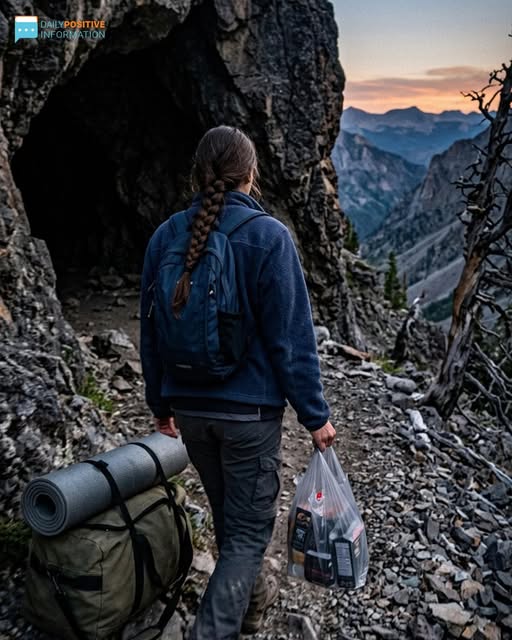
The footsteps stopped just outside the entrance.
They weren’t careless, stumbling steps of someone unfamiliar with the terrain, nor the shuffled steps of a lost hiker. These were deliberate, measured—each step placed with purpose, as if the person already knew exactly where they were going and had decided, carefully, that they wanted to arrive.
Aitana pressed herself against the back wall of the old root cellar, holding the metal box tightly against her chest. The damp earth seeped through her jeans. Her heartbeat had changed—something she hadn’t felt in eleven years. Not the controlled, measured fear of a woman who had survived imprisonment by reducing every feeling to its functional core, but something raw. Something belonging to the girl she once was, the girl who had trusted people.
She stayed completely still.
The cellar’s entrance was a low, arched cut into a hillside of what had once been her grandfather’s property—a parcel in the high desert outside Tucson, worked for forty years by Don Teodoro Ruelas, left, in theory, to his family. The gray late-afternoon light formed a rectangle in the doorway, just bright enough to silhouette the figure stepping through.
A man’s shape. Moving carefully.
She saw his face.
“Don’t open it,” a rough, aged voice said, layered with something else she couldn’t name. “If you found that box, you’ve already started something you may not be able to stop.”
His name was Jacinto Ruelas.
Her grandfather’s foreman for twenty-three years. The man who had carried her on his shoulders at the county fair when she was six, who had cried openly at Don Teodoro’s funeral. Older now, more bent, beard streaked with gray—but she would have recognized him anywhere.
He stared at the box as if it were something he had observed from afar for decades.
“How did you know I was here?” Aitana asked, rising to her feet.
Jacinto turned his hat in his hands, glanced at the box, then back at her.
“I’ve been coming up here for years,” he said. “Checking that it was still buried.”
The cold she felt had nothing to do with the cellar’s chill.
“What is this?” she asked.
He took a deep breath.
“The truth,” he said. “The one that cost you eleven years.”
Jacinto first lit the oil lamp he had brought, then told her she could open the box.
The yellow flame pushed shadows back enough to make the cellar almost livable. Aitana looked at the box. An old metal document box from the 1990s, zipper rusted but still functional.
Her fingers shook, something they hadn’t done in years.
She worked the zipper.
The lid opened with a dry, compressed sound, as if the box had been holding its breath.
Inside, wrapped in old cloth: a black composition notebook filled with pages, a thick manila envelope, a stack of brittle documents bound with a rubber band, a USB drive tied with a short red ribbon—and one more thing: a silver chain.
She recognized it before touching it—the weight, the length, the small cross at the end. The one her grandfather had worn every day of her childhood, last seen on the lapel of his burial suit, when she had attended the funeral in restraints.
Her throat closed.
She set the chain down and picked up the envelope. On the front, in her grandfather’s handwriting—firm, slightly backslanted—were the words:
For Aitana. Only if the day comes when everyone has turned against her.
She breathed before opening it.
The letter changed the shape of the last eleven years in about four sentences.
Aitana read standing; sitting felt impossible. Her grandfather’s careful, deliberate hand wrote as a man who knew the weight of words.
“Aitana, if you have this letter, what I feared has happened. You did not forge those documents. You did not steal anything. What was done to you was deliberate, carried out by people who share your blood.”
She read it three times. Not from confusion, but to absorb the depth.
Don Teodoro had discovered irregularities in the family’s communal property—hundreds of acres outside Tucson in a family trust—for eight months before her arrest. Documents marked as sold, but no sale had occurred. Signatures forged. Documents with her name on transactions she never conducted.
He investigated.
The scheme had been running at least three years, orchestrated by one attorney, Benjamin Cardenas, and aided by two family members: her mother, Elvira, and her brother, Fausto.
Aitana sank onto a rock—not a choice, but an inevitability.
“He knew,” she whispered.
“He found out,” Jacinto corrected. “By the time he understood, the pieces were already in place against you.”
“He could have reported it.”
“He tried.”
“What stopped him?”
“They scared him. He was seventy-three, with a bad heart, and they knew how to apply pressure without leaving marks. He died four months after your conviction. He never got to act.”
Aitana stared at the letter.
“He planned this,” she said. “He buried it for me.”
Jacinto nodded. “Every few months, I checked on it. If you came back, it meant you needed the rest. If not, it stayed buried.”
Next, she read the notebook. Don Teodoro’s meticulous record documented a fraud that had ruined lives: suspicious transactions, unauthorized land transfers, and names—Cardenas, Fausto, Elvira—linked throughout.
The operation extended beyond the family: elderly landowners, heirs unaware, identities borrowed, properties funneled into LLCs with no obvious ties.
Aitana had unknowingly helped. Part-time summer work at Cardenas’s office—scanning, data entry, filing—had made her the perfect scapegoat.
“There’s a witness statement,” Jacinto said. “Teresa Vinalay, Cardenas’s former secretary.”
“I saw it,” Aitana whispered.
“She watched them forge your file.”
“And?”
Jacinto’s silence stretched.
“She died in a car accident, nine years ago.”
Aitana’s chest tightened.
“And the timing?”
“Two weeks after signing.”
The cellar seemed to shrink.
“Nobody investigated?”
“Nobody interested enough to act.”
She set the notebook down, picked up the USB drive, red ribbon and all. Her grandfather had never used computers—this meant whatever was on it mattered deeply.
“What’s on it?” she asked.
“A video,” Jacinto said.
“Of what?”
“The night before your arrest.”
Jacinto had brought a laptop. Specifically because he knew this moment was coming.
He pulled it from his backpack—old, secondhand, a laptop that had lived a full life before this one—and set it on the flat rock next to the lamp.
“You carried that up here?” Aitana asked.
“I’ve carried it the last six times I came to check on the box,” he said. “Just in case.”
She looked at him.
“Six times,” she said.
“I’ve been doing this for eleven years.”
She didn’t respond. There was no clean thing to say.
The laptop booted slowly. Aitana stood holding the USB drive, listening to the desert: wind moving through scrub, the distant cry of a hawk, the quiet of land that had existed long before anyone argued over its ownership.
She plugged in the drive.
One file. Timestamp: September 14—eleven years ago. The night before the police arrived at her apartment with a warrant, a fraud complaint, and a collection of forged signatures that the DA’s office would spend eight months convincing a jury looked exactly like hers.
She pressed play.
The video ran twenty-three minutes. She watched it, unmoving.
The footage was from a fixed security camera in the back office of Benjamin Cardenas’s notary practice. Grainy, muted colors, slightly compressed audio—but clear enough.
Benjamin entered first. Younger, slick, posture perfect, tie adjusted—the man who believed he was the most capable person in any room.
Fausto entered two minutes later. Her brother. Broad-shouldered, walking with the same entitlement their father had.
Then the door opened again. Their mother.
Elvira Ruelas-Vega, sixty-two in the footage, silver earrings glinting as they had at every court appearance. Calm, measured, her words precise.
They discussed logistics—numbers, dates, terms Aitana could barely parse. Then Benjamin said clearly:
“She doesn’t suspect anything. She signed where we needed her to sign. Thought it was standard paperwork for the upstate property.”
“It needs to be airtight,” Fausto said.
“It won’t fall apart,” Benjamin replied.
Fausto hesitated. “If it does—”
“Fausto,” Benjamin said, setting something on the desk. “It won’t.”
Then Elvira spoke.
“Aitana has always been the complication,” she said. “Your father loved her in a way that made everything harder. Land, the trust—it won’t resolve cleanly while she’s free.”
Fausto fell silent.
“With what we’ve built, the DA’s office will take it. Fraud, embezzlement, forgery. Years.”
“And if she talks?”
“She’ll talk,” Elvira said, “and nobody will listen. By the time she builds any defense, all transfers are complete.”
Benjamin slid documents across the desk. Fausto signed. Elvira signed. They poured three glasses, raised them as if to toast a plan that sent their own daughter to prison.
Aitana realized she was crying. Not sound—just silent tears, long-contained emotion finally freed.
She closed the laptop.
The silence afterward didn’t need filling. Jacinto sat quietly, having seen this before, knowing exactly what was coming. He had carried that weight for eleven years—a different sentence from hers, but a sentence nonetheless.
“They threatened your daughter,” she said.
“Yes,” he replied.
“How?”
“Specifically. Not vaguely.”
She looked at the notebook on the rock.
“I’m not going to tell you I forgive you,” she said. “I’m not there.”
“I’m not asking you to be.”
“But I’m also not going to sit here hating you when more important things demand attention.”
“They’re all still here,” she said. “Benjamin—county official now?”
“Alternate district representative.”
“Fausto runs a construction company.”
“And my mother?”
“Front pew, every Sunday,” Jacinto said carefully.
Aitana almost laughed. Not out of humor, but some part of her body needed a sound.
“We need to get this out tonight,” she said.
“I know a journalist in Phoenix. She’s been tracking Benjamin’s land dealings for two years, not knowing what she was missing.”
“Tonight,” Aitana repeated.
“There’s something else,” Jacinto said.
She looked at him.
“In a town this size, people noticed you came back. I didn’t expect them to move this fast, but—”
Engines cut him off. More than one.
They killed the lamp, darkness returned instantly.
Truck doors. Boots on gravel. Voices coordinating. Headlights swept through the brush, strobing across the hillside.
“How did they know so fast?” Jacinto breathed.
“Someone saw me at the house. Or chapel. Or when I asked about Fausto in town,” Aitana said. “They’ve been waiting eleven years for me not to come back. Me coming was always going to be a problem.”
The men moved with unhurried confidence—four, maybe five. Then, stepping into the lead truck’s headlights: Fausto. Forty-five, built like their father, shirt pressed at nine o’clock at night—everything told her he had advance notice.
“Aitana! Nobody’s here to cause trouble. Just want to talk,” he called.
We just want to talk. The same line had preceded every major loss in her life.
She stepped to the entrance. Desert wind hit her, cool, smelling of creosote and distance. She saw the men, they saw her.
Fausto smiled—exactly that childhood smile, confident it would go as planned.
“Wrong sibling for that story,” she said. “You ran.”
“Come down. Let’s do this like adults.”
“I’m fine here.”
“I came back with everything,” she said, loudly. “Notebook. Witness statement. Bank records. Video from Benjamin’s office, September 14—the night before the police came.”
The smile faltered. Men behind him tensed.
“You’re confused,” Fausto said. “Whatever you found—”
“I watched the video. All twenty-three minutes. Heard Benjamin say they’d have everything transferred before I could defend myself. Heard our mother say I was the complication.”
Silence.
“Give me what you found,” Fausto said, voice dropping. “Family option—inside only.”
“Family,” she echoed. The word hung heavy.
“I don’t have a family,” she said. “I had a grandfather who loved me and died trying to protect me. Everything else was taken.”
Fausto’s jaw tightened.
“You don’t know what you’re starting. Benjamin has people. Hand it to someone, and this becomes bigger than a property dispute.”
“It was always bigger than a property dispute. You just counted on me not surviving long enough to find out.”
His face broke—calculated, and now failing.
“Take it,” he said quietly. The men behind him moved.
Jacinto stepped out, holding the oil lamp in one hand, his grandfather’s hunting rifle in the other.
“Everybody stays where they are,” he said.
Fausto spat contempt.
“Old man. You have no idea.”
“I know exactly what I’m doing,” Jacinto said. “What I should’ve done eleven years ago.”
The wind surged through the brush again.
Aitana gripped the USB drive. She looked at her brother. Eleven years of planning, loss, correctional life—all words she had rehearsed for this moment. She chose three:
“I’m going to Phoenix tomorrow. Everything goes to the journalist, DA’s office, and the land records attorney. When it comes out—and it will—I’ll be there.”
Fausto stared. For the first time, she saw it: not guilt, not remorse—real, unfiltered fear.