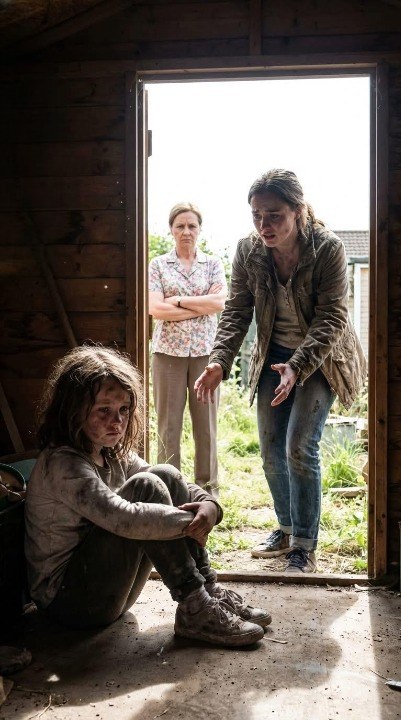
I knew something was wrong the second I pulled into my mother’s driveway and didn’t see Ava running toward me.
She always did that. Every single time. My eight-year-old couldn’t sit still when she knew I was coming home. Usually, she’d be waiting by the window, backpack half unzipped, hair a mess from school, bouncing with excitement like I’d been gone for months instead of just a shift.
But that Friday afternoon… nothing.
The yard was still. Too still. The faint rustle of leaves in the wind was the only sound, and even that felt wrong, like it was holding its breath along with me.
I parked the car, my hands tightening around the steering wheel. My heart raced. A million scenarios ran through my mind, none of them good.
When I walked inside, I found my mother, Linda, sitting at the kitchen table with my nephew Ethan. They were eating cookies like it was just another normal day. The smell of chocolate still warm in the air. The sunlight glinting off the ceramic mugs, the kind of ordinary domestic scene that made the tension hit even harder.
“Where’s Ava?” I asked. My voice was steadier than I felt.
My mother didn’t even lift her head.
“She’s being punished.”
Something cold settled in my chest.
“Punished… for what?” I asked, though part of me already feared the answer.
Ethan glanced at her, then quickly looked down at the toy in his hands—a brand-new remote-controlled truck. I knew it immediately.
It was Ava’s birthday gift.
I had worked extra shifts for three weeks just to afford it. Every early morning and late night had been worth seeing her eyes light up with pure joy.
“She refused to share,” my mother said, her voice flat. “She pushed Ethan and acted like a spoiled brat.”
“That toy is hers,” I snapped. “Where is my daughter?”
Only then did she look at me. Calm. Irritated. Like I was the problem.
“She’s in the back storage room,” she said. “She needs to learn respect.”
For a second, I didn’t understand.
“The back… what?”
“Oh, don’t start,” she muttered.
But I was already moving. My legs propelled me forward almost automatically.
I ran through the kitchen, out the back door, and across the yard toward the old shed my father used for tools. The air smelled of wet grass and old paint. My stomach churned.
And then I saw it.
A padlock. On the outside.
My chest tightened so hard it felt like I couldn’t breathe.
“Ava!” I screamed, banging on the door. “Ava, baby, answer me!”
At first… nothing.
Then—a faint scratching sound.
My heart shattered into a million pieces.
“I’m here!” I yelled. “Hold on, sweetheart, I’m here!”
I yanked at the lock, but it didn’t budge. My hands were shaking so badly I could barely think. I grabbed a heavy metal bar leaning against the shed and slammed it against the lock over and over until it finally snapped.
The door swung open.
The smell hit me first. Stale, trapped air. Dust thick as smoke.
And then I saw her.
Curled up in the corner on the cold floor. My daughter. Her lips were dry, her face pale, her little body trembling.
“Ava…” I dropped to my knees and pulled her into my arms.
She was so light. Too light. My arms ached from holding her, but I couldn’t put her down.
“I’ve got you,” I whispered, my voice breaking. “I’ve got you, baby. You’re safe now.”
Her head rested weakly against my shoulder.
And then, in the smallest, most fragile voice, she whispered,
“I tried to be good, Mommy… I didn’t cry… I thought if I was quiet, Grandma would let me out…”
Something inside me broke in a way I didn’t know was possible. Every instinct, every warning bell I had ignored for years, screamed at me now.
I held her tighter, my whole body shaking.
“You did nothing wrong,” I told her. “Nothing. Do you hear me? This is not your fault.”
She clung to me, barely conscious.
“I was so thirsty,” she murmured.
That was it. That was the moment every ounce of doubt, every instinct to “keep the peace,” every excuse I had ever made for my mother… disappeared.
I carried Ava inside without looking at my mother.
“Call an ambulance,” my friend who had just arrived shouted from the doorway, already dialing.
My mother stood there, arms crossed, her face a mask of irritation and disbelief.
“You’re overreacting,” she said. “She needed discipline.”
I turned to her slowly, my voice low, steady, but unfamiliar even to me.
“You locked a child in a room without food or water for two days,” I said. “That’s not discipline. That’s abuse.”
She scoffed. “In my day—”
“In your day, people didn’t call the police,” I cut in. “I will.”
For the first time, she looked uncertain.
But I was done.
The paramedics arrived within minutes. They checked Ava, gave her fluids, and rushed her to the hospital. I rode with her, holding her hand the entire way, whispering that she was safe, that I wasn’t going anywhere.
That night, sitting beside her hospital bed, watching the rise and fall of her tiny chest, I made a decision. My mother would never see her again. Not after this. Not after what she had done.
And when the police came to take my statement, I told them everything. Every detail. Every lie my mother had tried to dress up as “discipline.”
Because protecting my child wasn’t optional.
It was the only thing that mattered.