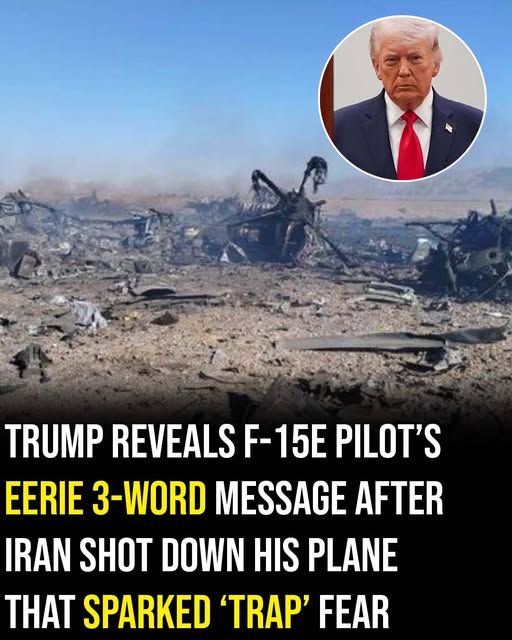
Alone in the jagged mountains of Iran, a wounded American pilot pressed himself into the cold rock, every breath a struggle, every sound amplified in the eerie silence. His F-15 had gone down suddenly, violently, leaving him and his co-pilot stranded in hostile terrain. One of them had been pulled to safety quickly, but he remained behind, alone, bruised, bleeding, and with only a handgun for protection. Hours stretched into what felt like an eternity, and in Washington, the White House staff and military command centers watched every blinking dot and radio pulse, their nerves fraying with each passing second. Then, through the static, came four strange, hushed words. Four syllables that froze everyone mid-action.
For a fleeting moment, the message sounded like a prayer, whispered with the cadence of devotion. Generals leaned closer to monitors, intelligence officers replayed recordings, and analysts debated feverishly: had Iran just set a trap? Was this the perfect ambush, designed to lure American forces into an impossible situation? Every scenario raced through the minds of those trying to make life-or-death decisions from thousands of miles away. The pilot’s voice was weak, measured, yet filled with a desperate clarity that left no room for error.
Iranian forces, it was later revealed, had reportedly offered rewards for the pilot’s capture, and civilians were caught up in the hunt. Hidden in a rocky crevice, he knew any wrong move could be fatal. Each rustle of the wind, each distant shout, felt like a threat. His radio became his lifeline and his only connection to a world that seemed impossibly far away. As analysts in Washington combed through every “beep” and tracking ping, one terrifying thought dominated: what if the signal wasn’t real? What if this was a decoy designed to manipulate, to mislead, to turn a rescue into a catastrophic trap?
Yet, amidst the fear and confusion, there was another layer no one could ignore. The pilot was deeply religious, a man whose faith had guided him through training, combat, and personal trials. That four-word message wasn’t just a signal—it was a reflection of courage, of trust, and of a will to survive that refused to break under pressure. It forced everyone monitoring to consider not only the tactical situation but the human one: a life hanging on belief, on instinct, and on split-second judgment.
Hours later, after painstaking analysis, drone feeds, and ground reconnaissance, US special operators located the real man. The decoy fears, the bait scenarios, the endless simulations—all of them converged to one outcome: survival. He was pulled from the mountains, bruised but alive, flown to safety in Kuwait, and reunited with his team. The operation became less about politics, less about headlines, and more about the delicate interplay of courage, faith, and the razor-thin margins that separate life from death in war.
The story spread quietly at first: a man trapped in hostile territory, clinging to life, whose whispered words sparked panic, debate, and awe. In the end, it became a testament not only to the bravery of one pilot but to the tension, fear, and humanity that underpin every life-or-death decision made in the shadows of conflict. It was a reminder that in war, a single word, a single choice, can echo across continents, freeze entire governments, and change the course of a life.