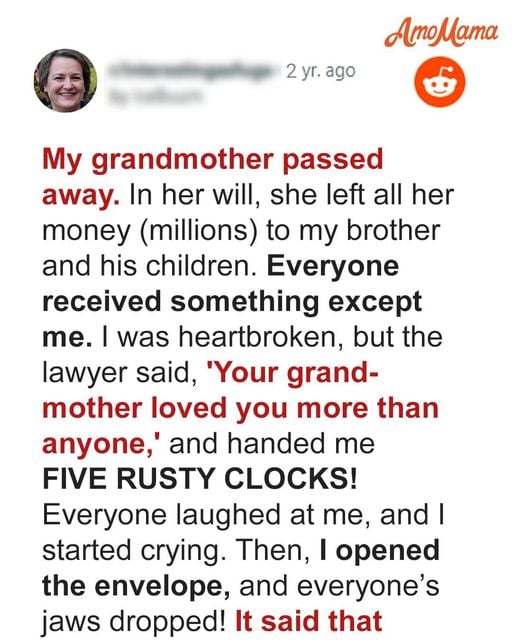
My grandma’s last gift wasn’t what anyone expected. Not the sprawling house with its creaking floors. Not the savings account carefully built over decades. Instead, she left a box of ticking clocks, each one wound and whispering time, accompanied by a handwritten note that made the air in the room feel suddenly heavier and impossibly light at the same time. In another town, three siblings shuffled reluctantly into a dusty workshop, expecting little more than the usual clutter of a long-dead grandfather. And across the state, a quiet widower noticed a teenager’s small acts of kindness, never imagining that such gestures would ripple into a life-altering inheritance. These were not the legacies most people envision—but they carried something far deeper than money.
Some inheritances arrive wrapped in greed, inked contracts, or cold legalese. Others appear in sawdust, faded wood, and quiet ticking. And sometimes, they arrive in the stunned pause between a lawyer’s words, when the room is still except for the echo of possibility. A grandson, initially dismissive of the old clocks, soon realizes that this “lesser” inheritance contains far more than sentimental value: each gear and pendulum a message, a puzzle, and ultimately a fortune carefully hidden by a woman who valued loyalty, patience, and attention over simple material wealth. In those boxes, her love continues to pulse, guiding choices, teaching lessons, and rewarding care in a way that money alone never could.
Meanwhile, three reluctant grandchildren, pushed into their grandfather’s cluttered workshop, discover that legacy is not measured in dollars or titles but in rhythm and shared effort. The dusty room, once a repository of forgotten projects, transforms under their hands. Old wood is sanded, joints aligned, and a single rocking chair becomes a vessel for reconciliation. Arguments soften into laughter as shavings fall like quiet confetti across the floor. With each measured stroke of hammer and brush, they realize that love can carve itself into objects, and that working side by side can heal wounds that inheritance alone never would. What began as a chore becomes a bridge, a memory, and a story to pass on.
And in a small Ohio town, a teenager’s small, consistent kindness toward a lonely widower culminates in a gift that neither bloodline nor expectation could predict. The widower, touched by empathy, humor, and genuine care, quietly bequeaths his estate—his home, his savings, and the small treasures he’s accumulated over a lifetime—to someone who simply noticed him. In doing so, he proves that family is not always defined by name or lineage, and that the quiet choices we make, the ways we see and honor others, can echo long after we are gone.
These three stories, disparate in time and place, whisper the same truth: what we leave behind is never just things. It is the love we chose to show, the attention we gave, the faith we placed in others. It is the patience, generosity, and small gestures that outlast dollars, titles, and grand estates. A box of clocks, a rocking chair, or an unexpected inheritance may seem ordinary—but within them, the heartbeat of a life lived with care continues to guide those who remain. In the end, legacy is less about what we leave and more about how we chose to love while we were here, and how that love continues to shape the world long after our own hands have fallen still.