There are wounds that never truly heal.
They don’t always show themselves, but they stay with you—in the silence between breaths, in empty rooms, in those fleeting moments of joy when grief quietly reminds you of everything it cost to get there.
For me, that wound began six years ago, in a hospital room filled with the sharp scent of antiseptic and quiet dread.
I went into labor expecting to meet my twin daughters.
Instead, I was told only one had survived.
They placed Junie in my arms.
And they told me Eliza was gone.
Just like that.
No explanation that made sense. No goodbye. No chance to hold her. Only soft voices and hollow phrases—“complications,” “we did everything we could”—as if words like that could ever fill the emptiness that opened inside me.
They didn’t even let me see her.
That kind of loss changes you. It settles deep, reshaping how you move through the world.
At first, Michael and I carried it together. In the quiet of the night, we whispered Eliza’s name like it was something sacred, fragile. We kept her alive the only way we could—through memory, imagination, and the ache of what should have been.
But grief has a way of pulling people apart.
Over time, my sorrow became something Michael couldn’t stand beside anymore. Or maybe it was his own pain he couldn’t face. Either way, he left.
After that, it was just me and Junie.
The daughter I could hold.
And the daughter I believed I had lost.
By the time Junie started first grade, I had learned how to exist alongside the absence.
Not heal. Not move on. Just exist.
I packed lunches, folded clothes, paid bills, smiled when expected. I learned how to keep going while carrying a grief no one else could see anymore.
On her first day of school, Junie bounced to the car in brand-new sneakers and uneven pigtails, buzzing with excitement. I waved as she disappeared through the doors, lingering a moment too long—because motherhood often feels like worrying in public.
Then I went home and did what I always did when anxiety crept in: I cleaned.
Counters. Sink. Cabinets. Anything to keep my hands busy and my thoughts quiet.
When the front door burst open that afternoon, I was still at the sink, soap clinging to my hands.
Junie rushed in, cheeks flushed, backpack slipping.
“Mom! Tomorrow you need to pack another lunch!”
I turned, smiling automatically. “Another one? Why? Didn’t you have enough today?”
She looked at me like I’d missed something obvious.
“For my sister.”
At first, I laughed—not because it was funny, but because I didn’t understand.
“Sweetheart,” I said gently, “you don’t have a sister.”
She frowned instantly, stubborn in a way that reminded me so much of her father.
“Yes, I do. I met her today.”
Something tightened in my chest.
“What do you mean?”
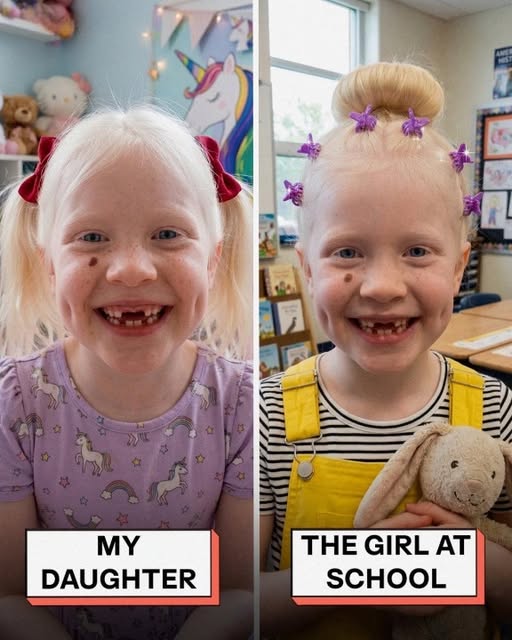
“She sits next to me,” Junie said casually, digging through her bag. “Her name is Lizzy. And she looks exactly like me.”
I froze.
“Exactly like you?”
Junie nodded eagerly. “Same hair, same eyes, same freckles. Just her hair parts the other way.”
A cold unease spread through me.
“And… what does Lizzy like to eat?”
“Peanut butter and jelly,” she said. “But she said yours has more jelly than her mom’s.”
I stopped breathing for a moment.
Then Junie brightened. “Oh! I took a picture!”
That morning, I had tucked a small disposable camera into her backpack, thinking it would make the day special. Something simple, something sweet.
She handed it to me proudly.
I flipped through the photos absentmindedly—until I reached one by the cubbies.
And there they were.
Two little girls standing side by side.
Junie.
And another child who looked so much like her it made my hands go numb.
Same curls. Same eyes. Same faint freckles beneath the left eye.
I almost dropped the camera.
“Have you ever seen her before today?” I asked, my voice thin.
Junie shook her head. “No. But Ms. Kelsey asked if we were sisters. Lizzy said maybe we are.”
Maybe we are.
The words echoed inside me.
That night, after Junie fell asleep, I sat staring at that photo until my eyes burned. Logic told me one thing. Instinct told me another. And beneath both was something more terrifying: recognition.
I didn’t want to hope. Hope felt dangerous.
But by morning, I knew I had to see her.
The next day, I drove Junie to school myself.
She talked the entire way—about crayons, recess, and how Lizzy liked purple, or maybe just had a purple backpack.
I barely heard her.
My hands gripped the steering wheel so tightly they ached.
At the school, the parking lot buzzed with noise and movement.
Then Junie squeezed my hand. “There she is.”
I followed her gaze.
A little girl stood near the entrance.
And for one impossible moment, it felt like I was seeing my own child twice.
She was real. Alive.
Standing beside a woman in a navy coat.
My stomach dropped.
Then I saw someone else.
Standing just behind them.
A face I hadn’t seen in six years.
Marla.
The nurse.
Older, but unmistakable.
The sight of her hit me like a blow.
Junie ran ahead, smiling toward the girl. They met like magnets, drawn together without hesitation.
I walked toward them, my heart pounding.
“Marla?”
She turned, her face draining of color.
“Phoebe…”
“What are you doing here?”
Before she could answer, the other woman stepped forward.
“You must be Junie’s mother. I’m Suzanne. We need to talk.”
I looked between them, every instinct on edge.
“How long have you known?”
Suzanne’s composure broke. “Two years.”
The number hit hard.
“Two years?”
She nodded, tears forming. “Lizzy had an accident. She needed blood. That’s when things didn’t add up. I started digging… and I found the altered records.”
Altered records.
The words barely made sense.
“You knew my daughter was alive,” I said, “and you said nothing.”
“I was afraid,” she whispered.
A bitter laugh escaped me.
“Afraid? I mourned her every day while she was alive somewhere in this city.”
She didn’t deny it.
“I told myself I was protecting her,” she said. “But really… I was protecting myself.”
I turned to Marla.
“You took my daughter.”
Her voice shook. “There was chaos. I made a mistake… and then I panicked.”
“A mistake?” My voice rose. “You let me believe my child was dead.”
“I know,” she cried.
“No,” I said sharply. “You don’t.”
The days that followed blurred into meetings, reports, lawyers, investigations.
But even after the truth came out, something strange remained:
The pain didn’t disappear.
It changed.
I wasn’t grieving a lost child anymore.
I was grieving six stolen years.
First steps. First words. Birthdays. Bedtime songs.
A life that should have been mine to witness.
Suzanne and I eventually sat together while the girls played nearby, laughing, building, arguing like only sisters can.
“Do you hate me?” she asked quietly.
I studied her. She looked broken. Human.
“I hate what you did,” I said. “But I can see you love her.”
She cried.
“That doesn’t make it okay.”
“I know.”
“But she loves you too,” I added. “And I won’t let her be torn apart because of what adults did.”
She nodded.
“They’re sisters,” I said, watching them. “That part is not up for debate.”
Months later, I took both girls to the park.
They sat on a blanket, laughing over melting ice cream, arguing about nothing and everything.
I picked up a disposable camera—our new tradition.
Different colors each time.
Little pieces of proof that we were here now. Together.
“Smile!” I called.
They pressed their faces together. “Cheese!”
I took the picture.
And for a moment, I felt something I hadn’t felt in years.
Not relief. Not peace.
Gratitude.
Not because the pain was gone.
But because something had endured.
Love.
Motherhood.
And somehow, despite everything, the bond between my daughters had found its way back.
Later, both of them leaned against me.
“Mom, are we getting all the camera colors?” Junie asked.
“Even green?” Lizzy added.
I kissed their heads and smiled.
“All of them,” I said. “I promise.”
My phone buzzed—a message from Michael. I glanced at it, then turned it face down.
He had walked away long ago.
But I was still here.
And now, finally, so were both my daughters.
No one could give me back those six years.
But from that moment on, the story was ours.
And no one would ever take another day from us.