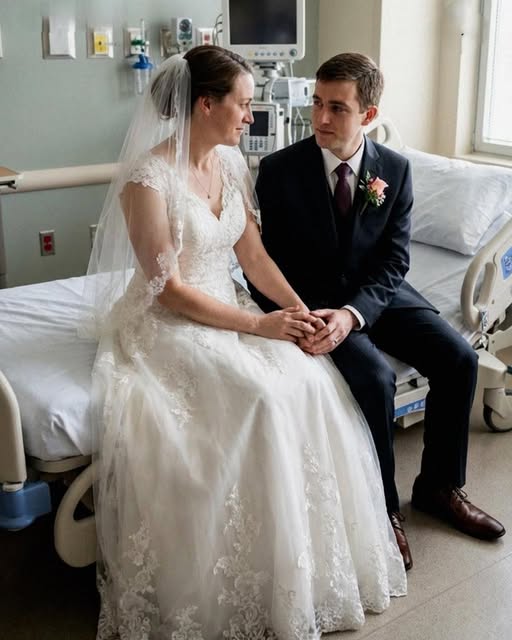
I always believed growing up in an orphanage defined me. A life of being unwanted, a story I carried like a scar, a narrative I shared with Anna, the woman I intended to marry. We were two halves of the same broken history—or so I thought. But as our wedding approached, Anna’s behavior shifted. No ballroom, no garden—she insisted on a hospital ward for the critically ill.
“Just trust me,” she whispered, eyes pleading. Mine filled with confusion and a simmering resentment.
I arrived in a stiff tuxedo, a grotesque intruder among people fighting for their lives. Anna went inside; I lingered by the entrance, gripped by betrayal. Was she sick? A test? My spiral stopped when a tug on my sleeve brought me to a kindly old woman holding a white bouquet.
“Logan,” she said, voice trembling, “it will be worse if you don’t know now.”
She pointed me to Room 214.
I don’t remember walking down the sterile hallway. One moment, sun on my face; the next, I was in front of a heavy wooden door. Anna appeared beside me, her wedding dress stark against the hospital walls.
“You knew,” I snapped. “You let me get this close to the altar without telling me she was here?”
Anna’s eyes didn’t waver. “I know how you work, Logan. You run when you’re afraid. Shut down when you’re hurting. If I had told you, you wouldn’t have come. And she doesn’t have a week left.”
Anger drained, leaving a hollow thud in my chest. I pushed the door open.
Inside, propped against thin pillows, was a woman whose eyes mirrored my own. Frail, silver-haired, yet the way she looked at me—as if I were a miracle—shattered the wall I had spent twenty years building.
“I never stopped being your mother,” she whispered, pulling a faded blue baby blanket from her bedside drawer.
She told me a story I had never allowed myself to imagine: a young girl coerced into signing away her child, the state sealing the records, turning her into a ghost. For twenty years, I believed I wasn’t worth keeping. But in that quiet hospital room, I realized I had only been lost.
Anna hadn’t tricked me to be cruel; she staged this to heal me. She wanted me to marry not as a man defined by abandonment, but as a man who knew he was loved from the very beginning. She was my courage when I had none of my own.
I turned to the woman in the bed. “I’m getting married today,” I said, voice thick. “Would you like to come?”
Ten minutes later, in a small, unadorned hospital chapel, we stood before the officiant. My mother sat in a wheelchair at the front, her shaky hand eventually signing our marriage certificate as a witness. No flowers but the bouquet held by the woman who led me to Room 214. As I looked at Anna, I saw the person who loved me enough to face my deepest fear for me.
I walked out of that hospital as a husband, but more importantly, as a son. No longer the kid left behind at the orphanage, I was a man who had been found, chosen, and made whole.