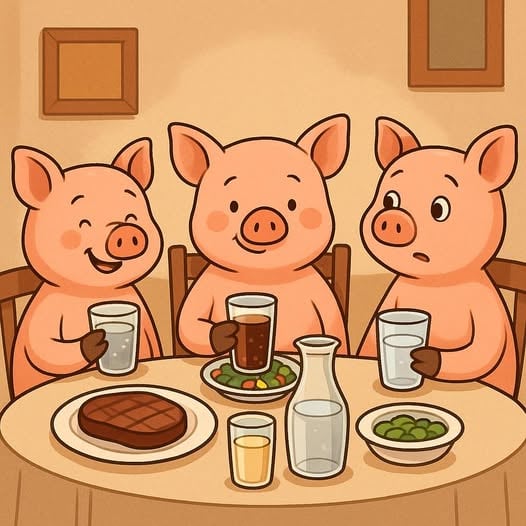
The punchline lands, and something inside you flinches. You laugh, yet the laughter is uneasy, like staring into a mirror you never agreed to approach. It is not the humor itself that startles—it is the sudden recognition, the shock of seeing your own reflection in a story meant to amuse. Three little pigs, a panicked waiter, a farmer cornered by rules, tradition, or shame—suddenly the joke is no longer outside of you. It points inward. At your habits, your compromises, your small moral evasions. You feel the laugh catch somewhere in your throat, lodged between genuine amusement and uncomfortable self-awareness.
The details of the joke grow sharper as you replay them in your mind. The pigs, seemingly naive, are cunning in subtle ways; they maneuver around rules, pretending ignorance until it suits them to strike. The waiter, frantic and flustered, represents the tension between societal expectation and personal capacity. And the farmer—oh, the farmer—he embodies the burden of trying to manage outcomes that are never entirely under control. In this layered absurdity, you realize: comedy has done more than make you laugh. It has held up a spotlight on your own daily evasions, your polite lies, the hidden scripts you run when no one is watching.
What lingers after these stories is not merely amusement but a gentle, gnawing discomfort. You notice the pig who plays dumb until the moment it’s safe to reveal sharp intent; in that character, you see yourself. The echoes of your double scripts resonate: the careful words spoken to avoid conflict, the private calculations you hide even from yourself, the strategic retreats you stage to dodge blame. Humor, in this sense, does not merely entertain—it reflects, refracts, and exposes. It makes us complicit in our own patterns while we laugh, leaving a trace of unease that is harder to shake than the initial giggle.
The farmer’s predicament deepens that recognition. He attempts fairness in a no-win situation, distributing what he believes is justice among creatures that defy simple morality. Each payment, each compromise, each attempt at balance feels measured on paper but misses the heart of the problem. The absurdity of his predicament mirrors our own lives: how often do we craft compromises, policies, or apologies that look reasonable but fail to touch the true source of tension or pain? How frequently do we settle for solutions that preserve appearances while leaving the deeper issues unresolved? The comedy lingers here, in the uneasy pause between laughter and reflection, asking whether we possess the courage to confront not the joke, but ourselves.
As you think about the tale, the humor begins to fold into introspection. You consider the ways you have ducked responsibility, manipulated appearances, or delayed confrontation until the last possible moment. You recall your own “three little pigs” scenarios—moments when self-preservation, fear, or social expectation guided your choices more than conscience or clarity. You realize that the absurdity of the joke is not simply a story in isolation, but a mirror of the absurdities of life itself.
By the time the laughter subsides, the story has worked its quiet magic. It leaves you with a sense of personal audit: a spotlight on your daily maneuvers, the invisible compromises, the polite evasions that keep life manageable yet morally murky. The pigs, the waiter, the farmer—they are not just fictional characters—they are archetypes of your own inner negotiations. Comedy, then, becomes a tool not just for entertainment but for revelation.
The final recognition is subtle but unmistakable. Humor has forced an introspection, revealing cracks in your moral story, inconsistencies in your daily logic, and the hidden threads you follow to protect yourself from discomfort. It asks: will you merely laugh and forget, or will you notice the truths that peek out from behind the punchline? Will you confront your own patterns, or continue to play along with the scripts you’ve written to stay safe, polite, and seemingly harmless? In this lingering space, between laughter and self-awareness, you see that the real story—the one comedy illuminates—is the one you tell yourself, every day, about who you are and how you live.